Monday, June 17, 2013

"That's So MPOW!" (My Place of Work)

See this?


It's a fence. Not a large one. And it's blocking sprouting grass that used to be a path that connects a parking lot to one of our largest, busiest buildings. There was a folk theorem at play here. People created that path because they didn't like the alternative, because creating that path was more convenient. And my place of work's response was to plant some grass and throw up a fence. How's that for user experience? For dismissing local knowledge, metis?

I checked with our facilities department just to make sure, and they say this project is done. There's maybe fifteen feet of fence. It's not terribly attractive, but it's one way to solve a problem. It's not the way I would have done it. It's a cheap way to impose rationality. And it makes me wonder if I, as a librarian, am doing anything like this in the library. Or on the library website. Metaphors!

I hope this is not the first in a series of related posts, but it's also not the first time I've noticed the administration ignoring something that's potentially relevant, and it won't be the last.
Both the Director and the Provost are concerned that a patron would go into staff space for a chair, move it, and not replace it. I share this concern, but I have a different take. I think the patron just voted, just told us that our furniture, which does tend to move about at times (and is usually replaced), is not up to snuff. That someone would take a staff chair through three rooms, over 80 feet... that, to me, is a data point. It says something.

Thursday, June 13, 2013

SAVOR-Y, 2013 Edition


That song never gets old.

Thanks to the Craft Brewers Conference, SAVOR, an annual festival that pairs American-made craft beer with food, has moved to New York City, where it's having a bit of trouble selling out. So a colleague and I decided to have some fun over at DCBeer.com, letting New York know that the District appreciates good beer, and that we brew our own.
many breweries... claim to be in New York City, but brew elsewhere. Brooklyn Lager and other flagships? Utica, New York, home of the steamed ham. Sixpoint’s cans? Scranton, Pennsylvania (see below). Bronx Brewery’s many pale ales? Pawcatuk, Connecticut. The only major New York City brewery that doesn’t do some contracting is Kelso, which has enough capacity that it has contract brewed for Sixpoint. Take a bow.
Garrett Oliver, Brooklyn Brewery's brewmaster, even took time to comment on the post, and we had a good chat.

We also posted the DCBeer.com consensus top 25 beers of SAVOR. It's hard to pick just 25, but there was a fair amount of overlap between our choices. Here are my 25, in alphabetical order. Compare with DCBeer's.
Allagash FV13, American Wild Ale - Just an excellent sour beer.  
Avery Odio Equum, American Wild Ale - Just an excellent extremely sour beer.
Ballast Point Habanero Sculpin IPA  - The best IPA in America, spicier! 
Bayou Teche Cocodrie, IPA  - This brewery has done some interesting stuff, so it's telling that they waited this long before doing an IPA. Come see how they did. 
Bell's Black Note, Imperial Stout - This beer is highly-sought after, for good reason. You could drink a lot of this beer. You shouldn't, but you could. 
Bell's Raspberry Wild One, American wild ale - A little tart, a little funky.

Bull & Bush Brewery Tunip the Beets, Field Beer  - I might want 2 oz of this, which is what SAVOR is for. 
Boulevard Saison Brett - Perhaps the best example of this style.
Crooked Stave Surrette, Saison - Well, maybe this one. 
Yazoo Brett Saison - Or this one.
Choc Brewing Signature Gose - Choc is single-handedly responsible for resurrecting grazter, a smokey, hoppy, Prussian wheat beer. They found a recipe, found the yeast from a Polish homebrewer, the smoked malt from a German producer, and brought it back from extinction. Their gose will be similarly authentic.
Full Sail LTD Bohemian Pilsner
Firestone Walker Pivo Pilsner - Not one, but two breweries are bringing Czech-style pilsners. Fans of American IPAs may be pleased with the hop bite these two bring.
Hops & Grain Brewing Bourbon Barrel aged ALTeration - A barrel-aged alt? 'Murica!
Kane Bourbon Barrel Aged Solitude, Belgian-style dark ale - Kane is new to NJ and they're bringing out the big guns at SAVOR with this beer. 
Lost Abbey Deliverance, American strong ale - "A blend of bourbon barrel-aged Serpent’s Stout and brandy barrel-aged Angels Share." I think there's going to be a line at this table. 
Lost Abbey Saints Devotion, Belgian pale ale - The reason people geek out over this brewery is because of beers like this.
Schalfly Kolsch - I'll put this here every year. Also, it's now available for purchase in NY. 
Schalfly Single Malt Scottish Style Ale - Beer that tastes like scotch, and beer. It's so good I devoted an entire post to it. 
Shorts Goodnight Bodacious, Imperial American Black Ale - It's from Shorts, so you'll know you'll want 2 oz of it.
Spring House Brewing Co. Big Gruesome Chocolate Peanut Butter Stout - Dessert is served!
Starr Hill Monticello Reserve Ale, wheat beer - A little bit of history in a glass, brewed using Thomas Jefferson's "recipe." 
Three Floyds Zombie Dust, Pale Ale - It's in your head, it's in your heaaaad, citra, citra, citra-a-a-a!
Three Floyds Tiberian Inquisitor, Belgian-style pale ale - Aged in Chardonnay barrels, this one could be a keeper from a brewery that know what they're doing.
Yazoo Embrace the Funk Series “Wild Child,” Smoked Porter - This is a collaboration with a beer blogger, which is every beer blogger's dream.
In addition, SAVOR bills itself as "an American food and beer experience." We thought these pairings would hit the mark. Personally speaking, here's what I went with, in no particular order.
Founders Brewing Company Rubaeus  • Table Group 5
Paired with Shortbread Biscuit with Stilton and Pear  
Denver Beer Co. Rauchbier  • Table Group 8&
Paired with Eggplant Caponata on an Olive Oil Financier  
Terrapin Beer Company Side Project 19 Mosaic • Table Group 2
Paired with Bitter Chocolate Bon Bon with Passion Fruit and Mesquite Salt  
Santa Fe Brewing Company Freestyle Pilsner  • Table Group 3
Paired with Tomato Rasam (Southern Indian Stew) with Coriander and Cumin over Lentils  
Willoughby Brewing Company Peanut Butter Cup Coffee Porter  • Table Group 12
Paired with Black and Tan Brownie with Butterscotch and Pretzel Bite  
Captain Lawrence Brewing Company Smoked Porter  • Table Group 6
Paired with Pulled Chicken Taco with Black Mole

The Bruery Sans Pagaie  • Table Group 1
Paired with Tart Apple and Brie in Puff Pastry  
Brooklyn Brewery Black Ops  • Supporter Circle
Paired with Chicken Liver and Chocolate  
Cigar City Brewing Jose Marti  • Table Group 12
Paired with Glazed Short Rib of Beef with Soft Polenta and Crispy Leeks  
Burnside Brewing Company Sweet Heat  • Table Group 11
Paired with Jumbo Lump Crab Cake with Corn, Sweet Pepper and Citrus  
Bonus pairing! 
Upland Brewing Company Dantalion Dark Wild Ale  • Table Group 10
Paired with Demisphere of Grape Wrapped in Goat Cheese and Pistachio
A full list of beers and beer pairings is here. Check back next week to see how we did.

Cheers.

In older SAVOR news:
http://beerbrarian.blogspot.com/2012/06/savor-2012-wrap-up.html
http://beerbrarian.blogspot.com/2012/04/savor-y.html
http://beerbrarian.blogspot.com/2011/06/savor-wrap-up.html

Monday, June 10, 2013

Exit, Voice, and Loyalty in the Academic Library

Fully 91% of Americans ages 16 and older say public libraries are important to their communities; and 76% say libraries are important to them and their families. And libraries are touchpoints in their communities for the vast majority of Americans: 84% of Americans ages 16 and older have been to a library or bookmobile at some point in their lives and 77% say they remember someone else in their family using public libraries as they were growing up. 
Still, just 22% say that they know all or most of the services their libraries offer now. Another 46% say they know some of what their libraries offer and 31% said they know not much or nothing at all of what their libraries offer. (Library Services in the Digital Age, Pew Research Center)
Ahh, libraries. Never more important, and never more irrelevant. One could be forgiven for thinking that along with declining budgets, libraries themselves, as a concept, are in decline. When faced with this perception, or perhaps the reality, librarians have three options: exit, voice, and loyalty.

Exit means leaving the profession, as at least one librarian has done rather vocally in the last week. Others are thinking about it. The specific reasons for exiting are varied, but stem from dissatisfaction. Exit need not be physical; plenty of people mentally exit their jobs.

Voice means the airing of grievances, and I suspect the majority of librarians fall into this ideal type; seeking to improve libraries and working conditions by speaking up in a variety of media.


Loyalty is the action and behavior of those relatively satisfied with their organizations. We rarely hear from them, and as a result tend to discount their numbers.

Voice takes many forms, but a recent meme is to decry the death and decline of libraries at some future date thanks to current events. Enter the "academic library at risk."

Armed with horrific data about what faculty think of us, never mind that 76% of faculty are adjuncts whose own livelihood is far more tenuous than any academic library's, the "academic library at risk" trope is for the most part unhelpful because it offers alarmist rhetoric without any solutions. To wit:
We will not survive by focusing on what we think our patrons need and ought to want, in contradiction to what our patrons say and believe they need and want. We will not survive by trying to convince them to want what we provide, but only by changing and coming up with new provisions that excite and delight them.
And
We need to change. We need to provide new and different services. We need to preserve some services, but significantly change the manner in which they are delivered.
And
And yes, that means we need to reduce and eliminate other services too. Change is hard. Yes, there are still some staff and patrons who are used to and rely on the services we’ve got now exactly how we deliver them now, and are going to be disrupted and upset by change.
Okay, so I'm cheating, because all those three quotes are from the same article. And to be fair, alarmist rhetoric is not without value. And unlike many other articles I will not link to, these are worth reading. But at what point is an academic institution going to forgo a library? When will it happen, and will it happen because the library becomes nothing more than a website with databases and a discovery service? Who among institutions of higher education is "disruptive" enough to do something truly daring and close a library?

How important are libraries? So important that as soon as opposition occupies physical space, it attempts to build one, as evidenced by recent actions in Turkey as well as the Occupy Wall Street movement. So important that 91% (!) of Americans ages 16 and older say public libraries are important to their communities. And yet, at the same time, not important enough to fully fund. Not important enough to keep people from exiting for monetary reasons.

Focusing on a decreasing percentage of tenure-track and/or full-time faculty to show an academic library's worth and to obtain funding is a fool’s errand. Budget cuts are coming regardless, and have been for some time; appealing to this shrinking group won’t be a bulwark against cuts.

Rather, these cuts originate in state and local governments, and the rise of a bloated administrative class of higher education professionals whose populations sometimes exceed the number of full-time/tenure-track professors, as is the case in the University of California system. It is telling that even climate change denier George Will recognizes this latter point. There are three ways to get tenure: teach, research, and administrate. We can infer from the rise of Massive Open Online Courses, MOOCs, who is in charge and what they think of teaching.

Many academic libraries are playing a game that’s rigged. We may as well focus on what we do best, and that includes student services, whether they are appreciated or not. As a librarian and an administrator, if my library is going down regardless, it’s going to do so on my terms. The primary focus of this library, and, I suspect, most academic libraries, isn't faculty, or administrators. It's students. So I'm concerned that 18% of faculty agree with the statement "Because scholarly material is available electronically, colleges and universities should redirect the money spent on library buildings and staff to other needs," up from 8% in 2006 (Source is figure 44 below), but I'd be a lot more concerned if they came from the people who use our library the most, students.

Download Report

What else do we do best? We have values. We don't give your data away, we don't violate your privacy, and most of us will politely chuckle when you make a Dewey Decimal System joke. We are a "third place," and that includes a place for faculty. And yes, we're more than "just books."

I won’t give up on outreach to administration or faculty; I will continue to use the language of institutional mission statements and strategic planning and to collect and present data that shows what we do and how we add value, and values, but how we go about earning that data is going to be on our terms, not theirs.

Thursday, May 30, 2013

Interview 4.5.1: The Four-and-a-Half Follow Up Post

Initial book cover via Elizabeth (Eli) Perez. Source: http://eliperez.com/#portfolio-2
Job interviews are a strange thing. Based on as little as two pieces of paper and a half-hour of talking in person, hiring managers are supposed to be able to identify applicants who would benefit and add value to an organization. Last week I wrote about the face-to-face aspects of the job hunt, so what follows will make no sense unless you've read this. Go ahead, I'll wait.

Criticism 1: The ethics of oversharing
I accept that it may be the case that these applicants recognize themselves in the post. No doubt Applicant 5 will, as that person has accepted our job offer. I scrubbed all identifying information from these candidates. You will find nothing about gender, age, or appearance. The "f--king bunheads" did not have that hairstyle, as that terms refers to a mindset, and there's more on it below. In addition, I altered the chronology of the applicants. Applicant 1 was not the first person we interviewed, nor was Applicant 5 the last. I did this for the same reason I omitted other identifying details. If the candidates read that post and recognize themselves I think that is fine. I hope they take away some valuable insights from the interview process, which was one of the goals of the post. If the friends, families, and colleagues of the interviewees can recognize the candidates, then I agree that I have a problem.

On commenter wrote, "I do think you could have written this in a more generalized way, without having to tiptoe around or cross over professional and ethical lines." To me, and I think to most readers, these details are important because of the advice contained therein. Did anyone really need to be told to not act nervous during an interview, or to at least try to minimize the manifestations of those nerves? I'd rather not use this space for cliches and platitudes. The details are what matters; there are concrete ways in which candidates can improve their interview process. That post was about, in part, such improvements.

"The controversial aspects of the essay would vanish if you had disclosed your intention, to publicly share details of the search process, with your five candidates," wrote another commenter. This is food for thought for future interviews, though I doubt the controversy would vanish thanks to at least one tweet I wrote, and more on that below. But I am not seeking to to publish posts like this in journals that would require institutional board review (IRB) approval. I gave these applicants anonymity in the post, which of course they are owed.

Another commenter accused me of violating the American Library Code of Ethics (pdf), articles V and VIII. Here are said articles.
V. We treat co-workers and other colleagues with respect, fairness, and good faith, and advocate conditions of employment that safeguard the rights and welfare of all employees of our institutions. 
VIII. We strive for excellence in the profession by maintaining and enhancing our own knowledge and skills, by encouraging the professional development of coworkers, and by fostering the aspirations of potential members of the profession.
I think that the charge relating to article V is wholly without merit, but it is addressed below all the same, as is article VIII (see: "Worst. Boss. Ever.). The last clause of article VIII is, I think, an awful thing to aspire to. I want competent librarians. I want good librarians. I want excellent librarians. The only way to ensure that our profession is to be good is to do good. If there is someone who wants to be a librarian, but you don't think will make a good one, then talk them out of it. Don't foster their aspirations. If you're not good at your job, I may call you out on it. It's been done before.

On that note, I talked none of these applicants out of librarianship. They all looked good on paper. In practice they need work interviewing. I hope they read this and recognize themselves and come back stronger next time. For all of them there will be a next time.

It is telling that an arm of the very organization in charge of this code of ethics promoted this blog post via the ALA Job List, though of course that was not without controversy or push-back. The weekly newsletter of American Libraries, American Libraries Direct, did the same.

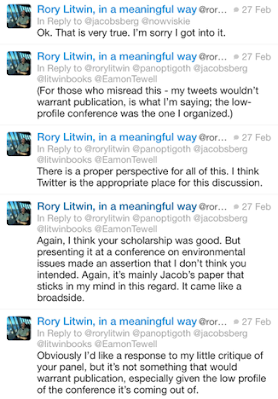
Here is the Facebook part of said controversy. 

Corollary: They follow me on twitter.
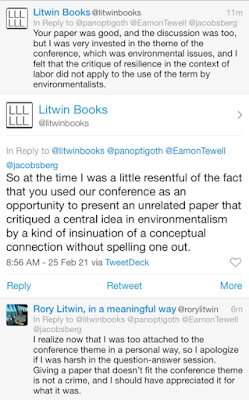
No, these people do not follow me. Nor do I follow them. Though pseudonyms are all the rage, and I cannot rule out creating a false identity, I'm pretty good at figuring out who is following me on twitter, thanks to my librarian sleuthing skills. In doing a social media background check on the applicants I found one on twitter. I do not and will not follow this applicant on twitter, unless the applicant asks me to. There are other staff at the library who tweet. I also do not follow them. The same goes for friending them on Facebook. My reasoning is that I don't want them to think they're being watched on social media. And they're not being watched, at least not by me. An exception is on May 8th, when I noticed a candidate taking photos of our campus and putting them on Instagram. This candidate also linked a resume to their twitter handle, so I checked that after the interview to see what was said, if anything, about the process. And as it turns out, this person did say something. And it was nice. Because I like nice things, I tweeted it, which is below.

Let it be known that I do not tweet during job interviews, but I may do so beforehand and afterwards. Thanks to the miracle of the twitter archive, here are the sum total of my tweets about interviewing candidates:
Question I really wanted to ask that last applicant, but held back on: "Have you ever killed someone by accident, but secretly enjoyed it?" - 5/16/13
"Connecting with people through information." - Something a job applicant here said. There's still hope for the future. -5/15/13
Interviewing someone for a PT position today. The candidate has an un-googleable name because it's the same as a semi-famous author. - 5/15/13
Our interviewee on twitter: "Job interview went well - cosy [sic] library which screamed 70s retro, small dedicated team, amazing smell." - 5/8/13
Doing a social media check on a job applicant while said applicant is instagramming photos of our campus. Ahh, the 21st century. - 5/8/13
Just interviewed a candidate who also works at Trader Joe's, so my first question was "what's your favorite item?" Answer: Garlic naan. - 1/15/13
Just interviewed a candidate who's writing a thesis on ska. #librariansareawesome - 1/10/13
Arriving 25 minutes early for an interview & then asking to have it immediately is poor form, prospective applicants. #protip - 8/6/12
First person we interviewed for the part-time position name-checked The Wire. The bar has been set. High. - 8/3/12
Attn, #library job seekers: if I ask you for a color, and you say "banana," you don't get the job. Answer the question! - 5/23/11
I assume that the first tweet above is the one driving much of the criticism of this piece. I find it humorous because I have a dark, morbid sense of humor. It was also clear to me that the candidate I wanted to ask this question to was out of their element, and asking odd questions, though not this odd, can often "reset" an interview. We employed that tactic in one interview. I didn't work. So it goes. Another applicant had spent some time in Naples, so I asked a question about the best local options for Neapolitan-style pizza. Some may find the first tweet cruel and callous, and I understand why. To the extent that there are intersubjective, agreed upon ethical norms here, I don't think they were violated, and I'm heartened that the majority of people who've given me feedback agree. In fact, the number of compliments on that post from library and information professionals who are looking for work outweighs all criticism by at least thirty to one. Moreover, much, if not all, of the criticism on that job post appears to be from employed librarians, whereas the response of job seekers has been positive. I like to think that I know where the ethical line is, and judging from the responses, I have that right.

"[I]f you were confident that the candidates were following you on social media, would you still write this?" asked a commenter. I think that's an excellent question, one I don't have an answer for. In January we hired someone for a similar position who I had a pre-existing professional relationship with via twitter. I have noticed a tendency among librarians on social media to overestimate the role of said media. In the grand scheme of things, very few of us (something like 120,000 librarians, of whom 51,000 are American Library Association members) are on twitter, for example. And while you, dear reader, may conduct some research on a position beforehand, it was clear to those of us present in these interviews that this was not the case. Not everyone is as savvy as you, though I wish they were. As for posting potentially controversial statements, thoughts, opinions, and quotes on social media, the internet comic xkcd has it right, but that is my mileage; yours may vary.

Criticism 2: Heartless bastard
Again, back to that first tweet. Yeah, I thought it. I also tweeted it. I didn't ask it. That would be an awful, irresponsible thing to do. We don't bring people to campus for interviews so we can mock, torture, and humiliate them. We don't have that kind of spare time and I'm not that sadistic. We bring them to campus because based on their resumes and cover letters, they appear to be strong candidates for a position here. In this round of interviews, much more so than other rounds, there was a disconnect between what was on paper, or the screen, and meeting in person.

"Perhaps some of your candidates didn't do well during the interview process because they could tell you were dismissive of them," wrote one commenter. No. Despite what you think of the alleged professionalism or lack thereof of that blog post, we don't do that at my place of work. Again, that would be an awful, irresponsible thing to do. Also again, based on what we saw in terms of resumes and cover letters, we were eager to meet these applicants. There were multiple people present for these interviews, always including someone who is not a librarian. We were all in agreement on these candidates, who were given numerous opportunities to present themselves, free of any biases.

There is an alternative explanation: the applicants met us and within the first five minutes decided to tank the job. I find this highly unlikely given how they interviewed, but it's not out of the realm of possibility. I once had a phone interview for an academic position and it was clear within about that time frame that it was not going to be a good fit. I was a bit frustrated and it was not my finest moment. I regret doing so. After all, I could end up meeting these fellow librarians in the future. It was a stupid, immature move on my part, one I've learned from. But again, I don't think that happened here.

As a librarian aware of the surfeit of unemployed librarians on the job market and as someone who has been unemployed in the past, I know the pain of the job searching process. I still remember the shame and humiliation, the loss of self-worth, that comes with the job search process while not earning any money, being unable to provide. It's an awful feeling. It's one reason why I write posts like these from time to time.

I'm rooting for these candidates. We all are. I want to cheerlead for them. We all do. But if they come into an interview having not prepared, being so nervous that they can't complete a sentence, well then my time, our time, is being wasted.

"I think candidates 1-4 dodged a bullet" said another commenter. And that brings us to the work environment here.

Corollary I: Worst. Boss. Ever.
Might this workplace be some sort of dystopian nightmare, based on that blog post? Might I run around humiliating staff, calling them names like a library version of Gordon Ramsay?


Far from it. There are six, soon to be seven, people who work in the library. I have been in several positions here, over a total of more than six years. Our reference librarian has been here for more than five years in two positions. Two of our part-time staff enjoy this work atmosphere so much that despite earning full-time librarian positions some time ago, they still work here between fifteen and twenty-five hours per week (they also have students loans to pay off; it's not all sunshine and rainbows). We are one of the most stable departments on campus, which is something I'm proud of. I like to think that our interview process, which has graced us with these staff members, plays a role in their longevity. We know how to pick 'em. Then we know how to keep 'em. I'm also proud of the culture of experimentation and ownership that I've helped to create at this library. It is okay to fail here. I have their backs, and they know that. In January of 2012 I wrote,
I called a meeting of all our full-time and part-time staff, and told them to treat the library like a laboratory. We’re going to try some things here. We will fail some of the time, but that’s life, and I’ll do my best to limit the damage.
None of these staff members is over 30. All have skill sets that I, and the others, don’t. Some are still in library school. I retain veto power, but this will be interesting. More later. 
To the extent that I have the power to control what goes on in this library, and some days it's more than others, I think you, dear reader, would like it here. And because we, not just I, were unimpressed with many of the applicants we brought in, we're still hiring. Interested? Let me know.

Corollary II: F--king Bunheads
I did not come up with this term. Another academic library director did, and immediately apologized for it. Note that I linked to said apology. Note the quote from the library loon about librarianship getting what it deserves at the top of the post. Self-awareness? I haz that. Irony? That, too. Also note, as one astute commenter did, that the theme of my blog is a shelf full of books. A shelf full of books is a wonderful thing, made more so with a dark lager.

But if you are interviewing for a position in an academic library, "I like books" is not an appropriate response to any question save for "Do you like books?" Know your audience, interviewees. This is not to say that books are not important, they are, and they will continue to be so. Yet in academic libraries there is no primacy of books, certainly not in the way one might see books in children's section of a public library or a school library. And full disclosure, I moonlight as a school media specialist. I, too, love books, but of the approximately 214,000 circulating items in this library, only 10,613 did so (data is from the 2011-12 fiscal year). It's unfair to expect an applicant to know that, but I think it's fair to expect them to be somewhat aware of the challenges facing academic libraries when interviewing for a position.

Criticism 3: Taxonomy
No, there is no such thing as a "librarian personality, 1, 2, 3,..." You get the idea. This is not a taxonomy. It's fine if you self-identify as "I'm type 1 with a dash of 5," but Myers-Briggs is probably better suited to an exercise like the one some readers and commenters are engaging in.


Criticism 4: Johnny Law
"yikes! doesn't this kind of thing violate privacy and hr laws? (sorry to be a party pooper)"
That's a tweet from someone who read the post. No, it doesn't violate any laws.

The Plight of Applicant 1
Applicant 1 wasn't so engaging in their enthusiasm because they were compensating for lack of experience. This candidate had worked in archives and also had significant experience teaching, researching, and supervising students workers. On paper, Applicant 1 was excellent. I tried to talk myself into hiring this person, but it was clear that it would not be a good fit in this library, even though this person would no doubt help advance the mission of the university. That we did not extend this person an offer says far more about me, and my management style in particular, than it does about them. 

Do not be surprised to hear about this person as a Mover/Shaker/Emerging Leader, or some other holder of accolades in the near future. It just wouldn't work here, and that's sad. I wish I knew how to manage someone with that energy level and personality. But I don't, and I'm still thinking about it. 

Acknowledgements
By now everyone knows the cliche "don't read the comments!" I'm very heartened and appreciative of the respectful and inquisitive tone of comments and feedback on the initial post, be they on the blog, or on social media networks like twitter, Facebook  and Google +. Thank you all for reading, sharing, and commenting. I'm happy to continue doing so on or in media of your choice.


Best,

Jake

Tuesday, May 28, 2013

Choose wisely


"...his contempt for his own university faculty is astonishing; when he was asked about the quality of SJSU’s [San Jose State University] online courses, for example, he just quipped that 'It could not be worse than what we do face to face.'" (Source)

That is a quote from the person in charge of the university that produces more Masters of Library and Information Science than any other program in the country.
That is a social coupon site offering a deal (‽) on a Masters degree. I strongly urge readers to look at the fine print of this relationship between Udacity and The Georgia Institute of Technology, which includes specifics on how many "face hours" course "assistants" must provide students, among other details. To their credit, the Georgia Tech faculty are suspicious of this arrangement.

http://www.skipprichard.com/

That is the personal website of the person who is in charge of the organization that is in charge of libraries cataloging, and other, metadata. Platitudes exist in the disconnect between thought and action. Without the latter, these koans are the web-based equivalent of a page-a-day calendar of inspirational quotes.

"OCLC's position in the profession has been greatly compromised in effectiveness by its continual blurring of the line between being a for-profit vendor and being a non-profit library cooperative." (Source) Many librarians, myself included, are curious to see how Mr. Prichard balances these interests. His website does not offer many clues.

Choose wisely.

*To be fair, Mr. Prichard travels with Old Bay, which is awesome. There may be hope for us yet.

Monday, May 20, 2013

The Four-and-a-Half Types of People I Met in Job Interviews in May

"If you want the... best students in your hiring pools, librarianship, kindly convince... students that you deserve them."
- The Library Loon (source)

Over the past two weeks at my place of work (MPOW), we interviewed five people for a part-time position in the library that is either a part-time librarian position, the adjunct, or an intern position. Either way, it pays. We brought five people in for interviews. All looked good enough on paper; resumes gave the appearance of care and effort, cover letters discussed strengths and what one might bring to this position. Some had extensive library experience, right down to the kind of integrated library system (ILS) we use (Voyager), and some did not. But all appeared, on paper, as both trainable and interesting.
Applicant 1, you are brilliant. You will be an amazing librarian, probably a better one than any of the other applicants I've seen in this round of interviews. You understand our mission and you're already committed to it. You've lived it. You code switched three times in the interview in ways that felt organic and natural, not forced. But you won't become a great librarian here, and I'm disappointed in myself for writing that. I realize that oftentimes a discussion of "fit" is an excuse for all sorts of biases in hiring, especially in academia. However, fit applies here. As a manager, I have no idea, none, how I would harness the frenzied energy and passion you would bring to this job. I get the sense that you would kill for librarianship. These two things, the energy level and enthusiasm, terrify me. Our styles do not mesh. There is a mentor out there more suited to your needs. You'll find that person. But not here.

In the meantime, it's probably cold comfort to know that I've been beating myself up about this for the past week or so. I'd love to have you here, but I'd need to change my management style to do so, and that's what I've been thinking about for the past week. I don't know how to work with you, with someone like you, and that's challenging. It's my hope that there are more people like you out there, though perhaps their motors run at seven instead of ten, and that when I meet them, I'll be ready. I'm not ready now. "It's not you, it's me," may be a cliche, but sometimes it applies.

Applicants 2 and 3, you are librarians. Or "librarians." When I ask non-librarians to picture librarians, they picture you. That's not always a compliment. You like books. "Books are central to the library's mission," you tell us, without having seen our (dismal) circulation statistics. We ask you if you like the content of books or the container, and you stare blankly back at us. We ask about e-books, about databases, about the internet. You nod, but your world-views appear to be set. It seems hard for you to contribute to this discussion. You are Ptolemy in a book-centric world. Another library director has termed people like you "f--king bunheads."

You are tense, Applicant 2. You don't sit back, you clutch your umbrella for support and never take off a bag throughout the interview. You are boring, Applicant 3. We ask you questions to draw out your personality, but it never comes through. You've gotten back into writing? Please, tell us about it. What was the last interesting thing you've read? We're working way too hard to extract this information from you.

In hindsight, it was probably telling that the word "book" or "reading" or some variation thereof are in your email addresses.

Applicant 4, you look solid on paper. You know our ILS, our consortium, and our neighborhood. You want to work in an academic library and teach library instruction sessions. I have no idea how you would go about doing this when you can't form a coherent sentence in an interview. You are beyond tense and nervous, graduating to a blubbering mess. You tell us that libraries have been central to your development and maturation, dating back to grade school, but when I ask you to recall a negative or sub-optimal experience in a library, you draw a blank. Do you really mean to tell us that you've never had one? Are libraries immune from customer service issues in the service sector? Have you never encountered a staff member having an off day? You have extensive library experience. I ask you what you like and what you dislike about working in libraries. I want to know this because it's important for us to put people in positions where they can succeed and grow. You don't answer the question, so our reference librarian asks it. Yet again, you don't answer it.
I hope you're not always like this, and it's not fair that I only have two documents plus this interview to assess your abilities, but here we are. Please, sit back in the chair. We don't bite. You end the interview with "I won't let you down," but you already have.
Applicant 5, you have knowledge of self. You are honest about your strengths and weaknesses, and you can articulate them both on paper and in person. This helps us better manage people, and it helps applicants because it turns potential negatives into positives. You make eye contact, you are engaging, you laugh at our jokes, and appear enough at ease to contribute a few of your own. Like the other applicants, you have retail experience. Unlike the others, you seem able to not only apply this to librarianship writ large, but also to your experiences therein. That you have been a non-traditional student, like many members of our community, is a plus. More importantly, not only do we know this, but you do. You make the connections. You don't tell, you show. We have a sense of who you are, and where you might fit in our organization, our library. During the interview we can picture you working here. Thank you for accepting our job offer. Welcome aboard.

UPDATE: Based on feedback in the comment section and on other forms of social media, there is another post that follows up on comments, complaints, critiques, and questions.

Tuesday, May 7, 2013

The Things They Carried: Preserving User-Generated Data in Learning Management Systems.


Like many librarians, I am the product of a distance-learning Masters of Library and Information Science program, which means that I am familiar with using learning management systems (LMS) like Blackboard and Moodle as media for delivering courses. Even in brick-and-mortar, face-to-face education, LMS are popular for a variety of reasons. They enable faculty to "flip" classrooms by posting lectures and notes online, serve as a forum for discussions and chats outside of scheduled class time, and are a platform to deliver quizzes and assignments, among other roles.

LMS generate a tremendous amount of data, the far majority of which does not get used again and is lost to history. While faculty can and do copy and export the skeletal structure of courses from semester to semester, the meat of what takes place in an LMS is often thrown away once a class ends. I'd like to change this.

Much of my work in a MLIS program is saved to Google Drive and/or a local hard-drive. But not all of it. I wish I had access to what I had written in discussion forums. And maybe you do, too. Even if you don't in practice, in the abstract it makes sense. Users created that data. Let them have it beyond that semester. It may come in handy later on. Or it may sit in a box like my college notes, but let the users decide. It's their information. They made it.

Though I am often a critic of MLIS programs, the discussion boards of our LMS were useful. They're gone now, which is a shame. It doesn't have to be that way. Moodle, a popular open-source LMS allows for the creation of "portfolios" for users. The sum total of a user's Moodle activity can be downloaded or exported. Here's how. Note that "Portfolios are disabled by default" in this LMS.

I do not know if this option exists in Blackboard, but entire discussion boards can be exported and saved to .zip files. Here's how.

Why MLIS programs? Because librarians, and by extension library science programs, are natural partners for this endeavor. We care about data, about information. We preserve it and make it accessible every day. Except here.

This isn't just talk. I'm working with our Director of Educational Technology to create user portfolios within Moodle that can be downloaded and exported upon graduation or transfer (or drop-out, but let's not talk about that. Yet.). I urge you to do the same. Thank you.