Showing posts with label vendors. Show all posts

Thursday, November 5, 2015

Parsing Elsevier: Lingua and Open Access

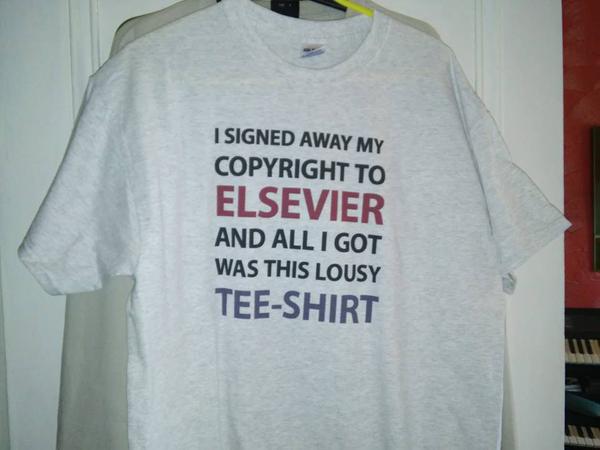
Yet again, http://www.cafepress.com/fakeelsevier 
In late October, the editors and editorial board, six and thirty-one people, respectively, of the linguistics journal Lingua resigned. They did so to protest the publisher's, Elsevier, policies and pricing, having unsuccessfully asked the company to convert the journal to open access and hearing from libraries that one of linguistics premier journals was becoming too expensive. Per Inside Higher Ed:
Johan Rooryck, executive editor of the journal until his resignation takes effect at the end of the year, said in an interview that when he started his editorship in 1998, "I could have told you to the cent what the journal cost," and that it was much more affordable. Now, he said, single subscriptions are so expensive that it is "unsustainable" for many libraries to subscribe. Rooryck is professor of French linguistics at Leiden University, in the Netherlands, where academic and government leaders have been sharply critical of journal prices.
This was not the first instance of a journal editorial board quitting over Elsevier, as The Economist noted in 2012:
In 2006, for example, the entire editorial board of Topology, a mathematics journal published by Elsevier, resigned, citing similar worries about high prices choking off access. And the board of K-theory, a maths journal owned by Springer, a German publishing firm, quit in 2007.
Simmons hosts a comprehensive list of journals that have declared independence.

Tom Reller, Vice President and Head of Global Corporate Relations at Elsevier, addressed this most recent resignation in a blog post. In it, Reller makes a number of claims that should go fact-checked. I do so below.

I am not the first person to parse Elsevier's statement. Martin Eve, Senior Lecturer in Literature, Technology and Publishing at the University of London and head of the Open Library of Humanities, which will play host to the new journal to be run by the previous editors of Lingua, Glossa, does an excellent job clarifying some of what Reller wrote. Eve notes that it was not Rooryck, solo, who wanted to take ownership of the journal, as Reller asserts, but rather the editors, writ large, and counters Reller's claim that Elsevier founded the journal. More importantly, Eve takes issue with Reller's definition of "sustainable," given that Elsevier reported a 37% operating profit in 2014.

These are the 2012 numbers. Chart via Alex Holcombe at the above link.
Reller argues that lowering the article publishing charge (AAPC), a fee that authors and/or institutions pay Elsevier for publication, for Lingua from $1800 to $440 is unsustainable, yet given the publishers' profit margins this seems unlikely. Indeed, Elsevier does publish other journals with lower APCs, more in line with what Rooryck, other editors, and the board asked for. At issue here is a definition of sustainability that takes Elsevier's profits into account, but not the balance sheets of academic libraries.

To Eve, let me add:
  • In Reller's response, he notes that Elsevier is "the world’s third largest open access publisher," but this, too is misleading. His company is the largest publisher of scholarly journals, but of the 2,500 journals they publish, only 300 are fully open access. Another 1,600, including Lingua, have some hybrid form of open access. Elsevier's claim comes from its size, a function of how many journals it publishes. Elsevier is not a member of the Open Access Scholarly Publishers Association, as some of its competitors are, including Springer, Wiley, Taylor and Francis, SAGE Publications, and Oxford and Cambridge University Presses, among others, which signals a lack of commitment to Open Access Gold, immediate free and open dissemination. Indeed, if one were to point to the largest strictly open access publishers, it would include the Public Library of Science and BioMed Central Ltd., owned by Springer, among others. Not Elsevier. 
  • Reller claims that "Elsevier will receive 1.2 million article submissions this year, publish 400,000 of them into a database of 12 million articles," for an acceptance rate of 33%, higher than that of the American Psychological Association, and many other publishers.* One effect of "the big deal" for libraries includes charging for lesser journals that don't get much use, similar to paying for cable television for just a few of the hundreds of available channels. 
    • To wit, the Massachusetts Institute for Technology notes that "UC economist Ted Bergstrom concludes through his calculations (including price per citation) that 59% of Elsevier titles are considered a “bad value.” In comparison, The American Physical Society has 0 titles that are “bad value” based on the same calculations." 
  • Elsevier is more than entitled to make a profit, which includes happy and productive employees that can exercise on the job, but sustainability is a two-way street. There are ways to make money in strictly open access environments that academic librarians should invite them to explore, such as "generating better metadata for... open access items; designing stronger, more relevant search functionalities; and creating attractive and user-friendly platforms." (Source) 
  • Per usual, when discussing issues of open access, faculty are barely present. So long as faculty cannot or do not or refuse to recognize the political economy of scholarly communication, the longer it will remain a moral hazard in which they are immune to its costs. If it is professionally and personally possible, academic librarians should initiate these conversations with faculty and academic administration. That means you, tenured librarians. To colleges and universities that employ scholarly communications librarians and help them succeed: thank you. 

Elsewhere on this site, explore the open access tag.
A Chronicle of Higher Education article on Lingua.

* Yes, I know that this is a problematic argument for a variety of reasons and I lack access to Cabell's Directory of Publishing Opportunities at the moment, but bear with me.

Tuesday, February 4, 2014

From Here to Discovery

The following is a presentation given at the 6th Annual "Bridging the Spectrum" Symposium, hosted by the Catholic University of America's Library and Information Science program. More information on the Symposium here.

Abstract: A discovery service is a single and unified index of a library’s holdings across multiple media. As more academic libraries are implementing a discovery service as the primary online face of the library, library websites have evolved with them. Website changes, however, are relatively unexamined. This briefing reports on one library’s experience with a discovery service, EBSCO’s EDS, and the effects of the discovery service on the library website. It compares these changes to those made by other academic libraries. It answers the question of whether there exists a set of best practices for academic library websites upon implementing discovery services, and addresses what happens to online public access catalogs (OPACs), individual databases, and other items frequently found on academic library websites. It also discusses how to market and promote website changes to academic communities.

From Here to Eternity, by James Jones.

What is Discovery?

It is not two French robots that play disco.

Daftpunk Robots from http://daftrobots.tumblr.com/ 
Single searching across databases, with results ranked by relevancy
  • The ability to sort said results
  • Full text
  • Features for end users
Via Hoeppner, A. (2012) The Ins and Outs of Evaluating Web-Scale Discovery Services. Infortoday.com, http://www.infotoday.com/cilmag/apr12/Hoeppner-Web-Scale-Discovery-Services.shtml Accessed 29 January 2014

From http://www.librarytechnology.org/discovery.pl 
Our library chose Ebsco's Discovery Service (EDS) in large part because we found it the "least bad." EDS' use of metadata to retrieve relevant results seems to be more robust than the other options we examined, Primo and Summon.

Via http://www.dotnetfox.com/Terms-and-Conditions.aspx

In addition, librarians judged the results returned by EDS superior to those returned by other discovery services, though this study is not without its methodological issues.
“On the quantitative benchmarks measured by this study, the EBSCO Discovery Service tool outperformed the other search systems in almost every category.”
- Asher, Duke, and Wilson (2013) Paths of Discovery: Comparing the Search effectiveness of EBSCO Discovery Service, Summon, Google Scholar, and Conventional Library Resources. College & Research Libraries. 74(5) 464-488. http://crl.acrl.org/content/74/5/464.full.pdf+html
This is our first semester using a discovery service, so we're eager to see what happens.

You've seen this gif elsewhere on the site, astute reader. Via Reaction Gifs
Though people have many goals using discovery services (some more realistic than others), including promoting local collections, replacing Google as the primary place people do research, and expanding the universe of available resources, among others, our main goal is to reduce friction for people who use our library website.

From Reddit. 
With that in mind, here is our lovely library website. Keep in mind thanks to unfortunate protocols in academic information technology, we at the library are somewhat "locked in" to this format. We use WordPress throughout the university.


Please note our mission statement front and center, because of course when people go to a library website, that's among the first things they want to see.

When I see a mission statement on the front page I’m like

Via Reaction Gifs.
We have some "stuff" on the left-hand side of the page that is rather important. A goal is to get this stuff front and center.


Let's take a closer look.


Note that we're trying to use plain, natural language. Regrettably, at the moment we're not able to do that with our discovery search box, but we are very open to suggestions here.

Here's our current search box, along with another friction point that applies to off-campus users.


Here's what will replace it, the discovery search box.

Again, we're trying to take the stuff from the left-hand side, and put it front and center.

Here's our old online public access catalog (OPAC).


See, I made a meta-funny. Right now our community searches our catalog, doesn't find something, and then clicks on a link to search the catalog of the consortium we're partial members of (like Facebook says, "it's complicated.").

And here's what it's going to look like.


Note where our consortium is circled on the right. If you do a keyword search in our catalog, it will trigger a keyword search in the consortium catalog, displayed on the same page. If you search by author, that consortium widget will do an author search as well, and so on. 

Our databases move from the left-hand side to the center.


As do our subject research guides, our in-house version of LibGuides.

We're trying to reduce friction here, get people where they want to go on our site, quicker.

Via Reddit and DatGif.
One of the things I'm most proud of about our move to discovery is the open access (OA) search feature.


That definition comes from the Budapest Initiative, by the way. I don't expect this feature to get much use, however, I do think its presence is important. I want it to jump-start conversations, to provoke thought around issues of access to information, academic publishing, and scholarly communication. In short, we want to create a discursive space for these issues.

Here's what the OA search output looks like.


Note not only the consortium widget, but also a Digital Public Library of America (DPLA) widget.

The OA search is the primary reason why we've taken so long in implementing discovery. We really wanted to push Ebsco, our vendor on this, and to their immense credit, they responded. I know that I'm sometimes guilty of painting the library-vendor relationship as adversarial, but that's not always, and even not often, the case. As far as I know our library is the only one out there to ask for this from a vendor, but there's no reason why your library can't do this, too. This is how collaboration is supposed to work.

Via Giphy. 
As presently constructed, our library sits between full collection discovery and full library discovery. In the former, libraries use discovery services to promote their collections. In the latter, the discovery search not only encompasses collections, but also locally hosted items that are on the library website, but are not part of the collection. Think room reservation forms, requests for materials, and the like.

We're going to market discovery services in several ways, chief among them, perpetual beta.

Post Perpetual Revolution by Patrick Camut, Photo by Alison Reken.
http://www.pcamut.com/revolution/. 

We'll also use library instruction one-shot sessions to talk about discovery, as well as table toppers in the dining hall, and I'll make a few appearances there as well, armed with a computer and a projector to promote the services.

We're going to dive right in and make mistakes. We'll tinker with it, and solicit feedback. We may tweak the relevancy rankings to excludes newspaper articles and reviews... or we may not.

A current debate among proponents of discovery is how best to express search results.

3 ways libraries try to help improve search results in discovery services.
Musings About Librarianship.
Villanova, above, and North Carolina State University, below, both use what's termed a "bento box" model of search results output.

3 ways libraries try to help improve search results in discovery services.
Musings About Librarianship. 
Note that the results are compartmentalized, broken down and presented using controlled vocabulary.

Via Giphy.
At present, we are not using bento. This is because our community is familiar with Ebsco's blended interface, in which the results are presented as a list, ranked by relevancy based on the available metadata. Moreover, bento, to me, looks a lot like Yahoo!'s hierarchical website organization structure, whereas the native Ebsco interface looks more like Google's. Rhetorical question: which of those won out? (Pause.) That's what I thought.

Discovery is not without its critics, and they are justified. They are aimed more at undergraduates than at faculty, graduate students, and librarians, so these three later groups may not like it as much, as they are more advanced searchers who will use individual databases to find what they want. With that in mind, we may not want to "throttle" results by filtering out things like newspaper articles and reviews, as those are important parts of the research process for undergraduates.

The metadata that Ebsco uses in its databases is privileged in its discovery service, so Ebsco resources are promoted, sometimes at the expense of a better resource from another, rival database.

We've asked Ebsco to play nicer with other vendors here, in terms of metadata integration, as Primo and Summon have, and there are some encouraging signs.

One study found that a custom Ebsco search box, trawling only Ebsco databases, would be nearly as robust as EDS, again, because of how Ebsco's metadata brings their local results to the top.
Would an custom EBSCO search box do pretty much the same thing as EDS?
- Calvert, C. (2015) Maximizing academic library collections: measuring changes in use patterns owing to EBSCO Discovery Service. College & Research Libraries. Anticipated Publication Date: January 1, 2015. Manuscript#: crl13-557. Available from http://crl.acrl.org/content/early/2014/01/17/crl13-557.full.pdf 
In some sense, are we just spending money for the sake of spending money? It's a cynical question, but a valid one all the same. Often times we librarians don't get an increase in funding unless we ask for something shiny and new that will improve our communities, as opposed to increasing funding for existing initiatives. In this sense, it almost doesn't matter whether discovery works or not, because it represents a semi-permanent budget increase.

The Tim and Eric Show, via Reaction Gifs.
In sum:

Be empathetic
  • Use the language of the user
  • Reduce friction

Via Giphy.
Clear goals and outcomes
  • work toward them, or
  • backwards from them.
Via Giphy.
Is your goal to improve the user experience, to promote your holdings and databases, to expand the searchable universe...? Different goals require different strategies and tactics.

Mistakes are okay
  • If you fix them quickly
  • We are in an academic library, not dealing with nuclear launch codes. The far majority of mistakes one might make can be easily corrected and fixed.
Via Giphy.
And that, my friends, is the end of the presentation. Thank you.

Two very useful sites on discovery services:
Aaron Tay, Musings About Librarianship and Unified Resource Discovery Comparison.

Related, on this site:
On Failure: "Elizabethtown: Embedded Librarianship as Overreach."
A Rant on Library-Vendor Relations
Copyright for Educators
A Modest Defense of QR Codes in the Library
UPDATE, July 8th post: More Thoughts on Discovery, Plus a Poster 
Tuesday, May 28, 2013

Choose wisely


"...his contempt for his own university faculty is astonishing; when he was asked about the quality of SJSU’s [San Jose State University] online courses, for example, he just quipped that 'It could not be worse than what we do face to face.'" (Source)

That is a quote from the person in charge of the university that produces more Masters of Library and Information Science than any other program in the country.
That is a social coupon site offering a deal (‽) on a Masters degree. I strongly urge readers to look at the fine print of this relationship between Udacity and The Georgia Institute of Technology, which includes specifics on how many "face hours" course "assistants" must provide students, among other details. To their credit, the Georgia Tech faculty are suspicious of this arrangement.

http://www.skipprichard.com/

That is the personal website of the person who is in charge of the organization that is in charge of libraries cataloging, and other, metadata. Platitudes exist in the disconnect between thought and action. Without the latter, these koans are the web-based equivalent of a page-a-day calendar of inspirational quotes.

"OCLC's position in the profession has been greatly compromised in effectiveness by its continual blurring of the line between being a for-profit vendor and being a non-profit library cooperative." (Source) Many librarians, myself included, are curious to see how Mr. Prichard balances these interests. His website does not offer many clues.

Choose wisely.

*To be fair, Mr. Prichard travels with Old Bay, which is awesome. There may be hope for us yet.

Tuesday, March 5, 2013

Open Access: A World Without Database Vendors?

As a thought experiment, let's say we "win." Professional and academic associations go open access, as much of physics has. The Directory of Open Access Journals is able to capture the far majority of these newly free works, and in turn these are snapped up by library catalogs thanks to link resolvers and discovery services. The same happens with the Directory of Open Access Books with regards to chapters in edited volumes.

But there's a catch: DOAJ's search function is not, to put it politely, robust. And there's a larger problem behind search functionality thanks to incomplete metadata. Link resolvers and discovery services that pull from that search, culling that metadata, will lead to frustrated end users who cannot access and discover what they're looking for.

In addition, the DOAJ is overrun with new items to catalog in this scenario, creating a backlog of epic proportions.
Stack Of Books
This is not my desk, but it feels like it sometimes. 
There are roles for vendors in this universe: generating better metadata for these newly open access items; designing stronger, more relevant search functionalities; and creating attractive and user-friendly platforms; among others.

There's a less maximalist, more realistic, "winning" option here, too: more journals, and more publishers, allow for pre-prints to be housed in institutional repositories, which are cataloged by member institutions, and perhaps shared via consortia, and with a wider audience via interlibrary loan.

However, these repositories do not solve access problems, in fact, they exacerbate them by creating not only a patchwork network of databases, but also at least two discrete classes of items: pre-prints and final products, each with a different symbolic value attached to them despite containing the same information. Vendors can solve the first of these, a coordination game, by designing, creating, and implementing databases that allow access to the pre-prints among and between libraries, including negotiating licenses and usage rights with publishers. Only vendors have, as of now, been able to create inter-library databases with robust network effects and positive externalities. That is, the more libraries, the more repositories, that join an inter-library database containing items that might otherwise only be found in a repository, the stronger, the more useful said database is. Some of those vendors in our current information ecosystem were founded by libraries, such as OhioLink, JSTOR, and OCLC, as well as The Digital Public Library of America (perhaps), though they have now taken on lives of their own.

As for the latter, pre-prints versus final products, I have no solutions other than to hope that academics "get over it" by incentivizing open access. Giving preferences to OA publications as part of tenure and promotion, for example, would be an important and powerful signal.

Thus, academics hold their chains in their hands, but there are no worlds, no futures, without database vendors. I write this not only to reassure vendors, but also to argue that we librarians are inexorably tied to vendors, even knowing that vendors do not always behave as we wish them to.

Friday, January 11, 2013

A Rant On Vendor-Librarian Relations

It's January 11th and we already have our first misguided, librarian-penned, article on libraries of 2013. In the spirit of the late, great Fire Joe Morgan, I'm going to break this one down. The article in question is "Six Mistakes the Library Staff Are Making," and you can read it here, though I'll heavily excerpt below.
What follows, then, is a combination of things boiled down into six points — the most commonly reported and (in my estimation) most important mistakes that library staff are making in their dealings with sales reps. 
1. Rudeness/unprofessionalism. Let’s begin with the most egregious and patently unacceptable of the mistakes listed here — rude and unprofessional behavior. Examples include: treating a sales rep or customer service staffer with discourtesy or derision; treating the rep like one’s personal therapist; unilaterally inviting a spouse or friend to a meal hosted by the rep; or failing to show up for appointments on time (or at all). 
Like the author, I will also plead guilty to the first instance of this category, though I suppose it's worth mentioning that as a conversation drags on, see item 2, below, the more frustrated I may become. I often, more than once a day, get cold calls from sales representatives who know nothing about this library, what library staff do, and the communities we serve. To the extent that one can do research ahead of time and recognize the milieu in which we find ourselves, which includes a consortium that may hamstring our ability to purchase materials, the more seriously a sales representative will be treated. Cold calling me to change our ILS is a nonstarter. Do your research.
2. Squandering one’s time with the rep. Wasting the rep’s time by forgetting a meeting or spending it on personal complaints falls under the category of rudeness and unprofessionalism, but squandering the time one has with the rep is a different matter. This is about failing to take into account the extremely limited opportunities that one has to work in-person with the sales rep, and consequently spending that time on activities that could and should have taken place before the meeting, or on conversations that could just as easily take place by email, or on issues that would be better addressed with a member of customer service staff.  
No. No no no no no no no. No. NO. I am not the one wasting time here. When I get cold called, my time is being wasted. There are two full-time staff here; I have better things to do than listen to a vendor try to sell me something. If I want something, I will initiate contact with a vendor. "But Jake, how do you know what's out there," you say. Well, dear vendor, that's what networking is for. That's what the internet is for. If I'm interested, I'll contact you. I'll come to your booth and take a pen and some candy (note: I will probably do this anyway). If I'm going to buy something from a vendor, there is no limit to the in-person opportunities. Seriously. We're working with a vendor right now on a Discovery platform. If I call this nameless vendor up right now, a representative will be in my office tomorrow. It's that easy. Vendors who don't provide this level of service are missing out. But I won't do that, because my time is precious, more precious than that of any vendor given our budget and level of staffing compared to theirs.

Similarly, after being given a five-minute version of an elevator speech, and on the phone it seems like an eternity, I don't really want to give a vendor feedback on their business model, as I'm often asked to do, or to recommend other libraries and/or library staff to be given the same sales pitch. If you'd like to hire me as a consultant, that's fine. I'll at least listen. But don't try to get that information for free.
3. Knee-jerk adversarialism and distrust. Many of my vendor-side informants bemoaned what they feel is a knee-jerk adversarialism on the part of many librarians and their staff. Now, some library-side readers will roll their eyes (“Of course our relationship is adversarial; you want our money, and we want what’s best for our patrons”), but the reps have a point. As rhetorically convenient as it might be to cast the library-vendor relationship as one of white hats vs. black hats, it should be obvious to any reflective person that the reality is far more complex than that. 
Based on what I've written above, I come across as adversarial. I understand that, and to the extent that I'm propagating that norm or stereotype, I'm sorry. But relations with vendors are often something like a power law. Ninety percent of my interactions with vendors are cold calls and solicitations. Yet those interactions do not take up anywhere near ninety percent of the time I spend with vendors. Rather, those ten percent of meetings, in person, on the phone, vie email, or otherwise, with sales representatives are fruitful, productive, and time-consuming. It is a disservice to many vendors to treat them with distrust, but there are also some who earn that, and they can earn it rather quickly if they don't do their research.
4. Failure to prepare for meetings. Before you meet with your sales rep, prepare an agenda. Send it to the rep ahead of time, and invite him or her to contribute to it. Know what will be discussed, prepare any documentation that will be needed in order for the meeting to be productive, and know what you hope to accomplish by the end of the meeting (as well as how you’ll know whether it was accomplished). If the rep provides spreadsheets, analyses, or specs ahead of time, you and your staff should read them beforehand so you’re not wasting time in the meeting trying to absorb the information they contain. 
Valid points, all. But I don't call meetings with vendors without doing this work, and I hope you, dear reader, don't either. It's sad that this needs to be said, and is even more sad that a librarian is the one saying it. As mentioned above, the majority of planning fails aren't on me, or library staff, they're on vendors who solicit having done no research on my library. It breeds distrust and adversity. 
5. Failure to prepare the ground for product consideration. One of the surest ways to waste both your time and that of your sales rep is to instigate trial access for a product that you know perfectly well you will never purchase, or for which it is not clear that there is real demand. Trials and pilot programs create work on both sides of the sales equation, and it’s important that the investment not be wasted. 
Confession, we have trialed products here knowing full well they would never be purchased or implemented. We've done it just to get vendors out of our hair, to show them that there's no demand. I'm not sure there's anything wrong with that. I dispute that there's anything wasted by it. At the least, I add a link to the "Trials" section of the library website and email interested parties in the community we serve. I doubt this process has ever taken longer than five minutes.
6. Putting political library concerns above patron needs. I’ve saved for last the “mistake” that I know is likely to be the most controversial, but I think it must be said. Because the issue is so complicated, this will be a topic for a full post at a later date, but for now I’ll just say that it has long seemed to me (and comments from my vendor-side informants seem to confirm it) that too often, we in libraries put politics ahead of mission and service. By “politics,” I mean our personal views about how the world ought to be, and more specifically our views about how the scholarly communication economy ought to be structured. 
Putting politics above mission and communities served is not so much a vendor issue as it is an "everything, everywhere in all workplaces" issue. In the context of library-vendor relations, I don't begrudge vendors profiting off the current state of scholarly communication, but there is a limit to those profits, as some vendors have realized. Even if all content were open access we would still need vendors to solve the coordination game of getting all this "stuff" in one, or a few places, making it as user-friendly as possible, for both patrons and library staff. There's plenty of value to be added by vendors even in the most utopian model.

Furthermore, politics is not just external, around the library, it's internal, within library departments, within a community. Vendors can and do benefit from the latter in the mad rush to allocate resources. The money I choose to spend on Discovery, for example, could go elsewhere. But it's going to a vendor. The allocation and distribution of scare resources, be they money, time, or staff, is politics. 

Keep in mind that this author is himself a library director, and has also written about what vendors and sales representatives should do before meeting with library staff, but does it look remotely equal to you? On which side of the equation does the money and staffing lie? Vendors can and should work harder, work more, and work better to serve libraries and library staff. I'm already on record as that library staff, especially fellow directors, should as well. Because we're the ones with two full-time employees. Not them. We all have responsibilities, but from where I sit, more of the onus is on them.


Monday, November 12, 2012

I'm Famous! Brief Musings On Libraries, Vendors, & Open Access


Thanks to this post, I somehow find myself quoted in the most recent issue of Chemical & Engineering News. Though The American Chemical Society publishes C&EN, I found the article to be impressively fair and balanced to librarians and vendors alike. It's worth a read. On a related note, library-vendor relations are going to drastically change in the near future thanks to the promise of open access. Vendors can help us with the perils by aggregating content and designing user-friendly interfaces. Such changes are already taking place in the field of particle physics.

Images via a google search: http://www.tumblr.com/tagged/don't-touch-me-i'm-famous

Tuesday, September 25, 2012

Another World is Possible: Particle Physics Goes Open Access


Well, it finally happened. The entire (sub?)field of particle physics, okay, ninety percent of it, just went open access (OA). Details, via Nature:
After six years of negotiation, the Sponsoring Consortium for Open Access Publishing in Particle Physics (SCOAP3) is now close to ensuring that nearly all particle-physics articles — about 7,000 publications last year — are made immediately free on journal websites. Upfront payments from libraries will fund the access.
Payments, from libraries, that would have gone to vendors are now going directly to journal publishers, eliminating the middle man. Simple. Elegant. Less expensive.

Let's get to the big question: is this replicable in other fields? Kind of. CERN, the European Organization for Nuclear Research, oversees the Large Hadron Collider (LHC) that is responsible for producing much of the research in particle physics, and as such, the organization exerts more influence over what's published than similar bodies in other fields. It's hard to imagine the American Political Science Association (APSA), for example, being able to sway publishing in that field the way CERN does for particle physics. Political scientists aren't dependent on APSA for producing research; there's not a political science equivalent of the LHC. In addition, as Nature notes, particle physics is a concentrated field, in which twelve journals account for ninety percent of the scholarship produced in article format.

In sum, if you want to replicate this in another field, look for one with a strong, centralized organization and limited options for article publication. The organization can control research production, as CERN does, or wield power via accreditation, certification, or other means. It's not unthinkable that a OA could be a part of such a regime, in terms of either sheer volume or percentage of scholarship that is made accessible. That organization and just a few publishers/journals ensures fewer parties at the negotiating table, which may make it easier to reach an agreement to achieve open access in a field.

In the meantime, please credit SCOAP3, CERN, and these journals for taking this unprecedented step. Another world, another scholarly publishing ecosystem, is possible. Librarians play an important role in SCOAP3. Let's not just watch, let's get creative and build off of this.

Wednesday, September 19, 2012

Supposed To's: An Open Letter to Library Directors

A library director balances the library budget with the needs of the community, and for it is hailed as a hero.

There is something wrong with this picture.

You're supposed to be doing that!

Here's what Jenica Rogers did, working with faculty, administration, and other library staff to reduce dependence on American Chemical Society resources.
Given that there was no apparent ACS-based solution to our budget crunch in the face of what we feel is unsustainable pricing, we went to our Chemistry faculty and discussed all of this with them. This was not our first meeting; we’ve been discussing this since fall 2011 when we clearly understood that ACS pricing would continue to increase, and was pushing at the ceiling of what we could sustain.  Along with two librarians – the Collection Development Coordinator, and our subject liaison to Chemistry – I laid all the facts out. We described our subscription history in support of their scholarship, teaching, and learning needs, pulled out the costs for ACS content when we first subscribed in the early 2000s and referred back to the discussions we had then (when I was CD Coordinator, not Director), laid out the current cost of ACS publications and the price increases over the past five years, and estimated what our 3-year prices would be. Based on our discussion, I think that some of our faculty were surprised, some seemed resigned, some were horrified, and they were all frustrated by what seemed to be a plate full of bad options. However, after two meetings and much discussion of how to reconfigure our ACS subscriptions to meet our budgetary constraints, I believe that we all agreed that this goes beyond having a tight campus or library budget: this is simply not appropriate pricing for an institution like ours. The result of our first meeting was that the chemistry faculty agreed to take their concerns to the ACS based on their individual professional involvements with the organization, talking with sales and the Chemical Information Division about their concerns, and we agreed that we’d look into other library solutions to their chemical information needs.
Some analysis, via another library director:

To underscore just how radical this is, Jenica spells out that the American Chemical Society “is in the unique position of both approving programs and selling the content necessary for approval” — an egregious conflict of interest.  (I’m wondering how unique this is, actually.) For this, the ACS extorts free labor from faculty who have no choice but to publish (or perish) — free labor to the ACS, but certainly not free to the supporting institutions — then turn around to charge increasingly high prices for their product. Jenica notes that “the ACS package would have consumed more than 10% of my total acquisitions budget, just for journals for this one department.”
N.b.: this also points to the importance of including librarians — or at least librarian-informed judgment –  in the university program approval and review process; some universities understand this, while others do not. It is to Jenica’s credit that she has built the organizational relationships to make possible the necessary conversations to do what elsewhere would be unthinkable.

"Unthinkable?" Really? Isn't this what library directors should be doing? Are our peers really this deaf to the milieu in which libraries find themselves in the twenty-first century? To trends in scholarly communication? To the value of building organizational relationships?

What Jenica did only works if others do it. She can't be the lone voice in the wilderness. Don't praise her for doing her job. Look in the mirror and do your job. You're supposed to be doing that!

Indeed, in 2011 we ended our relationship with the Nature Publishing Group, whose namesake print publication was responsible for more than fifteen percent of our print serials budget. Fifteen percent! I'll let that sink in, and feel free to do the math if you'd like. Library staff worked with the provost and affected faculty when eliminating Nature. It helps that we're a small university without graduate programs in the sciences, and with faculty focused more on teaching than research, but SUNY-Potsdam's experience is proof that larger institutions can and should be investigating and then acting on alternatives. Because, you know, that's part of our job. That's what we're supposed to be doing.

Tuesday, August 28, 2012

Library and Craft Beer Bullies

I have the strange fortune of being in two industries, one as an employee, the other as a blogger, that perceive themselves as being bullied. The former is librarianship, the latter is craft beer. There's no shortage of ink, digital and actual, spilled over this in librarianship. We're the victims of budget cuts, subject to the whims of vendors. We're not in control. When we exercise what agency we have, we might think we're driving, but the correct analogy is probably closer to downhill skiing. We're heading down a path, dodging trees, trying not to fall, but we think we're going to end up in the valley regardless of what happens on the journey. "Yes, there is a teleology here."

Or so the story goes. I find a tension in the discourse around this subject: that libraries and librarians are agents, are superheroes, and yet at the same time find themselves objects, acted on, then perhaps reacting. I prefer to think of it as complexity. Agents at one moment can be structures the next, and the opposite is true as well.

Craft beer defines itself, in large part, by what it's not. It's not bland, light, made with adjuncts, not made in fifteen locations. It's not macro beer, made by Bud, Miller, Coors. And yet what it's not is a myth. Craft beer can be all those things, though perhaps in two rather than fifteen locations, and even owned by the large companies mentioned above. Like libraries, craft beer has a chip on its shoulder, feels oppressed, and, perhaps like libraries, with good reason. To wit, a document that purports to show the incentives offered by one distributor of beer, Reyes Premium, to remove Devils Backbone, a Virginia craft beer, off of local draft lines. 


If this document is genuine and accurate, this could be considered evidence of a distributor paying its employees to remove a craft brewer from a draft line in favor of Blue Moon. It’s my opinion that Blue Moon sucks, as does Shock Top, which is also mentioned in the photograph. These beers masquerade as craft, but are made by MillerCoors and InBev, respectively. The best thing I can say about them is that they might get you to move up to Allagash White. These beers are to craft beer what “useful idiots” are to Lenin.* 
That being said, selling beer is the job of any distributor and its employees. Distributors are paid to put products in bars, restaurants, and on the shelves. These bonuses (if genuine) are incentives for a sales force; this is a common practice in other industries and businesses. People who love craft beer have a tendency to romanticize this industry while forgetting that it is also very much a business. People strive to make good beer for a living, but without turning a profit on that beer, we’re left with hobbyists, not an industry. 
On the other hand, bonuses, incentives, and commissions that involve cash introduce the potential and possibility of kickbacks. One can easily envision a situation in which an employee of a distributor splits his or her bonuses with people who work in bars, restaurants, and stores that sell alcohol, or even that the bonuses come from brewing companies themselves. MillerCoors and InBev have deeper pockets than any craft brewer. DCBeer is not suggesting that this is the case here, nor do we have evidence that such practices are occurring in this or any instance. We merely have a photo posted to Twitter. However, there have been discussions of this behavior in the past, and no doubt there will continue to be more in the future.

There's more information, and speculation, here.

Both in libraries and beer, much of any alleged bullying happens behind the scenes, away from the public. The paying public doesn't see the how and why of that draft line moving from one beer to another, or the how and why of an ebook or journal that's no longer available. It our job in both those fields to acknowledge, publicize, and fight that bullying without coming across as whiny or shrill. The solutions are also similar: education, outreach, marketing. We're targets; let's adapt.

* The initial DCBeer.com post attributes this quote to Marx. I have corrected it here. Photo credit to twitter user @wort2yourmom.

Thursday, March 17, 2011

#hcod and Academic Libraries

The main source of outrage over HarperCollins decision to limit e-book checkouts came from public libraries and their staff, which makes sense since the market for circulating e-books comes more from their neck of the woods than mine. However, it's not difficult to envision a scenario in which academic libraries, even ones that don't loan e-books, are affected. That's one reason why I was surprised to see this post from the Annoyed Librarian, which challenges the big tent that is the American Library Association. I'm not going to get into the commonalities that all librarians share, mostly because Andy Woodworth does a good job with that, but also because I can see both sides of this debate. I think that the Annoyed Librarian's piece makes some good points about what separates academic, public, school, and special librarians, among others from archivists, and I saw these divisions from the start of my MLIS program, which were reified in the courses offered. So the following is done in the spirit of "If you tolerate this, then your children will be next."

The library where I work, the library that I now run, I guess, doesn't really do the book thing. We've got books, but they're books from the 70s, when the core of the school was arts and sciences. In the last fifteen years, four of which involve me, the school has expanded, moving from a college to a university with several professional schools. For a variety of reasons, all of them depressing, the library did not keep up. As a result, we've got a great collection of Victorian literature... and nobody to teach about it. We've got books in French and German... languages no longer offered. You get the idea. We're getting better, more current, but we've got a ways to go. We're starting a distance-learning, online-only program in the fall, and we push patrons towards electronic and digital resources because we think that's where the world's headed... but this make us more vulnerable. We provide access to information, to knowledge, that we don't own. E-books are different from books that way; we don't lease any physical copies of books, although students can do that through the campus bookstore.

What if the next move of other, more academic, publishers is to limit access to e-books in a way similar to HarperCollins? What if an e-book could be accessed or viewed, analogous to circulating, as I see it, 26 times? What would happen to our distance learning program then? What about e-books placed on reserve to be accessed via course management software? A class of 20 students wouldn't last half a semester under that regime, and thus the library's budget wouldn't, either. So you see, Annoyed Librarian, we're all in this together, we're not so dissimilar. Let's hang together instead of separately on this issue.

New York Times enacts pay-per-view

I got this in my inbox a minute ago. Yeah, on St. Patrick's Day, on the first day of March Madness, perhaps when the NYTimes thinks we won't be paying attention. Well, are we?

An important announcement from
the publisher of The New York Times


Dear New York Times Reader,

Today marks a significant transition for The New York Times as we introduce digital subscriptions. It’s an important step that we hope you will see as an investment in The Times, one that will strengthen our ability to provide high-quality journalism to readers around the world and on any platform. The change will primarily affect those who are heavy consumers of the content on our Web site and on mobile applications.

This change comes in two stages. Today, we are rolling out digital subscriptions to our readers in Canada, which will enable us to fine-tune the customer experience before our global launch. On March 28, we will begin offering digital subscriptions in the U.S. and the rest of the world.

If you are a home delivery subscriber of The New York Times, you will continue to have full and free access to our news, information, opinion and the rest of our rich offerings on your computer, smartphone and tablet. International Herald Tribune subscribers will also receive free access to NYTimes.com.

If you are not a home delivery subscriber, you will have free access up to a defined reading limit. If you exceed that limit, you will be asked to become a digital subscriber.

This is how it will work, and what it means for you:

  • On NYTimes.com, you can view 20 articles each month at no charge (including slide shows, videos and other features). After 20 articles, we will ask you to become a digital subscriber, with full access to our site.
  • On our smartphone and tablet apps, the Top News section will remain free of charge. For access to all other sections within the apps, we will ask you to become a digital subscriber.
  • The Times is offering three digital subscription packages that allow you to choose from a variety of devices (computer, smartphone, tablet). More information about these plans is available at nytimes.com/access.
  • Again, all New York Times home delivery subscribers will receive free access to NYTimes.com and to all content on our apps. If you are a home delivery subscriber, go tohomedelivery.nytimes.com to sign up for free access.
  • Readers who come to Times articles through links from search, blogs and social media like Facebook and Twitter will be able to read those articles, even if they have reached their monthly reading limit. For some search engines, users will have a daily limit of free links to Times articles.
  • The home page at NYTimes.com and all section fronts will remain free to browse for all users at all times.
For more information, go to nytimes.com/digitalfaq.

Thank you for reading The New York Times, in all its forms.

Sincerely,

Arthur Sulzberger Jr.
Publisher, The New York Times
Chairman, The New York Times Company


As a loyal reader of NYTimes.com, you will receive a special offer to save on our new digital subscriptions. We will e-mail this special offer starting on March 28, the day we begin charging for unlimited access to our Web site and mobile apps*. We truly value your readership and look forward to bringing you the world’s finest journalism every day.

*Mobile apps are not supported on all devices. Does not include e-reader editions, Premium Crosswords or The New York Times Crosswords apps. Other restrictions apply.

This message was sent to inform you about an important change to our Web site and NYTimes applications. Please note, if you have chosen not to receive marketing messages from The New York Times, that choice applies only to promotional messages. You will continue to receive important notifications that are legally required or could affect your service.

To review our Privacy Policy, please go to:
http://www.nytimes.com/content/help/rights/privacy/policy/privacy-policy.html

© 2011 The New York Times Company / 620 Eighth Avenue, New York, NY 10018

Monday, February 28, 2011

The eBook User’s Bill of Rights

The following post is from Sarah Houghton-Jan, who blogs over at Librarian in Black. I whole-heartedly endorse the following.

Meanwhile, there's spirited debate concerning a boycott of HarperCollins. Because librarians and libraries are about customer service, it’s not something I can completely sanction, but I understand. HarperCollins’ decision is what started this, but at least they make e-books available for a loan, or 26. Simon & Schuster, on the other hand, does not. If a boycott is what gets libraries to the table when decisions like these are made, then ultimately I’m for it. But to me the real enemy is DRM, and what’s below in the bill of rights is much more about DRM than it is about individual publishers.

The eBook User’s Bill of Rights is a statement of the basic freedoms that should be granted to all eBook users.

The eBook User’s Bill of Rights

Every eBook user should have the following rights:

  • the right to use eBooks under guidelines that favor access over proprietary limitations
  • the right to access eBooks on any technological platform, including the hardware and software the user chooses
  • the right to annotate, quote passages, print, and share eBook content within the spirit of fair use and copyright
  • the right of the first-sale doctrine extended to digital content, allowing the eBook owner the right to retain, archive, share, and re-sell purchased eBooks

I believe in the free market of information and ideas.

I believe that authors, writers, and publishers can flourish when their works are readily available on the widest range of media. I believe that authors, writers, and publishers can thrive when readers are given the maximum amount of freedom to access, annotate, and share with other readers, helping this content find new audiences and markets. I believe that eBook purchasers should enjoy the rights of the first-sale doctrine because eBooks are part of the greater cultural cornerstone of literacy, education, and information access.

Digital Rights Management (DRM), like a tariff, acts as a mechanism to inhibit this free exchange of ideas, literature, and information. Likewise, the current licensing arrangements mean that readers never possess ultimate control over their own personal reading material. These are not acceptable conditions for eBooks.

I am a reader. As a customer, I am entitled to be treated with respect and not as a potential criminal. As a consumer, I am entitled to make my own decisions about the eBooks that I buy or borrow.

I am concerned about the future of access to literature and information in eBooks. I ask readers, authors, publishers, retailers, librarians, software developers, and device manufacturers to support these eBook users’ rights.

These rights are yours. Now it is your turn to take a stand. To help spread the word, copy this entire post, add your own comments, remix it, and distribute it to others. Blog it, Tweet it (#ebookrights), Facebook it, email it, and post it on a telephone pole.