Showing posts with label budgets. Show all posts

Wednesday, January 16, 2019

Furloughed

The last time I went to work was Friday, December 21st, 2018. I set up an out of office message, took a look around, and left. I still have some trail mix and chips on a shelf in my office. I wonder if they've gone stale, or if a library mouse is enjoying them and the solitude.

When the shutdown started, our living room furniture was set up just so. Since then it's been moved two more times. I think we're finally happy with it.

I do some quick calculations in my head about our food situation. We're fortunate that we can miss a month or two of paychecks and be okay, but just in case, better to buy in bulk now--hello, Costco--and supplement with Aldi or the "seconds" produce at the weekly farmers market. I update my resume and CV, just in case.

The second week of the shutdown my wife notices some water damage on our bedroom ceiling. We call a roofer. They spend maybe twenty minutes poking around, and two days later write us an estimate for $11,000. We laugh.

I also apply for unemployment in the second week. I figure I pay into this system, I may as well use it. At the end of the process the unemployment website gives me fifty-eight jobs to apply for that are either in a library or library-adjacent. I filter them by distance to my house, fifteen miles or less given Metro and the state of local roads, and an hourly rate of $20 and over. The updated search returns zero results.

I hear nothing for over a week, then get a letter in the mail, instructing me to use their website to file a weekly claim. There is no information on how to file a weekly claim on the website. I call instead. Due to the volume of callers, I'm asked to try again later.

I meet fellow furloughed friends for lunch downtown. The takeout traffic looks okay, but the dining room is empty, and a server confirms that business is down about seventy percent. Some of the staff are losing shifts.

Mr. 12 in particular thinks the shutdown deals are a hoot. We live within walking distance of an &pizza, a fast casual chain that cooks made-to-order pizzas in a high-speed oven. They're offering a free pizza with a federal or contractor ID card between 6 and 8pm every day, and bless them for it. On Friday, January 11th, the day of the first missed paycheck for federal workers, there's a line out the door at 7. I don't tell Mr. 12 that I could buy about eight pizzas at the hourly rate my contractor bills.

My aunt sends me $100 Trader Joe's gift card. We don't need it, but the thought, the kindness, matters so much more. When I go "public" on social media about filing for unemployment, I receive more kind messages, and some friends asking about the process, which they'll choose to go through.
People ask me how I'm holding up. I tell them that the laundry is done, the house is clean, the meals are home-cooked, I'm caught up on prestige tv, and the dogs are walked. But at about week three I start thinking about the $6,000 or so I've lost thus far. As a contractor, I'm almost certainly not getting that back. My anxiety spikes.

It spikes a second time when I think about going back to work. The emails I'll come back to, the feelings of being overwhelmed that other staff will almost certainly have and how I'll manage that, the accreditation committee that hasn't been tended to in almost a month, the missed deadlines. I bake cookies. I walk the dogs again.


If you'd like to help, and have the means, the following organizations do good work:
Bread for the City
Capital Are Food Bank
Greater DC Diaper Bank
So Others Might Eat

Thursday, November 5, 2015

Parsing Elsevier: Lingua and Open Access

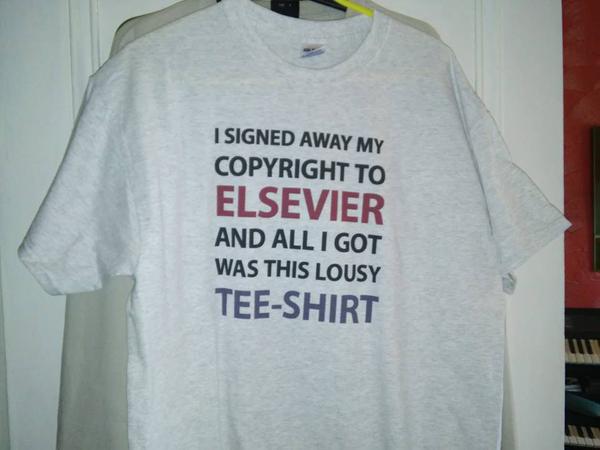
Yet again, http://www.cafepress.com/fakeelsevier 
In late October, the editors and editorial board, six and thirty-one people, respectively, of the linguistics journal Lingua resigned. They did so to protest the publisher's, Elsevier, policies and pricing, having unsuccessfully asked the company to convert the journal to open access and hearing from libraries that one of linguistics premier journals was becoming too expensive. Per Inside Higher Ed:
Johan Rooryck, executive editor of the journal until his resignation takes effect at the end of the year, said in an interview that when he started his editorship in 1998, "I could have told you to the cent what the journal cost," and that it was much more affordable. Now, he said, single subscriptions are so expensive that it is "unsustainable" for many libraries to subscribe. Rooryck is professor of French linguistics at Leiden University, in the Netherlands, where academic and government leaders have been sharply critical of journal prices.
This was not the first instance of a journal editorial board quitting over Elsevier, as The Economist noted in 2012:
In 2006, for example, the entire editorial board of Topology, a mathematics journal published by Elsevier, resigned, citing similar worries about high prices choking off access. And the board of K-theory, a maths journal owned by Springer, a German publishing firm, quit in 2007.
Simmons hosts a comprehensive list of journals that have declared independence.

Tom Reller, Vice President and Head of Global Corporate Relations at Elsevier, addressed this most recent resignation in a blog post. In it, Reller makes a number of claims that should go fact-checked. I do so below.

I am not the first person to parse Elsevier's statement. Martin Eve, Senior Lecturer in Literature, Technology and Publishing at the University of London and head of the Open Library of Humanities, which will play host to the new journal to be run by the previous editors of Lingua, Glossa, does an excellent job clarifying some of what Reller wrote. Eve notes that it was not Rooryck, solo, who wanted to take ownership of the journal, as Reller asserts, but rather the editors, writ large, and counters Reller's claim that Elsevier founded the journal. More importantly, Eve takes issue with Reller's definition of "sustainable," given that Elsevier reported a 37% operating profit in 2014.

These are the 2012 numbers. Chart via Alex Holcombe at the above link.
Reller argues that lowering the article publishing charge (AAPC), a fee that authors and/or institutions pay Elsevier for publication, for Lingua from $1800 to $440 is unsustainable, yet given the publishers' profit margins this seems unlikely. Indeed, Elsevier does publish other journals with lower APCs, more in line with what Rooryck, other editors, and the board asked for. At issue here is a definition of sustainability that takes Elsevier's profits into account, but not the balance sheets of academic libraries.

To Eve, let me add:
  • In Reller's response, he notes that Elsevier is "the world’s third largest open access publisher," but this, too is misleading. His company is the largest publisher of scholarly journals, but of the 2,500 journals they publish, only 300 are fully open access. Another 1,600, including Lingua, have some hybrid form of open access. Elsevier's claim comes from its size, a function of how many journals it publishes. Elsevier is not a member of the Open Access Scholarly Publishers Association, as some of its competitors are, including Springer, Wiley, Taylor and Francis, SAGE Publications, and Oxford and Cambridge University Presses, among others, which signals a lack of commitment to Open Access Gold, immediate free and open dissemination. Indeed, if one were to point to the largest strictly open access publishers, it would include the Public Library of Science and BioMed Central Ltd., owned by Springer, among others. Not Elsevier. 
  • Reller claims that "Elsevier will receive 1.2 million article submissions this year, publish 400,000 of them into a database of 12 million articles," for an acceptance rate of 33%, higher than that of the American Psychological Association, and many other publishers.* One effect of "the big deal" for libraries includes charging for lesser journals that don't get much use, similar to paying for cable television for just a few of the hundreds of available channels. 
    • To wit, the Massachusetts Institute for Technology notes that "UC economist Ted Bergstrom concludes through his calculations (including price per citation) that 59% of Elsevier titles are considered a “bad value.” In comparison, The American Physical Society has 0 titles that are “bad value” based on the same calculations." 
  • Elsevier is more than entitled to make a profit, which includes happy and productive employees that can exercise on the job, but sustainability is a two-way street. There are ways to make money in strictly open access environments that academic librarians should invite them to explore, such as "generating better metadata for... open access items; designing stronger, more relevant search functionalities; and creating attractive and user-friendly platforms." (Source) 
  • Per usual, when discussing issues of open access, faculty are barely present. So long as faculty cannot or do not or refuse to recognize the political economy of scholarly communication, the longer it will remain a moral hazard in which they are immune to its costs. If it is professionally and personally possible, academic librarians should initiate these conversations with faculty and academic administration. That means you, tenured librarians. To colleges and universities that employ scholarly communications librarians and help them succeed: thank you. 

Elsewhere on this site, explore the open access tag.
A Chronicle of Higher Education article on Lingua.

* Yes, I know that this is a problematic argument for a variety of reasons and I lack access to Cabell's Directory of Publishing Opportunities at the moment, but bear with me.

Thursday, July 9, 2015

I Got Soul, But I'm Not a Soldier: On "a quiet culture war in libraries"

University of Utah Associate Dean for Scholarly Resources and Collections Rick Anderson has published an opinion piece in Insights, titled "A quiet culture war in research libraries – and what it means for librarians, researchers and publishers." This article is illuminating and instructive, but not, I suspect, for the reasons Anderson intended. Rather than revealing or elucidating a problem – the author offers no evidence beyond his opinions as the first comment on the article points out and cites only himself – it is a useful look into the mindset of a dean, one that I suspect is shared by others, as well as university and associate university librarians throughout North America. The article can also be read as an apologia for the current state of scholarly communication and library and information science (LIS) practitioners' roles in that.

I.

Anderson posits a spectrum from soldier to revolutionary with regards to how academic librarians and library staff approach their jobs, and that the tension between these mindsets drive much of the labor in academic libraries. To wit:
The soldier can be thought of as generally operating under ‘marching orders’, which he takes from his institution’s mission and strategic goals, and tends to focus mainly on local needs, the impact of library services on current patrons, and the library’s alignment with its institutional mission. Those with a predominantly soldier mindset will tend to think of the library primarily as a service and support program for its host institution.
And
The revolutionary mindset thinks less in terms of marching orders than in terms of global vision. A librarian with a predominantly revolutionary mindset will tend to think more about the library’s effect on the global scholarly community, its potential role in solving global and systemic problems, and the long-term impact of its collections and services in that context. The revolutionary will tend to think of the library less as a service than as a leader and educator on campus.
Anderson is rightfully careful to note that soldiers and revolutionaries operate on a spectrum, but by focusing on the extremes, "two different orientations," he writes, or at least the Weberian ideal types, the article gives the appearance of binary thinking and false dichotomies. His use of "spectrum" and "continuum" as cover are not unlike a lawyer who introduces something for the jury to hear, knowing it will be stricken and thus resonate.

The multiple uses of "war" are worth examining. Soldiers protect and defend, while revolutionaries take, using tactics that are sometimes outside the norm ("Man the barricades!"). Soldiers, viewed here, are drones, executing a mission, a mischaracterization of what actual soldiers do, and the discretion they exercise. The title of the article, however, postulates a different kind of war, one that will be familiar to students of United States' politics and history, a culture war. This phrase has a particular meaning, left-right/liberal-conservative.

This is a profoundly unserious analogy and metaphor, as the culture war in the United States had, and has, very real victims: poor people, single parents, the LGBT community, women seeking abortions, and people of color who used drugs, among others. However, it is because of these victims, and the co-option of militaristic language by the right in the United States that we must take it somewhat seriously. After all, if Anderson wanted to he could have used the principal-agent problem from organization theory to make the same, still unserious, point. That he chose to use the language he did is telling.

Soldiers defend the status quo (right/conservative), while revolutionaries seek to overturn it (left/liberal). As it pertains to scholarly communication, here is what soldiers are defending:
A professor publishes something, using the labor (librarians) and capital (materials purchased and leased) of the institution. The library, as an arm of the institution, then must pay for that article (again!), often as part of a "big deal" package of databases. 
It's a heck of a system to defend, and a great many people in higher education and publishing would not agree that the current political economy of scholarly communication is worth defending. Yet Anderson seems to treat the status quo as the correct, proper, and neutral system; a defense from someone who knows firsthand how tenuous the political position of academic libraries can be on a campus. Running an academic library is a fascinating middle-management experience; perhaps many library and university administrators expect soldiers while fearing or silencing revolutionaries. Yet when administration and the library align, which can be often, it's a beautiful thing. At one former place of work, I presented to faculty on open access and open educational resources (OERs), then worked with faculty and administration on assigning OERs instead of textbooks, and helped bring about a policy change in the university regarding required texts. Soldiers and revolutionaries look less like a spectrum and more like a Venn diagram than Anderson acknowledges, though there is some overlap on one of his matrices.

If there is any value in rescuing Anderson's soldier-revolutionary continuum, it is that they are not mindsets, but rather a series of practices that are contingent on a host of factors, both local and global, that would be difficult to pseudo-scientifically chart, plot, or graph. Library and university administrators can foster such practices or suppress them; some tech companies tout an 80/20 or 90/10 work schedule that gives room for practices Anderson deems revolutionary.

Stuck between university administration and the revolutionaries he sees online, Anderson may have internalized the mindset of the former. This is the writing of a person who views himself as under attack, both professionally and personally, in libraries, politics, and society. To the extent that others in positions of power in libraries share this mindset, this evidence-free article made it through the peer review process, after all, it is worth exploring.

II.

Anderson's scholarship is a self-referential meta-communication, more #critlib than #critlib. Time and time again Anderson has attempted to police the bounds of discourse he deems acceptable in the LIS community, particularly as it pertains to open access and scholarly communication. For someone who seems closed to the works of Michel Foucault, it is an interesting turn. Anderson continually attempts to create "truth," what is or should be accepted as reality, in his writings on Scholarly Kitchen, and this article can be read as an extension of that.

No doubt Anderson has observed the revolutionary mindset on twitter, and I suspect he has built this mindset inductively from his time on that site, a Burkean watching the new media revolution. Yet Anderson does not like to interact on twitter, finding the 140 character restriction to be limiting, lending itself to attacks rather than debate, which gives no credit to interactions like #libchat, #snaprt, and #critlib. He is happy to mine twitter for content, and to stereotype, but not to participate in community-building and learning networks.

Anderson positions himself as someone with answers, someone who sees the big picture and lays it out, never mind that the current model is increasingly unsustainable, which people realize, which is why we are seeing more big deal cancellations and open access mandates. Helpfully, however, Anderson has published this opinion in a web-based, open access journal, itself a revolutionary practice that is becoming more normal. This, too, is telling. After all, if scholars want to reach the most people, open access publications are the best scholarly medium for doing so.

III.

Anderson writes, "We are now working in an information environment that makes it possible for each library to exert a global influence in unprecedented ways. The desire to do so is both praiseworthy and solidly in keeping with many of what most of us would consider core values of librarianship." And yet so much of this article is not about those values, but how those values pertain to monetary value. Return on investment, time is money,... the monetization of all aspects of librarianship, the tension between these mindsets, is what this article is about, not our values. Anderson asks that we consider the trade-offs, the consequences, of his mindsets, but it certainly seems like economic scare tactics to this reader: that one should be more a soldier than a revolutionary.

In the end, it is not the soldier and revolutionary mindsets, nor the spectrum of the two, that matter here, but Anderson's. To the extent that other library and university administrators share his, this article is a valuable look inside, behind the curtain. It is worth reading to understand certain strains of thought in higher education and academic libraries, not for the arguments or opinions themselves. Anderson sees himself, his position in libraries and society, and those like him, as under attack. The same is true for the political economy of scholarly communication. He simultaneously shortchanges and overstates the power of LIS professionals (we cannot cajole or coerce faculty into OA mandates without their buy-in, for example), on social media and in their workplaces. There is danger therein, as is often the case with those who feel threatened. This application of organic statism to academic libraries concerns me, and I wonder what kind of candidates the University of Utah will get for open positions if Anderson's opinion is widely read. Be that as it may, I commend Anderson for showing us his thought processes in an easily accessible journal, and I wish other deans, university librarians, and administrators would do the same.


Elsewhere on this site concerning this author:
A Rant on Vendor-Librarian Relations
Your Special Collections Won't Save You

Tuesday, November 4, 2014

On "Pitching" and What Goes Unmentioned

I'm not sure if a few recent articles constitutes a trend, but I have noticed pieces imploring librarians to get better at "pitching" ideas to their funders, be they administrators, boards, or communities, among others.


While I understand that asking for things is a skill, I, like many librarians, find it somewhat unseemly. In no small part, this is because I view libraries not just as a public good, but as being, morally good, even though there's ample evidence that as an institution, institutions, they, we, are not.

Nonetheless, in the current political and economic climate, at least in the United States, funding is often hard to come by. Public libraries face shrinking budgets while institutions of higher education are subject to the same whims if they are public, and, when taken as a whole, continue a dangerous dalliance with neoliberal policies.

These pitching articles are very much agent-based, and are within the neoliberal locus. They focus on the need to pitch, without taking into account the structure, the political and economic milieu in which libraries and library staff find themselves. Given this structure, sometimes even the best pitches can fail and fall short, and that should be noted by authors.

So if you're writing one of these articles, I want to know details. What did you pitch, to whom did you pitch it, and what strategies and sales tactics did you use? Moreover, have you pitched something at a given time and failed, only to retry it later and have it work? What changed? Again, I get that pitching is a skill we library staff should have, but I want to move past it being "good," I want to know when it works, why it works, where it works, and how it works. I want to know who has had success with it, and who hasn't. Is there something like best practices for this? Can it be replicated? Can pitching move from anecdotes to social science?

Here, I'll start:


I have some experience with pitching, having successfully advocated for a discovery layer and link resolver. It took me well over a year to from the time I started lobbying the administration, our IT department, the university president, some deans and faculty, and the business office. I first brought it up to our then-provost at a time when my place of work sought to expand enrollment by more than thirty-three percent (33%) over five years. I mentioned, and cited, the library's role in student success and retention and led people through how our community went about using the library for research, and how that would change (in short, fewer clicks, less friction) under a discovery layer and link resolver. I invited stakeholders to meet with vendors, giving our campus partners some ownership of the process. I used powerpoints. And it worked.

But sometimes it doesn't. I ask for more full-time staff in much the same way; how I pitch is how I pitch. We're still in that five-year plan. Student success and retention remain concerns. Armed with memos and data from other libraries, I presented, and continue to present, my case to the administration. And I fail. But it's not me, and I write this as much for myself as anyone else. It's because full-time staff are more expensive than a discovery layer. Much more expensive. And that's structure. And it's missing from too much of what's written in and about libraries.

There's too much agency, too much bootstrapping, too much of what is basically the respectability politics of library advocacy ("if only I had pitched better!"). And while that's important, sometimes it doesn't matter how well you pitched, because it's not up to you. And if you want to wallow in nihilism about it, I understand that impulse. I've done it. I'll do it again. But I'll also get back up, and try again.

So what works for you, dear reader? Think about not just how you pitch, but when and where as well, and please let me know, because I always want to be able to navigate structures, when possible.

Elsewhere on this site:
Libraries as Structure, Libraries as Agents: Late Capitalism Edition
Exit, Voice, and Loyalty in the Academic Library
Toward a Unifying Field Theory of Librarianship, Or Not

Thursday, June 19, 2014

The ALA Annual Post #alaac14

At the American Library Association Annual Conference in Las Vegas, Nevada I'm presenting a poster on Sunday, June 29th, from 2:30-4pm in the Exhibit Hall. The topic is how discovery searching alters library websites and search boxes, and is based on this giffy blog post.

On Monday, June 30th, from 4-4:45pm, I'm on a panel moderated by Daniel Ransom on the experiences of first-time library directors. Kristi Chadwick, Jessica Olin, and John Pappas are also on the panel, so it will be a good mix of public and academic librarians.

If any of this sounds interesting, or you just want to say hi, add me to your schedule.

Speaking of which, here's where I'll be. And yes, I'm overbooked for many of these. I'll wake up and see where the day takes me. If I missed something you think I might be interested in, please let me know.


Useful Sites

Main conference website

Transportation

Vegas on a Budget

American Library Association Party Map

Unofficial Guide to Socializing via I Need A Library Job

Eater Las Vegas is your friend

Survival Tips and Vegas Eats from Library Journal

American Libraries Cognotes (pdf)

Arts Guide to Las Vegas from the Association of College and Research Libraries Arts Section (pdf)

Wednesday, April 30, 2014

Libraries, Beer, and Lobbying in Washington, DC


On Monday, May 5th and Tuesday, May 6th hundreds of librarians will descend on Capitol Hill to lobby Congress for funding. National Library Legislative Day is in its fortieth year, and one need not be in Washington, DC to participate.

But what if it were thousands? Tens of thousands?

Every year craft brewers arrive in DC to throw a party called SAVOR. The event takes place in DC in no small part because the brewers can have a legislative day, reminding Congress that breweries are small businesses that employ Americans and use agricultural inputs. The one year that SAVOR skipped DC, the Craft Brewers Conference was here instead, affording yet another legislative day.

I understand that politics, lobbying, and asking for money strikes some as distasteful, but if you are in a position of leadership in a library, or even if you're not, this is something you should be doing. The money you're asking for supports your communities and if you want to speak the neoliberal language of return on investment (ROI), libraries have you covered there, too.
  • Every dollar spent on an academic library returns about four dollars.
  • Every dollar spent on a public library returns between three to six dollars (page 3-4 of this pdf for both those numbers, though other dollar amounts are available elsewhere. Sorry, I don't know if there's research on special, law, governmental, and other libraries).
Lobbying and asking for things doesn't always work, but sometimes it does. For example, the Food and Drug Administration wanted to test the spent grain of breweries for various pathogens, and it wanted either breweries or the farmers who use that spent grain to feed livestock to foot the bill. Costs would no doubt be passed on to consumers, too. Senators Chuck Schumer (D-NY, and more importantly Amy Schumer's uncle) and Mark Udall (D-CO), among others, intervened, citing the economic impact to craft breweries that donate spent grain to farms. Two bills, the Small BREW Act and the BEER Act, probably won't pass, but to quote Lifehacker, "you don't get shit you don't ask for." Asking is important, as are building relationships within our admittedly broken political process.

And that brings us to the American Library Association. The ALA Annual Meeting, or at least the Mid-Winter one, should be regularly held in Washington, DC for the same reason that craft brewers come to town. We need more advocacy, we need it more regularly, and we need to build relationships over the long term. The Congresspersons in the House of Representatives are elected to two-year terms. What if at least once a term thousands of librarians from all over the country met with them?*

What's at stake?
  • Net Neutrality
  • Funding for the Institute of Museum and Library Services
  • Funding for the National Endowment for the Humanities (these two via Rep. Paul Ryan's, R-WI, proposed budget)
  • Open access for taxpayer-research
  • Online privacy
  • A whole host of education-related issues
  • And much much more.


Speaking of SAVOR, here is DCBeer.com's coverage of the event, which takes place on May 9th and 10th. Craft brewers will be on the Hill on the 8th and 9th. The National Beer Wholesalers Association held their annual meeting, again, always in DC, last night. There was beer and ice cream.


SAVOR Behind the Scenes: How the Brewery Selection Process Works
I also wrote a few profiles of some breweries:
Crux Fermentation Project
Funkwerks
Lickinghole Creek Craft Brewery
Societe Brewing

Anyway, more lobbying and advocacy in DC, and in state capitals, which means state library association meetings in capital cities, too, please.

* And yes, as a DC resident, it is selfish of me to ask for this. I'd also add that DC has no "stand your ground" law, same-sex marriage, some of the more robust transgender protection laws in the country, a human rights commission, and many minority-owned businesses, among others. 

Thursday, December 12, 2013

Fifty-Seven Channels and Nothing On: The Big Deal


Ah yes, the Big Deal, in which many many many titles are bundled and sold to libraries. Usually it's journals in databases, but sometimes it's a package of ebooks, or a suite of videos, or other multimedia project.

The Big Deal is useful; it allows overtaxed library staff to focus on something other than collection development, especially in areas s/he may not be familiar with (waves to our School of Nursing). The Big Deal puts many resources at our fingertips.

But the big deal is a product of extreme cynicism; as mentioned above, it removes collection development from the purview of library staff. And the far majority of the resources don't get used. The Big Deal is your cable television package: fifty-seven channels and nothing on. Though now it's more like nine hundred channels, tens of thousands of journals. So many options! We're adding more every day! Please pay more for them.

"Wow. Such choices. Amaze. Many research." Via Giphy/thebiggyiff
The Big Deal is patrolled, contested space, in which Harvard Business Review can police your IP addresses and servers, looking for signs of, lord forbid!, actual use while the parent institution, Harvard University, purports to be a proponent of open access.

And as of right now, the Big Deal isn't going anywhere. 

Friday, October 18, 2013

Your Special Collections Won't Save You


There are people who need a unique item to do research, but those people won't save your library. The same is true of your special collections, your unique items.

Here's how this will go down: The far majority of researchers who use your special collections are going to publish in their niche subjects, read by a handful of their peers, mostly likely in closed access journals. No fame. No fortune. The same old, same old.

All libraries, regardless of who they serve, have to prioritize. No doubt every patron is valuable. Are the above patrons the most valuable in an academic library? I'm skeptical.

Why is this the case? Because those collections are special for a variety of reasons, which cut both ways. There are reasons an item you have is the only copy; often the demand isn't there for more of them. Can we librarians and archivists drive demand? To some extent, yes. To the extent that special collections are what makes an specific academic library desirable for large segments of the communities we serve? Again, I'm skeptical. But hey, try it, because the following scenario might happen.
Special collections moved to an area of prominence, no longer behind closed doors. Unique books and manuscripts were of immense interest, a catalyst for research, integration into the curriculum, student internships, and user-driven content. (Source)
Yes, a modern-day Alexanderia, where people come from miles around to use your special collections and your expertise. Except there's this thing called satisficing, where researchers find items and sources that are "good enough," (pdf) as opposed to the perfect item, which may be tucked away in an archive or special collection. And yes, even tenured faculty practice this behavior at times. And because those special collections are special to us, but maybe not to our communities.

At my place of work (MPOW), we're using Omeka to help us digitize some of our unique collections. We're not doing it because we think doing so will boost our dwindling circulation or use of the library's physical items. We're doing it because we want to preserve our past, our heritage, who we are, for the future. That is part of our mission within our community. We have these resources, and we want to make them discoverable. However, it has never been our top priority, nor do I foresee a time or situation in which that will be the case. We spend far more time, more productive time, "buying love," as Rick Anderson might say.

What I'm particularly concerned about here is that, per usual, discussions of what R1 institutions should do are driving discourse in academic librarianship. Why is this? The far majority of academic librarians don't work at an institution with multiple Associate University Librarians, yet those places seem to dominate the conversation around what academic libraries should be doing. Much of this is because R1 libraries have the staff and budgets that, in theory, allow them to not only have these conversations, but to implement them. The money is necessary, but not sufficient, perhaps. And yes, I'm jealous of those staffs and budgets.

I'm not saying special collections are worthless. I'm saying they're worth less than you think they are and less than the current literature says they are. I'm saying that this probably isn't the hill you want to die on. Go look someplace else. At MPOW, we'll be looking to aquariums and zoos for inspiration.


My favorite response to Rick Anderson's "Can't Buy Us Love" is from Steven Harris.

Tuesday, October 15, 2013

The End of "The End of Libraries"

On Sunday, October 14th, yet another "End of Libraries" piece appeared. Per usual, it was written by a white male with no use for libraries, because every single time this trope appears, that's part of the author's demographic background. Beyond that, it's a crucial part of the author's background. It is overwhelmingly affluent white men* who argue that because they do not use something, it has no value for anyone. Libraries. The Supplemental Nutritional Assistance Program. Affordable health care. It's the same argument.
It’s hard for me to even remember the last time I was in a library. I was definitely in one this past summer in Europe — on a historical tour. Before that, I think it was when I was in college. But even then, ten years ago, the internet was replacing the need to go to a library. And now, with e-books, I’m guessing the main reason to go to a library on a college campus is simply because it’s a quiet place to study. (Source)
Every single one of these articles has a version of that paragraph in it, right down to the part where the author admits he hasn't been in a library recently and makes "guesses."
The people who write these posts will never stoop to doing actual research about library usage. Even when they work for Google, as the most recent author does, they'll never use a search engine to make their argument. They'll just talk and talk and talk. Libraries don't factor into their lives, and since being a (straight) white male is the default setting for life, libraries don't factor into anyone's life. Privilege is nice, isn't it?

As such, what follows isn't for the authors of these pieces. It's for fellow librarians, who will be rebutting if they so choose. Think of it as a clearinghouse of elevator speeches, if you will. And if a white man happens to do some actual research before writing yet another "Death of Libraries" piece and stumbles across this, all the better.

Andy Woodworth starts us off. You should follow him on twitter and read his blog.


Pew has done some excellent work on this topic, too, and has data in easy to use formats.
Wikipedia's page on "Trends in Library Usage" is also well done.
The New York Public Library system's 2012 Annual Report is chock full of data about how its libraries are thriving.
If you prefer information in infographic form, we have that, too.

Again
Fully 91% of Americans ages 16 and older say public libraries are important to their communities; and 76% say libraries are important to them and their families. (Pew)


The notion that libraries are in decline is a fundamental misunderstanding of what a library is. As physical institutions, libraries have been with us for over nine thousand years now, dating back to Ashurbanipal. When people write about the decline, end, or death of libraries, they are instead writing about a historic blip in the concept of libraries: the Carnegie-founded public library, which is less than one hundred and fifty years old. And as one can see from the links above, they aren't dying, either, though it would be nice if we voted for people to fund them.

Also well said on the topic: this.
Elsewhere on this site, relevant to the "death of libraries."

I'll leave you with some food for thought:
* The author of this post is, for the time being, a financially secure white male.

Wednesday, October 9, 2013

Don't Say it With Flowers...


This is how libraries die, not by fire or flood, but by neglect. Long slow deaths.
The ancient world's greatest library didn't die in battle — it died from thousands of little cuts, over centuries, that reduced this great institution of knowledge to a shadow of its former self.
and
What made the Museum and its daughter branch great were its scholars. And when the Emperor abolished their stipends, and forbade foreign scholars from coming to the library, he effectively shut down operations. Those scrolls and books were nothing without people to care for them, study them, and share what they learned far and wide. (Source)
Even then, the scholars, the staff, in a way, made the library as much as collections did.

Monday, June 10, 2013

Exit, Voice, and Loyalty in the Academic Library

Fully 91% of Americans ages 16 and older say public libraries are important to their communities; and 76% say libraries are important to them and their families. And libraries are touchpoints in their communities for the vast majority of Americans: 84% of Americans ages 16 and older have been to a library or bookmobile at some point in their lives and 77% say they remember someone else in their family using public libraries as they were growing up. 
Still, just 22% say that they know all or most of the services their libraries offer now. Another 46% say they know some of what their libraries offer and 31% said they know not much or nothing at all of what their libraries offer. (Library Services in the Digital Age, Pew Research Center)
Ahh, libraries. Never more important, and never more irrelevant. One could be forgiven for thinking that along with declining budgets, libraries themselves, as a concept, are in decline. When faced with this perception, or perhaps the reality, librarians have three options: exit, voice, and loyalty.

Exit means leaving the profession, as at least one librarian has done rather vocally in the last week. Others are thinking about it. The specific reasons for exiting are varied, but stem from dissatisfaction. Exit need not be physical; plenty of people mentally exit their jobs.

Voice means the airing of grievances, and I suspect the majority of librarians fall into this ideal type; seeking to improve libraries and working conditions by speaking up in a variety of media.


Loyalty is the action and behavior of those relatively satisfied with their organizations. We rarely hear from them, and as a result tend to discount their numbers.

Voice takes many forms, but a recent meme is to decry the death and decline of libraries at some future date thanks to current events. Enter the "academic library at risk."

Armed with horrific data about what faculty think of us, never mind that 76% of faculty are adjuncts whose own livelihood is far more tenuous than any academic library's, the "academic library at risk" trope is for the most part unhelpful because it offers alarmist rhetoric without any solutions. To wit:
We will not survive by focusing on what we think our patrons need and ought to want, in contradiction to what our patrons say and believe they need and want. We will not survive by trying to convince them to want what we provide, but only by changing and coming up with new provisions that excite and delight them.
And
We need to change. We need to provide new and different services. We need to preserve some services, but significantly change the manner in which they are delivered.
And
And yes, that means we need to reduce and eliminate other services too. Change is hard. Yes, there are still some staff and patrons who are used to and rely on the services we’ve got now exactly how we deliver them now, and are going to be disrupted and upset by change.
Okay, so I'm cheating, because all those three quotes are from the same article. And to be fair, alarmist rhetoric is not without value. And unlike many other articles I will not link to, these are worth reading. But at what point is an academic institution going to forgo a library? When will it happen, and will it happen because the library becomes nothing more than a website with databases and a discovery service? Who among institutions of higher education is "disruptive" enough to do something truly daring and close a library?

How important are libraries? So important that as soon as opposition occupies physical space, it attempts to build one, as evidenced by recent actions in Turkey as well as the Occupy Wall Street movement. So important that 91% (!) of Americans ages 16 and older say public libraries are important to their communities. And yet, at the same time, not important enough to fully fund. Not important enough to keep people from exiting for monetary reasons.

Focusing on a decreasing percentage of tenure-track and/or full-time faculty to show an academic library's worth and to obtain funding is a fool’s errand. Budget cuts are coming regardless, and have been for some time; appealing to this shrinking group won’t be a bulwark against cuts.

Rather, these cuts originate in state and local governments, and the rise of a bloated administrative class of higher education professionals whose populations sometimes exceed the number of full-time/tenure-track professors, as is the case in the University of California system. It is telling that even climate change denier George Will recognizes this latter point. There are three ways to get tenure: teach, research, and administrate. We can infer from the rise of Massive Open Online Courses, MOOCs, who is in charge and what they think of teaching.

Many academic libraries are playing a game that’s rigged. We may as well focus on what we do best, and that includes student services, whether they are appreciated or not. As a librarian and an administrator, if my library is going down regardless, it’s going to do so on my terms. The primary focus of this library, and, I suspect, most academic libraries, isn't faculty, or administrators. It's students. So I'm concerned that 18% of faculty agree with the statement "Because scholarly material is available electronically, colleges and universities should redirect the money spent on library buildings and staff to other needs," up from 8% in 2006 (Source is figure 44 below), but I'd be a lot more concerned if they came from the people who use our library the most, students.

Download Report

What else do we do best? We have values. We don't give your data away, we don't violate your privacy, and most of us will politely chuckle when you make a Dewey Decimal System joke. We are a "third place," and that includes a place for faculty. And yes, we're more than "just books."

I won’t give up on outreach to administration or faculty; I will continue to use the language of institutional mission statements and strategic planning and to collect and present data that shows what we do and how we add value, and values, but how we go about earning that data is going to be on our terms, not theirs.

Monday, April 29, 2013

The Adjunctification of Academic Librarianship


Much ink has been spilled talking about the future of libraries, but comparatively little attention has been paid to the future of staffing libraries, outside of Jeff Trzeciak's infamous recommendation to hire PhDs as opposed to librarians credentialed with Masters of Library and Information Science degrees. What is happening at my place of work suggests that perhaps we should be paying more attention to this aspect of potential library futures.
As director of the library, I'm culpable in this exercise. Trzeciak proposed to take advantage of a market efficiency, an excess supply of labor on the PhD market, and I am doing the same for MLIS holders. I have advocated for more full-time staff, paraprofessional and credentialed librarians, but due to an operating budget of $35 million (that's for the university, total, per year), my inability to successfully lobby the administration (though I'm unclear if I could successfully do so), and the political economy of permanent crisis in higher education, I find myself here, propagating a system I hate. There are two full-time staff and six part-time staff, two of which are in MLIS programs. Four are part-time librarians. They are, in short, adjunct librarians. This future of academic libraries may be coming to a university or college near you.

Why call these part-time staff adjunct librarians? Because when the only tool administration has is a hammer, everything looks like a nail. Adjuncts are a solution to a problem in academic departments. They are now a solution in the library. And to paraphrase Tarak Barkawi, I am in part to blame for administering and legitimating this "Thatcherite budget-cutting exercise."

The only way, it seems, I can staff a library, is to exploit the surplus labor on MLIS job market. That is frustrating. That is sad. That is depressing. And I don't know what to do about it. I would love to make the part-time staff full-time, but clearly that is not going to happen any time soon here. In the meantime, part-time staff get a paycheck, but no benefits, and some experience. We get labor. But that labor is tenuous. Last week two of these staff members gave their notice. One librarian has moved on to a full-time job, six months after receiving a Masters degree. Another is leaving to focus on the final semester of an MLIS program, and the frantic job hunt that goes with it. And for us, the cycle begins anew. I wish I knew how to stop it.


Friday, January 25, 2013

The Price of Scholarly Materials, Politics, and Access


Here is the full text of an email I just sent to a faculty member and cc'd to the Provost and Vice President for Academic Affairs. Let's watch what happens, shall we.
Dear [redacted],
Currently all books, save the [redacted] text, have been purchased and will be put on reserve if they have not already. We are considering purchasing the [redacted] text as well. However, under the current textbook paradigm there is a moral hazard, in which the library is supposed to make up the difference between the “perfect” text and a “good” one. This paradigm is unsustainable. If the price of a textbook is the primary factor in whether or not a student will add or drop a course, it is incumbent on faculty to take that into consideration when assigning materials.
Best,  
Jake

Wednesday, January 23, 2013

Outsourcing Technical Services: Some Thoughts on Columbia and Cornell


Last week, while libraryland discussed important issues, like the death of Aaron Swartz, and somewhat less important ones, like rockstars and egos and feelings, something very interesting happened that didn't get enough attention: Columbia and Cornell Universities are going to merge their Technical Services departments, expanding on a partnership, called 2CUL, formed in 2009.

The impetus from the initial collaboration was borne out of, in no small part, preexisting budget cuts. I worry, however, that in this latest move cause and effect have changed places. In 2009, Cornell University Librarian Anne Kenney said the partnership “will ameliorate the impact of  budget cuts while building our libraries' ability to innovate” (LJ, 2009). It was, and is, a clever solution to a series of problems concerning funding, non-English cataloging, data management, and digital preservation, among other topics, which has proved fruitful based on recent reports, quoted from a press release below, from 2CUL.
  • “Allowing Columbia and Cornell faculty, students and staff to borrow materials from either library on-site and expedite access through intercampus loan delivery; 
  • Building joint collections and sharing librarians and language expertise to expand access to more global resources in Asia, Latin America and Russia/Eastern Europe; 
  • Uncovering issues for long-term preservation and access to e-journal literature; and 
  • Creating programs to give tailored support for Ph.D. students in the humanities.” (Press Release)
Both Cornell and Columbia staff are taking great pains to note that this recent, upgraded relationship was not a merger, and a press release, again quoted below, favors the word "integration" instead, but make no mistake, this is going to cost some jobs and save some money. Job losses are, at the least, a positive externality for the two schools, in which Technical Services staff make up approximately twenty percent of library employees, if not part of the plan.
“This partnership goes far beyond avoiding costs. It extends to changing the way we think about staffing, task and expertise distribution and workflow design.” (Press Release)
It also begs the question that if two universities a four-hour drive away from each other can integrate some library departments, can it be done between schools, or libraries, that are a four-hour plane ride apart? What about a twelve-hour flight? Can Technical Services for Slavic-language materials be performed in a Slavic-speaking country? Might it be cheaper? Might some vendor capitalize on this idea and license it out to libraries? At what point does distance become a barrier?

For example, there are already digital preservation firms located in border states that take materials to Mexico where digital preservation and reproduction is significantly cheaper than it is in the United States. Is that the future of Technical Services as well?

Additionally, while partnerships, such as consortia, are formed by groups of libraries to benefit member institutions, there is a "feed the beast" mentality that often appears. 2CUL was formed to serve Columbia and Cornell, but it may not be long before Columbia and Cornell serve 2CUL in some way.

Regardless, kudos to Columbia and Cornell for truly thinking outside the box. If the merger costs jobs, as I suspect it will, I hope the losses are minimized to the extent possible. I also hope it doesn't give too many vendors too many ideas.

(Full disclosure: the author worked the circulation desk at Columbia University's Butler Library in 1999 and 2000.)
Image via http://www.future-shape-of-church.org/?e=71

Thursday, January 17, 2013

Makerspaces, 3D Printing, & Libraries

Thesis I: 3D printing is better-suited to public libraries, which already have a wealth of programming options, like butchery and homebrewing.
There, 3D printing takes place alongside other "community center" events, as opposed to "literary" events, though it's important to note that these two categories are not mutually exclusive. One can print a book, which is a three dimensional object, for example, and one can also read about homebrewing and then experience it at a library.
Thesis II: 3D printers make sense at large, R1 institutions, but they will probably end up in a lab, run by a department or departments, much in the same way that computing, science, and engineering equipment isn't often, or ever, found in a library.
That is, there are already communities of makers on many university campuses, whether they code or create objects in laboratory conditions. Those already-existing places make more sense than a library for a 3D printer. That being said, I am in favor of anything that gets people into the physical library space; if a 3D printer is one of those things on your campus, then by all means advocate for it. But please realize you may be lobbying against other departments and spaces on campus. 
Corollary: Beyond the "next big thing," which I think 3D printers will be, they seem to exist as a wish fulfillment fantasy for academic librarians because "making stuff" is a powerful alternative to the research paper. Every single research paper is 1) an invitation to plagiarize, and 2) a reminder to library staff that the way research is conducted is a miserable experience, fraught with friction.
1) Librarians and library staff are sick of research papers. The assignments are often poorly worded, full of grey areas that students interpret how they please, a danger zone in which plagiarism flourishes. Those that are not vague are overly-detailed to the point where the assignment may be longer than the paper. Students become so focused on following the rules of the assignment that they lose sight of what's important about research papers: finding stuff, interpreting it, and making credible and logical arguments. Panic may set in, which leads to plagiarism. 
2) In my heart of hearts I believe that the majority of students do not plagiarize. When students conduct research, they first use a search engine, almost always Google. They will be unable to distinguish between scholarly and/or authoritative resources and total crap. Savvier students will skip ahead to Google Scholar, where they'll be confronted with paying $42.99 for twenty-four hours of access to an article in pdf format. They will read abstracts and cite them as if they had read the full text of the article. Then, and only then, will they proceed to the library, either in person or via the library website, and that is where the friction happens. Search the catalog, then databases?, or use a "discovery" service that delivers everything at once, akin to drinking from a fire hose, wading through hundreds if, not thousands, of barely relevant results? That the research experience stinks is a painful reminder to librarians as to their, our, limitations, and failures in creating positive user experiences.
The research paper has a place, maybe even still a paramount place, in academia, but it should not be the only assignment given. Three dimensional printers are an expression of this discontent; "If only we academic librarians worked in a place where people actually 'made stuff.'"

In addition, 3D printers also capture the zeitgeist, tying into the rebirth of people who actually are making stuff. Leather workers cobbling shoes and wallets in Maine, and posting on Vimeo; the artisanal pickles at the farmers market; and yes, even craft beer; all these things are related. They do not take place in vacuums.

Discuss.


If you'd like to read more on the "3D printers at the library" debate, here are some good places to go:

http://hughrundle.net/2013/01/02/mission-creep-a-3d-printer-will-not-save-your-library/
http://quartz.syr.edu/blog/?p=2538
http://andromedayelton.com/blog/2013/01/04/3d-printing-library-missions-and-things-beside-the-point/

Tuesday, December 18, 2012

New Year, New Library: Digital Preservation on the Cheap, Book Mount Edition

As we've gained staff this year, we're able to work on some projects that had been on the back burner in previous years, such as taking stock of our woefully neglected rare books room. As far as I can tell, there hasn't been a proper accounting of what's in there, and we now have eager part-time librarians and interns who want to learn about preservation, digitization, and the original cataloging that comes with those topics. I repeat: you have not properly preserved nor digitized an item until there is robust metadata to go with it. End rant.

One of our part-time librarians has a nice camera, and has been trained to catalog, so what's left is to train this staff member to preserve and digitize. Book mounts can be remarkably expensive for being a few pieces of foam, but we have a trick up our sleeve: Michael's. Yes, the craft store.

My first library job was in preservation for a small theological library in New York City, where I blew a bunch of money on Mylar, and my third was guillotining and digitizing books at a large Midwestern university (yes, I was there for Double Fold, in which two of my bosses are quoted out of context), so I have some background on this area of librarianship. If you are into preservation, Michael's should be your best friend.

That large foam board is $5.99. The four cones are $3.99 each. Placing two cones on each side, slide them closer or further depending on the angle you want. Those three sheets of felt, with sticker backing, are $.99 each. Use them as needed, on the cones and on the board to reduce slippage and to protect the book or pamphlet. The sum of these materials is $26.42, including Maryland state tax. A book mount costs approximately ten times this. Budgets are tight. Get creative.

Monday, November 12, 2012

I'm Famous! Brief Musings On Libraries, Vendors, & Open Access


Thanks to this post, I somehow find myself quoted in the most recent issue of Chemical & Engineering News. Though The American Chemical Society publishes C&EN, I found the article to be impressively fair and balanced to librarians and vendors alike. It's worth a read. On a related note, library-vendor relations are going to drastically change in the near future thanks to the promise of open access. Vendors can help us with the perils by aggregating content and designing user-friendly interfaces. Such changes are already taking place in the field of particle physics.

Images via a google search: http://www.tumblr.com/tagged/don't-touch-me-i'm-famous

Tuesday, November 6, 2012

Norms and Library Security Systems: The Library as Panopticon

A thought experiment, if you will. It's 2am. It's late, you're tired. You're driving in a residential neighborhood not too far from home. It's deserted. You come to a stop sign. Do you stop?
STOP - Hammer Time

If so, do you stop because it's the right thing to do, are you governed by the logic of appropriateness, or do you stop because you fear getting caught, the logic of consequences? Or is it a combination?

Scholars James March and Johan Olsen define the former logic as
a perspective that sees human action as driven by rules of appropriate or exemplary behavior, organized into institutions. Rules are followed because they are seen as natural, rightful, expected, and legitimate. Actors seek to fulfill the obligations encapsulated in a role, an identity, a membership in a political community or group, and the ethos, practices and expectations of its institutions. (pdf)
While the logic of appropriateness is sociological and ideational (are you the "kind of person" who stops at a stop sign?), the logic of consequences is economic and rationalist, concerned with achieving goals that are often defined by materialist worldviews ("I wish to avoid an accident and a speeding ticket."). Note that at times these two logics compete, but at others they are complementary.

Here's why I ask about stop sign behavior. Last month our patron counter broke, which meant no more gate counts. Two weeks later, the library security gates broke. We have an older system in which these two functions are part of one structure, which makes replacement an expensive proposition. How expensive? This expensive. For a small library that didn't budget for this, it's a tremendous outlay.

But is it a necessary one? Thanks to the above logics, and the norms they propagate, does a library need a security system? Do enough patrons behave appropriately, and fear the consequences of inappropriate behavior, that a security system is irrelevant? And will the people who steal library materials, or "borrow" them without first checking out, find a way to take what they want from a library regardless of the state of library security?

The library security system is not quite a stop sign. Think of it more as a traffic light, with a red light camera attached. If you run the light, the camera goes off, takes a picture of your license plate, and mails you a ticket. If you take materials out of the library without them being desensitized, a sensor goes off, staff inspects your belongings, and you are perhaps shamed as other people stop to watch this spectacle. A neutered security system, however, is a stop sign. There is no enforcement mechanism without a functioning sensor beyond the norm that stealing is wrong. It operates within the logic of appropriateness. And yet the physical structure of the gate is still there; most patrons may not realize that the gate sensors do not work. The library security system has become a panopticon. It offers the illusion of consequences as a form of domination and control.

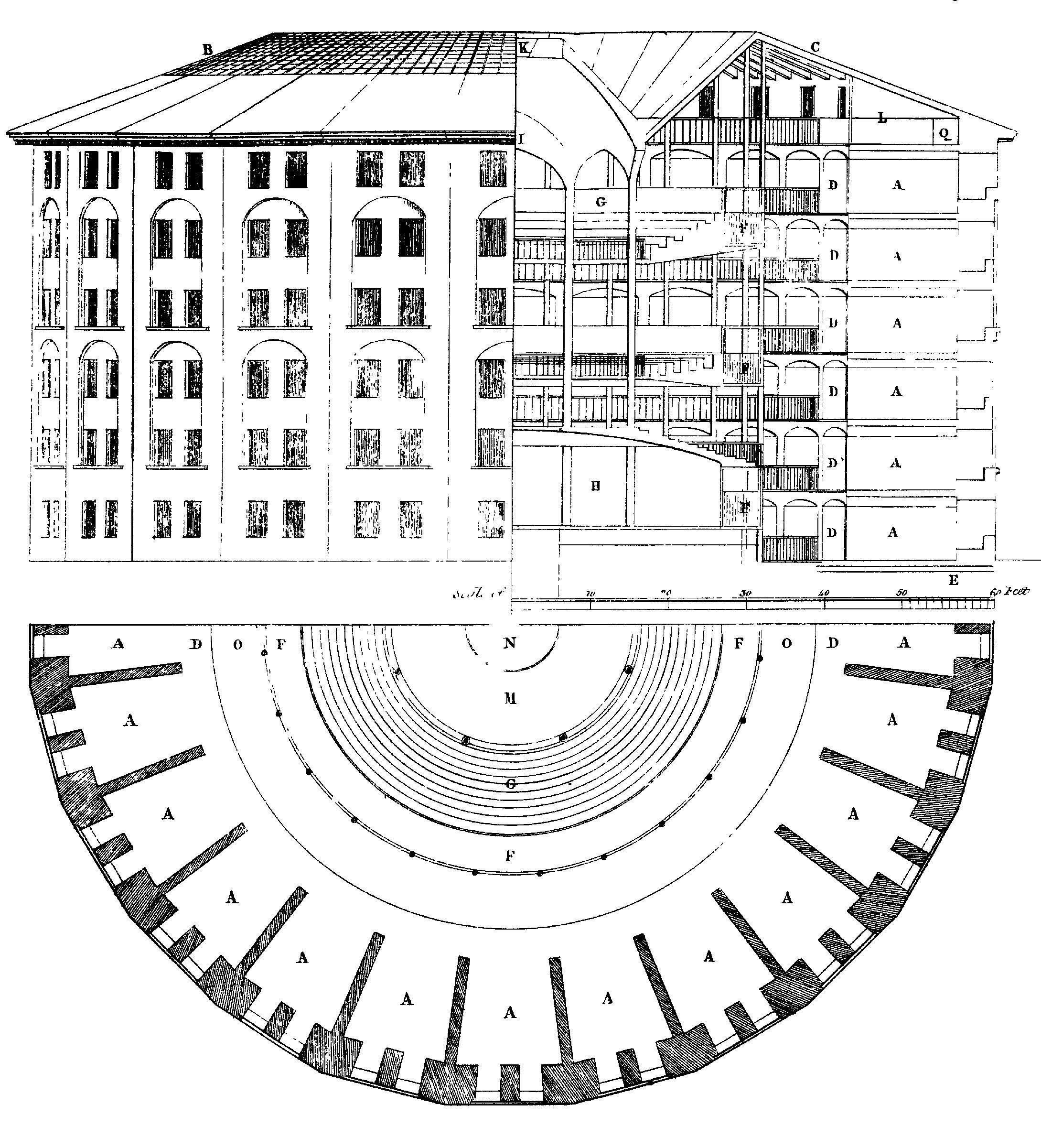
http://commons.wikimedia.org/wiki/File:Panopticon.jpg

The above image is a prison designed by utilitarian philosopher Jeremy Bentham, never built. However, its design has influenced a number of modern structures.

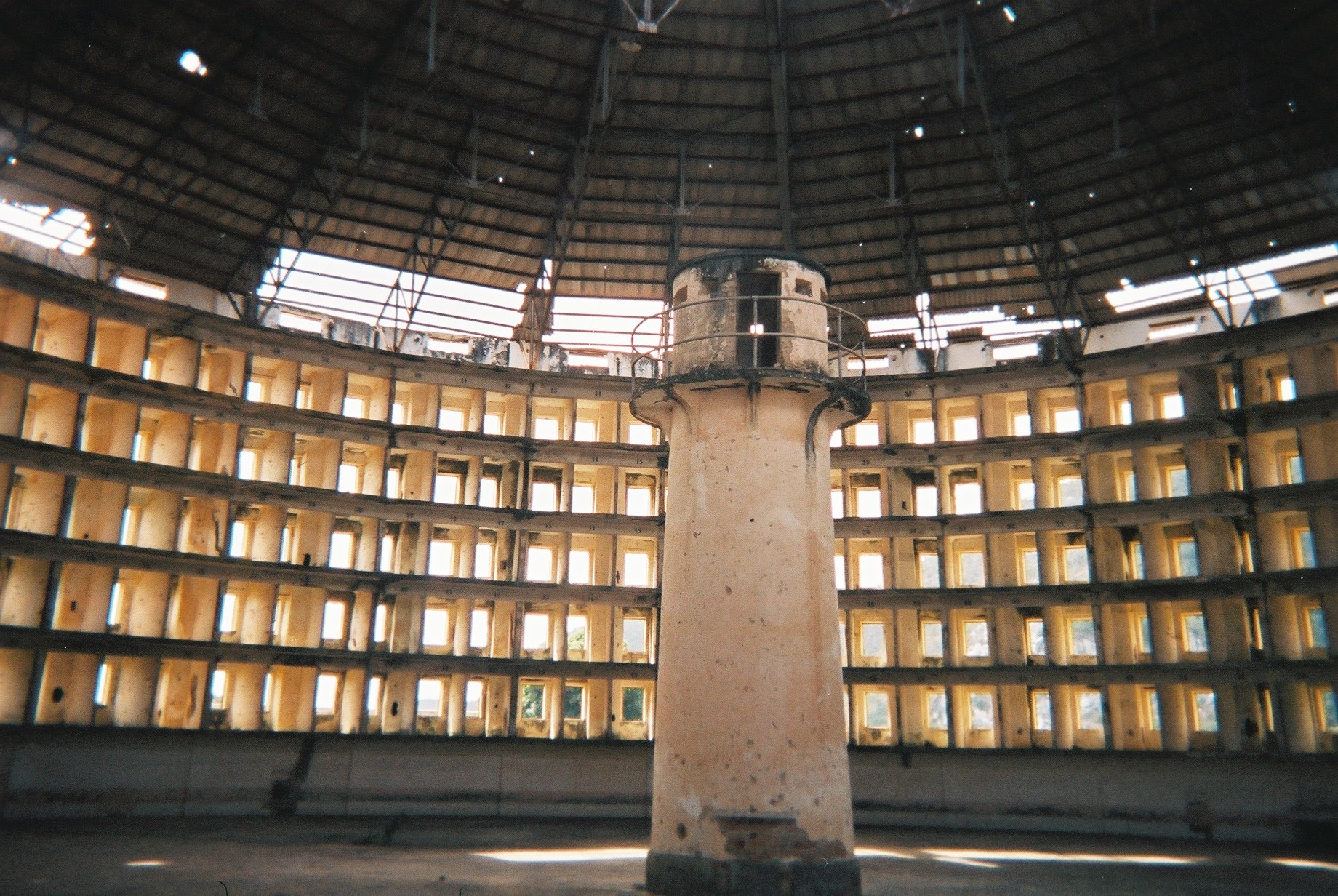
http://en.wikipedia.org/wiki/File:Presidio-modelo2.JPG
A guard tower in the middle of this Cuban prison allows for unobstructed views of all inmates, while shielding the guard from their eyes. In fact, a guard need not be present. This is our library security system, albeit in extreme form. Will the inmates, or patrons, realize that the emperor has no clothes? Until we can find the funds for a new library security system, we'll find out, relying on a broken security gate as a panoptic system of control to prevent library theft.

Our library contains approximately 214,000 items that circulate in one form or another. The far majority of these are out of date, relics of a time when the school was a women-only college, not a co-ed university. In the 2011-12 fiscal year, July 1, 2011 to June 30, 2012, 10,613 items circulated. Of these items, fifty-six (56) are labeled lost or missing. For the purposes of this exercise, I code those materials as stolen. Starting on November 1, 2012, I will begin a count of missing and lost items, ending when, and if, I suppose, we get a functioning security system, and I will report the finding in this space.

Wednesday, September 19, 2012

Supposed To's: An Open Letter to Library Directors

A library director balances the library budget with the needs of the community, and for it is hailed as a hero.

There is something wrong with this picture.

You're supposed to be doing that!

Here's what Jenica Rogers did, working with faculty, administration, and other library staff to reduce dependence on American Chemical Society resources.
Given that there was no apparent ACS-based solution to our budget crunch in the face of what we feel is unsustainable pricing, we went to our Chemistry faculty and discussed all of this with them. This was not our first meeting; we’ve been discussing this since fall 2011 when we clearly understood that ACS pricing would continue to increase, and was pushing at the ceiling of what we could sustain.  Along with two librarians – the Collection Development Coordinator, and our subject liaison to Chemistry – I laid all the facts out. We described our subscription history in support of their scholarship, teaching, and learning needs, pulled out the costs for ACS content when we first subscribed in the early 2000s and referred back to the discussions we had then (when I was CD Coordinator, not Director), laid out the current cost of ACS publications and the price increases over the past five years, and estimated what our 3-year prices would be. Based on our discussion, I think that some of our faculty were surprised, some seemed resigned, some were horrified, and they were all frustrated by what seemed to be a plate full of bad options. However, after two meetings and much discussion of how to reconfigure our ACS subscriptions to meet our budgetary constraints, I believe that we all agreed that this goes beyond having a tight campus or library budget: this is simply not appropriate pricing for an institution like ours. The result of our first meeting was that the chemistry faculty agreed to take their concerns to the ACS based on their individual professional involvements with the organization, talking with sales and the Chemical Information Division about their concerns, and we agreed that we’d look into other library solutions to their chemical information needs.
Some analysis, via another library director:

To underscore just how radical this is, Jenica spells out that the American Chemical Society “is in the unique position of both approving programs and selling the content necessary for approval” — an egregious conflict of interest.  (I’m wondering how unique this is, actually.) For this, the ACS extorts free labor from faculty who have no choice but to publish (or perish) — free labor to the ACS, but certainly not free to the supporting institutions — then turn around to charge increasingly high prices for their product. Jenica notes that “the ACS package would have consumed more than 10% of my total acquisitions budget, just for journals for this one department.”
N.b.: this also points to the importance of including librarians — or at least librarian-informed judgment –  in the university program approval and review process; some universities understand this, while others do not. It is to Jenica’s credit that she has built the organizational relationships to make possible the necessary conversations to do what elsewhere would be unthinkable.

"Unthinkable?" Really? Isn't this what library directors should be doing? Are our peers really this deaf to the milieu in which libraries find themselves in the twenty-first century? To trends in scholarly communication? To the value of building organizational relationships?

What Jenica did only works if others do it. She can't be the lone voice in the wilderness. Don't praise her for doing her job. Look in the mirror and do your job. You're supposed to be doing that!

Indeed, in 2011 we ended our relationship with the Nature Publishing Group, whose namesake print publication was responsible for more than fifteen percent of our print serials budget. Fifteen percent! I'll let that sink in, and feel free to do the math if you'd like. Library staff worked with the provost and affected faculty when eliminating Nature. It helps that we're a small university without graduate programs in the sciences, and with faculty focused more on teaching than research, but SUNY-Potsdam's experience is proof that larger institutions can and should be investigating and then acting on alternatives. Because, you know, that's part of our job. That's what we're supposed to be doing.