Thursday, January 10, 2013

Music & Beer, Beer & Music: 2013 edition

Every year, this guy and I trade top ten, or fifteen, or whatever lists, and then make fun of each other. My top fifteen albums of 2012 post is up. You like music, so I assume you know what to do. Here's a taste:
9) Swans - The Seer: The second-best psych freakout of the year actually works as something like the flip side to Lonerism. A demanding two hour-long bad trip that is somehow disturbing, uplifting, and revelatory. 
8) Passion Pit - Gossamer: Pop music! With the help of Nico Mulhy you get something like Jonsi, the Polyphonic Spree, and ABBA in a blender. The lead singer is mentally ill, and the lyrics reflect that. I don’t know how much longer he’ll last. Better get in while the getting’s good.  
7) The Amazing - Gentle Stream: Sax solos! Really. So pretty, so fragile... Did you know that this was released in Sweden in 2011, so it was in last year’s top 15, too? Well, now it’s a 2012 US release, and I like it more.  
6) Frank Ocean - Channel Orange: I believe this is a first for a top ten list (since I wasn't doing these in the 1970s), an actual R&B album, and perhaps the most interesting one since Shuggie Otis’ Inspiration Information at that. 
More here.

Guilty Simpson, murdering a Radiohead-driven horn section:


2012 was an okay year for music. I thought there was much "good," but little "great," and I wonder how many of these albums I'll be listening to a few years from now. I also worry that when it comes to music I'm becoming a grumpy old man. However, it was a great year for beer, as DC saw another brewery open, one that I put a bit of elbow grease into. Three Stars Brewing's coffee porter, dubbed the Pandemic (as in "two for $5!") is a keeper, and I'm a fan of the rest of their output as well. About 15 minutes away, DC Brau continues to impress, resurrecting grätzer; a hoppy, smoked wheat ale native to what was once Prussia, then part of Germany, and now part of Poland.

However, my favorite new beer of 2012 came from Baltimore, via a brewery in South Carolina: Stillwater's Premium, a post-modern joke of a beer designed using the ingredients of Bud, Miller, and Coors. Instead of lagering, Premium is an ale, and it's fermented with three strains of yeast, two of which are brettanomyces, which add a pleasing dryness and a bit of funk that's reminiscent of both a barn and a tropical plantation. At 4.5% alcohol by volume, it's easy-drinking, and I look forward to later this year, when we'll see it in cans.

Speaking of which, three other canned beers caught my eye in 2012. Two are lagers. New Belgium's Shift is a pale lager hopped with one of my favorites, Nelson Sauvin, from New Zealand, while just up the road in Fredrick, MD, Flying Dog came out with Underdog, another hoppy, pale offering. Like Premium, all lend themselves to sessioning. Both Shift and Underdog use hops in the same way, delivering fruit flavors, gooseberries and apricots, respectively, as opposed to piney or pithy bitterness. The third canned beer that is Brewery Vivant's Escoffier. It is, to my knowledge, the first canned beer to use brettanomyces, obtained via New Belgium. It's a wonderful red ale that uses brett for tropical funk as opposed to dryness, and I'd love to see more of it in our area.

Other standouts include New Glarus' Serendipity, an accidental fruit ale born out of a shortage of cherries in the midwest. New Glarus wisely added apples and cranberries to this beer to compensate, oaked it, and then used their house brett strain (sense a trend?). For the hop-heads, Williamsburg Alewerk's Bitter Valentine was a crushing blast of tropical fruit flavors, pine, and grapefruit pith. One of the better double IPAs I've had.

Beyond that aforementioned canned Premium, 2013 should bring us more options in terms of growler fills, and hopefully a few new breweries as well. Though we'll no doubt miss SAVOR, I'm also looking forward to the Craft Brewers Conference and the surrounding hoopla that's planned.

Cheers!

Tuesday, December 18, 2012

New Year, New Library: Digital Preservation on the Cheap, Book Mount Edition

As we've gained staff this year, we're able to work on some projects that had been on the back burner in previous years, such as taking stock of our woefully neglected rare books room. As far as I can tell, there hasn't been a proper accounting of what's in there, and we now have eager part-time librarians and interns who want to learn about preservation, digitization, and the original cataloging that comes with those topics. I repeat: you have not properly preserved nor digitized an item until there is robust metadata to go with it. End rant.

One of our part-time librarians has a nice camera, and has been trained to catalog, so what's left is to train this staff member to preserve and digitize. Book mounts can be remarkably expensive for being a few pieces of foam, but we have a trick up our sleeve: Michael's. Yes, the craft store.

My first library job was in preservation for a small theological library in New York City, where I blew a bunch of money on Mylar, and my third was guillotining and digitizing books at a large Midwestern university (yes, I was there for Double Fold, in which two of my bosses are quoted out of context), so I have some background on this area of librarianship. If you are into preservation, Michael's should be your best friend.

That large foam board is $5.99. The four cones are $3.99 each. Placing two cones on each side, slide them closer or further depending on the angle you want. Those three sheets of felt, with sticker backing, are $.99 each. Use them as needed, on the cones and on the board to reduce slippage and to protect the book or pamphlet. The sum of these materials is $26.42, including Maryland state tax. A book mount costs approximately ten times this. Budgets are tight. Get creative.

Friday, November 30, 2012

Never Mind the Hype: Lakefront's Black Friday Beer

Past, Present, & Future Sessions Here
As I've mentioned before, beer is for drinking, not for fetishizing. But that giddy thrill before you drink it...? It's pretty fun, sometimes even better than the beer. Maybe even often better than the beer. In those moments, the beer hardly matters. The anticipation, the endorphin and adrenaline rushes, the experience... those matter.

A byproduct of the rise of craft beer is that brewers have to compete for consumers. One way to do this is to hype up a beer. Let's call this top-down hype, as opposed to bottom-up hype, which comes from ones' peers (e.g., "you have to try this barrel-aged imperial wit dry-hopped with unicorn tears!"). Scarcity, top-down hyping if nothing else, means that a great many people, or at least a handful of craft beer aficionados, are going to want to try something there isn't a lot of, which is how I found myself standing outside Lakefront Brewing's Milwaukee building at 8am in a fifteen degree wind chill on "Black Friday."

Lakefront, marketing geniuses that they are, released an imperial black IPA--perhaps the most American, or at least 'Merican, beer they could--to get in on this traditional day of shopping madness. I happened to be in Milwaukee to celebrate Thanksgiving with my brother-in-law, who happens to be an ex-employee of Lakefront. Thanks to the magic of the internet, I found out about this event before he did (thanks, Beerpulse!), though to his credit he agreed it was a good idea.

That foolish fellow in the yellow t-shirt at dead center is my other brother-in-law, who now knows to bring a jacket to an 8am beer event. This photo was on the front page of the Milwaukee Journal Sentinel website on Black Friday.
Only 1200 bottles were made, with a limit of three per person. Yes, I bought three. In addition, the first 300 people in line got a Black Friday pint glass. My brother-in-law ended up with the last one of those.

As for the Black Friday imperial IPA? I haven't even had it.* It doesn't matter. Black IPA, or whatever you want to call it, isn't my favorite style. What matters is standing out in the cold, walking into a crowded, festive brewery (see below) on a Friday morning, and having a great time with great people. Hype? The beer is besides the point. It usually is.


* Thanks to air travel, I could only bring back two bottles, getting the rest at Christmas. I chose Three Floyds Broo Doo because it's a wet hop ale, it wasn't getting any fresher, and New Glarus Serendipity because it's New Glarus and delicious. Only one of these beers lives up to the hype. Speaking of which, I maintain that if Three Floyds distributed to 20 states instead of 5 there'd be a lot less talk about them about beer circles, and I say this despite liking many of their offerings.

Thursday, November 15, 2012

On Diversity in Library & Information Science Education

On Thursday, November 8th, and Friday the 9th the iSchool at the University of Maryland, College Park held its first Symposium on Diversity in Library and Information Science Education. It's an excellent idea that's well overdue, given that the profession appears to be somewhat demographically stagnant. To wit, in 2006 American Library Association members self-reported a composition that is approximately 89% white and 80% female (data in pdf form). In 2012, those numbers hadn't budged (pdf), which begs the question of what library and information science educators, librarians and paraprofessional staff, the ALA, academic advisers and faculty are doing or can do to correct this imbalance. I'm not naive enough to think that librarianship should reflect society, writ large, but for many librarians patron demographics are changing while ours are not.

Library and information science educators operate somewhat at the mercy of the other persons mentioned here. Graduate students are a self-selecting sample, and if not many students from diverse backgrounds attend MLIS programs, there is not much for this group to do beyond creating a welcoming environment for all students. Since that is easier said than done, more on that in a minute. [UPDATE: More on this in the comments.]

Librarians themselves, ourselves, have a role to play here as well. While academic librarianship may be a fallback career for failed academics, and I am guilty as charged, for a great many prospective librarians interactions with library and information science professionals can guide people towards the field. How we communicate with prospective students, both librarians and paraprofessional staff can go a long way towards recruitment.

For its part, the American Library Association has an Office for Diversity that I assume, like the rest of the ALA, is underutilized. Outside of the very effective Spectrum Scholarship Program I don't hear much about this resource. Divisions of the ALA, such as the Association of College & Research Libraries, have their own standards that are also worth examining.

Graduate programs in library and information science are dependent on undergraduate institutions for the "raw materials" of librarianship, the students, which is why there was an emphasis on academic advisers and faculty at the symposium. These professions can guide students towards librarianship, but without knowing the resources that exist to support graduate students their persuasive abilities may be circumscribed. Or worse, they may throw unprepared students to the wolf that is graduate school. That's where this conference comes in.

I was unable to attend the Thursday session, view the program here, but was present for Friday. Prior to lunch the main takeaway seemed to be the need to embed diversity and cultural competencies into all aspects of curriculum, to make it the new normal. This is important because hegemony really does exist. Lip service to diversity is not enough; rather, it needs to be as banal, unconscious, and as taken-for-granted as white privilege is. In practice, this means a focus on mentoring, hands on experience in a variety of roles, and celebrating and promoting diversity at every possible opportunity rather than devoting a mere week to it. Repetition makes routine. At one public library in Baltimore, diversity means thirteen different languages during story time.

Following lunch there was a focus on funding for diversity initiatives. The Storify below, put together by Rebecca Oxley, a conference organizer, has a wealth of links to funding sources, among others.

I am unsure if the symposium will be repeated next year, but it strikes me that if this is something we're doing every year, then we're not doing a good job of making LIS programs diverse and welcoming.


Monday, November 12, 2012

I'm Famous! Brief Musings On Libraries, Vendors, & Open Access


Thanks to this post, I somehow find myself quoted in the most recent issue of Chemical & Engineering News. Though The American Chemical Society publishes C&EN, I found the article to be impressively fair and balanced to librarians and vendors alike. It's worth a read. On a related note, library-vendor relations are going to drastically change in the near future thanks to the promise of open access. Vendors can help us with the perils by aggregating content and designing user-friendly interfaces. Such changes are already taking place in the field of particle physics.

Images via a google search: http://www.tumblr.com/tagged/don't-touch-me-i'm-famous

Tuesday, November 6, 2012

Norms and Library Security Systems: The Library as Panopticon

A thought experiment, if you will. It's 2am. It's late, you're tired. You're driving in a residential neighborhood not too far from home. It's deserted. You come to a stop sign. Do you stop?
STOP - Hammer Time

If so, do you stop because it's the right thing to do, are you governed by the logic of appropriateness, or do you stop because you fear getting caught, the logic of consequences? Or is it a combination?

Scholars James March and Johan Olsen define the former logic as
a perspective that sees human action as driven by rules of appropriate or exemplary behavior, organized into institutions. Rules are followed because they are seen as natural, rightful, expected, and legitimate. Actors seek to fulfill the obligations encapsulated in a role, an identity, a membership in a political community or group, and the ethos, practices and expectations of its institutions. (pdf)
While the logic of appropriateness is sociological and ideational (are you the "kind of person" who stops at a stop sign?), the logic of consequences is economic and rationalist, concerned with achieving goals that are often defined by materialist worldviews ("I wish to avoid an accident and a speeding ticket."). Note that at times these two logics compete, but at others they are complementary.

Here's why I ask about stop sign behavior. Last month our patron counter broke, which meant no more gate counts. Two weeks later, the library security gates broke. We have an older system in which these two functions are part of one structure, which makes replacement an expensive proposition. How expensive? This expensive. For a small library that didn't budget for this, it's a tremendous outlay.

But is it a necessary one? Thanks to the above logics, and the norms they propagate, does a library need a security system? Do enough patrons behave appropriately, and fear the consequences of inappropriate behavior, that a security system is irrelevant? And will the people who steal library materials, or "borrow" them without first checking out, find a way to take what they want from a library regardless of the state of library security?

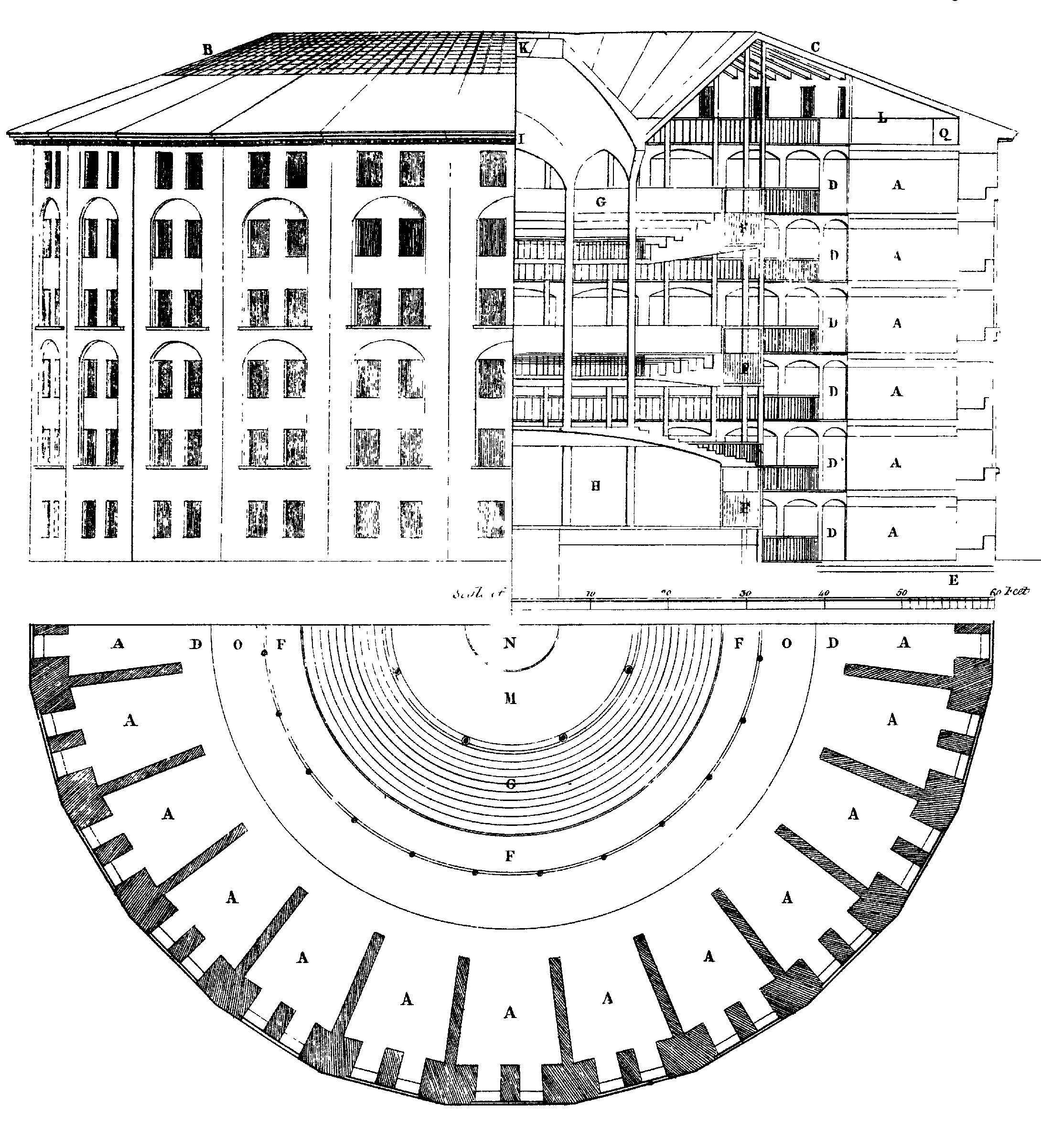
The library security system is not quite a stop sign. Think of it more as a traffic light, with a red light camera attached. If you run the light, the camera goes off, takes a picture of your license plate, and mails you a ticket. If you take materials out of the library without them being desensitized, a sensor goes off, staff inspects your belongings, and you are perhaps shamed as other people stop to watch this spectacle. A neutered security system, however, is a stop sign. There is no enforcement mechanism without a functioning sensor beyond the norm that stealing is wrong. It operates within the logic of appropriateness. And yet the physical structure of the gate is still there; most patrons may not realize that the gate sensors do not work. The library security system has become a panopticon. It offers the illusion of consequences as a form of domination and control.

http://commons.wikimedia.org/wiki/File:Panopticon.jpg

The above image is a prison designed by utilitarian philosopher Jeremy Bentham, never built. However, its design has influenced a number of modern structures.

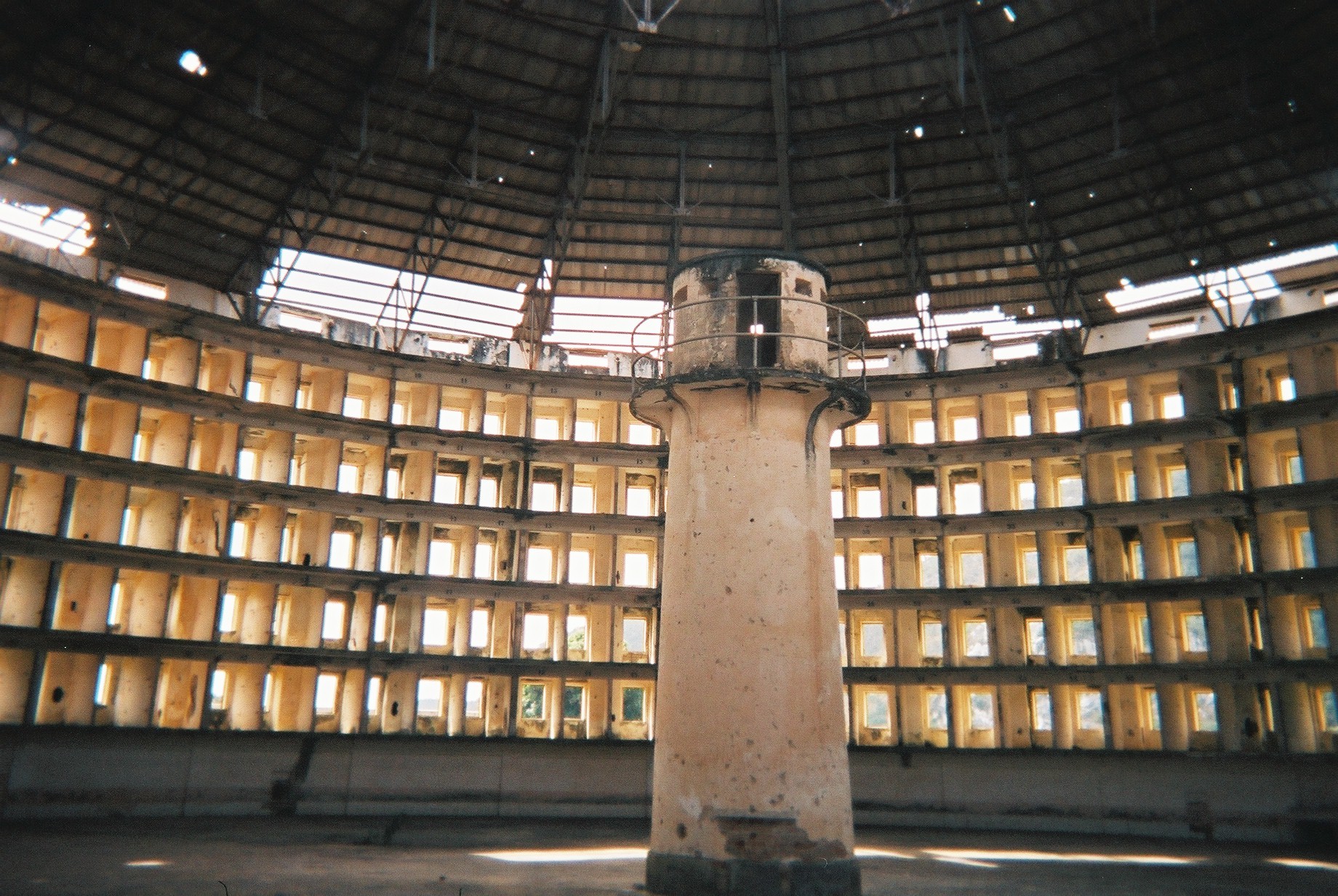
http://en.wikipedia.org/wiki/File:Presidio-modelo2.JPG
A guard tower in the middle of this Cuban prison allows for unobstructed views of all inmates, while shielding the guard from their eyes. In fact, a guard need not be present. This is our library security system, albeit in extreme form. Will the inmates, or patrons, realize that the emperor has no clothes? Until we can find the funds for a new library security system, we'll find out, relying on a broken security gate as a panoptic system of control to prevent library theft.

Our library contains approximately 214,000 items that circulate in one form or another. The far majority of these are out of date, relics of a time when the school was a women-only college, not a co-ed university. In the 2011-12 fiscal year, July 1, 2011 to June 30, 2012, 10,613 items circulated. Of these items, fifty-six (56) are labeled lost or missing. For the purposes of this exercise, I code those materials as stolen. Starting on November 1, 2012, I will begin a count of missing and lost items, ending when, and if, I suppose, we get a functioning security system, and I will report the finding in this space.

Monday, October 22, 2012

New Year, New Library: New Library (kind of)

It's been quiet here for the last month as we train new staff and bombard the campus with information literacy one-shots. In addition, much of my free time has been taken by volunteering for a local charter school that, like many schools in Washington, DC, lacks a school librarian or school media specialist.
To wit, for the 2012-13 academic calendar there are approximately sixty (60, 6-0) schools in DC that lack a librarian or school media specialist, covering between 16,000 to 17,000 students. There's plenty of blame to go around, starting with the Mayor, Vincent Gray (sample inflammatory statement from the mayor, "[W]e decided we would leave education to educators"), the Schools Chancellor Kaya Henderson, and individual principals, who decide whether or not to staff a school library. There is more sadness this way:
The results of a Freedom of Information Act request show that in FY11 and FY12, the money appropriated to DCPS [DC Public Schools] for library and media services was overwhelmingly used for other things. It paid for other things like building repairs, maintenance to HVAC systems. More than $400,000 was used for testing. DCPS used $80,000 of these funds to pay for a San Francisco-based consultant to develop a strategic plan for its Office of Family and Community Engagement.
This school, which one of my children attends, moved into a new facility last year, and this year finally has space for a library. But no librarian or school media specialist, and that's where parents like me come in. I suddenly find myself a Chinese-language cataloger (it's a Chinese-immersion school), blindly fumbling around, guided by ISBNs that may or may not lead me to a record, relying on Library of Congress Subject Headings that may or may not exist, and eyeballing the height of books to make a cataloging judgement. I've cataloged in Cyrillic before, with the help of a cheat sheet, and in Japanese, which I used to speak, but Chinese is a whole different animal.

On the plus side, the school has selected Follet's Destiny as an integrated library system, and it's easy to use. Within about fifteen minutes I felt comfortable with it, and this ease of use will allow teachers to check out materials to students. Double plus, some other parents are also librarians, and we've all taken active interests in the new school library.

In addition, the school is going to experiment with giving students raspberry pi (not pie, though that would be good, too), so I may be talking a bit (more) about programming in this space.

In the meantime, if you'd like to help DC's schools, please sign this petition. Thanks.