It's difficult to assess something that shouldn't be. My Bloody Valentine hadn't released an album in over twenty years until earlier this year, when vocalist, guitarist, and bandleader Kevin Shields made m b v available late on a Saturday evening in February.
This album was a culmination of a recording process that started seventeen years ago, and the band's reunion tour was a first opportunity to hear them present the material, new or otherwise. Shields, however, had other ideas.
The concert, at Philadelphia's Electric Factory, began with three songs off their classic album Loveless. The low-end crunch of "Sometimes" sent rumbles of bass and distortion throughout the venue, overpowering the vocals from Bilinda Butcher. Then, after what was to be one of many false starts to a song, the band launched into "I Only Said." Colm Ó Cíosóig's crushing drums stood out above the wall of noise created by Butcher, Shields, bassist Debbie Googe. and Jen Marco, a touring guitarist and keyboardist. "When You Sleep" was an early standout; a Beach Boys song run through consecutive filters of C86-style jangle, John Hughes' films, and a punishing roar of guitar squalls. A wall of amplifiers dwarfed Shields, stage left, and early in the set he retreated into them as if they were a cocoon.
The mellow, for My Bloody Valentine, "New You" followed, the first song they played off the new album. Ó Cíosóig's Madchester-style breakbeat continued to serve a reminder that under the noise, the band has a diverse palette to draw from.
Yet Shields was unhappy with some of the technical aspects of the show, and it showed. He missed one of Cíosóig's drum counts. Googe's bass and Butcher's low-end D, A, and E notes made some of the vocals unintelligible, and during "Come In Alone" Shields stopped in the middle to change guitars. It is unclear whether this was an error on his part, or on one of the guitar techs. These mistakes rattled Shields, someone who is such a perfectionist that he waits twenty-two years between releasing albums. Whatever sounds he was making with his guitar and pedals, he made it clear that they were the wrong ones, confusing the audience.
The stage lighting was at times abrasive, forcing audience members to look down or to close their eyes. With a band like My Bloody Valentine, however, not looking may be an asset. There are few groups that can provoke feelings of synesthesia quite like MBV. Without the benefit of sight, Shields' guitar-based tone poems evoked both the color schemes of impressionism and app-based generative music. The presence of the band playing in the same room was enough of an experience, as waves of sound washed over the audience and Butcher cooed wordlessly through songs like "To Here Knows When."
The band is infamous for ending concerts with extended versions of songs, often exceeding the fifteen-minute mark. It was telling, then, that the closing song, "You Made Me Realise," lasted just under seven minutes.
Befitting the shoegaze moniker, the band members never interacted on stage, each one lost in their task, reinforcing the discomfort. Aside from thanking the audience and wishing them, us, goodnight, Shields' only stage banter was to apologize for the sound.
Setlist
Sometimes
I Only Said
When You Sleep
New You
You Never Should
Honey Power
Cigarette in Your Bed
Only Tomorrow
Come in Alone
Only Shallow
Thorn
Nothing Much to Lose
Who Sees You
To Here Knows When
Wonder 2
Soon
Feed Me With Your Kiss
You Made Me Realise
Note, this review is also posted on Midnight to Six.
Wednesday, November 13, 2013

Thursday, November 7, 2013
The Subtle Joys of Selecting on the Dependent Variable
Academic research in the social sciences has a variety of aims, but much of it seeks to explain or elucidate phenomena or condition(s) and the relationships therein. In research parlance, this phenomena or condition is the dependent variable. One should not select cases that satisfy the criteria of the dependent variable; doing so is called selection bias and can lead to incorrect conclusions.
To wit, here is an example of selection bias from my former field of study, political science.
As it turns out, Alicia Silverstone is right to be skeptical about this claim.
However, there is a flip-side to selecting on the dependent variable: the results are often not only relevant, but highly entertaining.
To wit, James Scott's Seeing Like a State: How Certain Schemes to Improve the Human Condition Have Failed is, in my mind, a towering achievement and an immensely absorbing piece of research. Of course, he selects on the schemes that have failed.
And that brings us to library and information science.
Stanford University's Jacqueline Hettel and Chris Bourg are conducting research on "assessing library impact by text mining acknowledgements" from Google Books (Source). It is an impressive and creative way to measure how libraries can positively affect scholars, and at present it is in the "proof of concept" stage, so it is still early. Information and early data on the project is available at the following links.
http://www.linguabrarian.com/measuring-thanks/
http://www.linguabrarian.com/thanks-method-1/
http://www.linguabrarian.com/a-method-for-measuring-thanks-part-2-scraping-query-results-for-analysis-in-a-collaborative-project/
It seems that these scholars have a dependent variable robustly defined and measured in the form of acknowledgements that thank libraries and librarians for their help with research. While they have acknowledgements, proof of the impact of libraries, the dependent variable, they do not have the causes of these acknowledgements, and as a fellow librarian, the causes are what I am after. Those causes lead to a new metric of academic library success in scholarly communication. As of now, this work appears to be called "Measuring Thanks," a title that may hint at possible selection bias. I look forward to hearing more about the project, and I hope that they have not selected on the dependent variable by focusing on it at this early stage. As was the case above, a random sample of books, and the acknowledgements therein, is one way to avoid this bias.
Academic researchers are not supposed to select on the dependent variable, but doing so can lead to interesting and entertaining finds. More research that satisfies these latter conditions, please.
To wit, here is an example of selection bias from my former field of study, political science.
Analysts trying to explain why some developing countries have grown so much more rapidly than others regularly select a few successful new industrializing countries (NICs) for study, most often Taiwan, South Korea, Singapore, Brazil, and Mexico. In all these countries, during the periods of most rapid growth, governments exerted extensive controls over labor and prevented most expressions of worker discontent. Having noted this similarity, analysts argue that the repression, cooptation, discipline, or quiescence of labor contributes to high growth. (Geddes, 134 pdf)If one were to make policy recommendations based off this research, one might advocate that developing countries repress labor unions in order to get economic growth, the dependent variable.
 |
| Reaction Gifs, as always. And Clueless. |
In order to establish the plausibility of the claim that labor repression contributes to development, it is necessary to select a sample of cases without reference to their position on the dependent variable, rate each on its level of labor repression, and show that, on average, countries with higher levels of repression grow faster.
The two tasks crucial to testing any hypothesis are to identify the universe of cases to which the hypothesis should apply, and to find or develop measures of the variables. A sample of cases to examine then needs to be selected from the universe in such a way as to insure that the criteria for selecting cases are uncorrelated with the placement of cases on the dependent variable.(Geddes, 134-5)A random sample from a given universe is one such way to test a hypothesis or a relationship, but selection bias is not random, and when one does this, the research findings may be biased.
However, there is a flip-side to selecting on the dependent variable: the results are often not only relevant, but highly entertaining.
To wit, James Scott's Seeing Like a State: How Certain Schemes to Improve the Human Condition Have Failed is, in my mind, a towering achievement and an immensely absorbing piece of research. Of course, he selects on the schemes that have failed.
 |
| Via Google Books |
Stanford University's Jacqueline Hettel and Chris Bourg are conducting research on "assessing library impact by text mining acknowledgements" from Google Books (Source). It is an impressive and creative way to measure how libraries can positively affect scholars, and at present it is in the "proof of concept" stage, so it is still early. Information and early data on the project is available at the following links.
http://www.linguabrarian.com/measuring-thanks/
http://www.linguabrarian.com/thanks-method-1/
http://www.linguabrarian.com/a-method-for-measuring-thanks-part-2-scraping-query-results-for-analysis-in-a-collaborative-project/
It seems that these scholars have a dependent variable robustly defined and measured in the form of acknowledgements that thank libraries and librarians for their help with research. While they have acknowledgements, proof of the impact of libraries, the dependent variable, they do not have the causes of these acknowledgements, and as a fellow librarian, the causes are what I am after. Those causes lead to a new metric of academic library success in scholarly communication. As of now, this work appears to be called "Measuring Thanks," a title that may hint at possible selection bias. I look forward to hearing more about the project, and I hope that they have not selected on the dependent variable by focusing on it at this early stage. As was the case above, a random sample of books, and the acknowledgements therein, is one way to avoid this bias.
Academic researchers are not supposed to select on the dependent variable, but doing so can lead to interesting and entertaining finds. More research that satisfies these latter conditions, please.
Thursday, October 31, 2013
Data and the Surveillance State: Toward a New Ecology of Libraries
 |
| Image from the film The Lives of Others. It's excellent. Go see it. |
In short, we're going to need librarians and archivists.
The data that the state collects can and will be used against it later. History has borne this out. Truth and Reconciliation commissions, court cases, oral histories... archives are sites of contestation, of resistance. Archives are an opportunity to build new power structures, to speak truth to official versions of events.
And to ensure that future generations have access to this data, we'll need librarians and archivists right now, too. Privacy is now a good, a commodity, and it's one that information professionals can offer.
Last year I visited the Baltimore Aquarium and was impressed with how conservation was embedded into the building. It's not just a place to see fish, but a place to learn about how to keep those fish around. We need to do this for privacy, for sensible copyright law, and for open access materials, among others.
The ecology of libraries should look more like that of the aquarium.
- Secure browsers, search engines and email platforms, to the extent that these are possible.
- In library instruction "one-shot" sessions, educate patrons not just on how to select sources for a particular task, because:
our teaching must go beyond tools and skills, so that we can help students understand how information fundamentally works. This means exploring the moral, economic, and political context within which we create and share ideas. Access to information, she writes, is not enough. Our students need to see themselves in the context of "individuals and groups of people actively shaping the world as knowledge producers in a way that renders the consumer-producer dichotomy irrelevant." (The incomparable Barbara Fister quoting Christine Pawley)
- Discovery platforms that take open access, embargoes, and paywalls into account; educating people while they search.
- Notifications in the stacks and the catalog concerning
- banned and challenged books, and
- items that are affected by copyright extensions.
- Expanding digital literacies to include privacy education. (pdf)
- Staff that can leverage the power of the Internet to stay one step ahead of governments and multi- and trans-national corporations.
- Organizations and member institutions that fight for privacy, like the American Library Association (ALA) and the International Federation of Library Associations (IFLA).
 |
| Source is the above link. Glorious, isn't it? |
We're going to need to, sometime in the future, remind us how and when we lost our damn minds. Let's build for this now.
Elsewhere on this site, related:
The Library as Aquarium, or, The SOPA Post
Thursday, October 24, 2013
Dear Aspiring Librarians (On MLIS Program Placement and Salaries)
Let's revisit the US News and World Report rankings for Masters of Library and Information Science programs.
The rankings:
How they got this information:
Luckily, Library Journal has some useful data on MLIS programs. In particular, they list placement rates and salaries by type of library/organization as well as a breakdown by geography.

For discussion:

Though men are employed at a lower rate than women upon MLIS completion, their salaries tend to be higher, which both reflects and propagates a gender pay gap.

These salaries are probably not enough to help you pay off your student loans. You may have loans from undergraduate programs and then take additional loans for an MLIS program. Please forgive me for what I'm about to say, which comes from a privileged position, which I acknowledge:
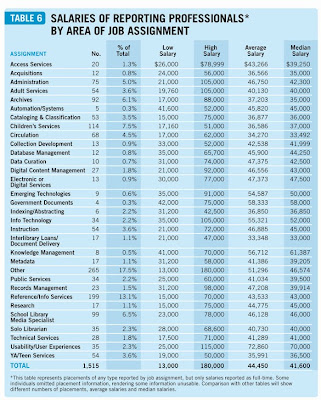
There are very few people in librarianship for the money. That being said, money is nice. So if you're on the fence about what to specialize in, perhaps this table, in conjunction with professors, coursework, peers, and librarians, can help you make up your mind.

Takeaways:
Elsewhere on this site and related: Dear Aspiring Librarians (On MLIS Program Rankings)
The rankings:
 |
| Source is a screencap from here. |
The library and information studies specialty ratings are based solely on the nominations of program deans, program directors, and a senior faculty member at each program. They were asked to choose up to 10 programs noted for excellence in each specialty area. Those with the most votes are listed. (Source)In sum, these rankings are useless. If the above paragraph doesn't convince you of that, here's more.
Luckily, Library Journal has some useful data on MLIS programs. In particular, they list placement rates and salaries by type of library/organization as well as a breakdown by geography.

For discussion:
- MLIS programs are a very gendered experience. Only two SUNYs (State Universities of New York), Albany and Buffalo, and the University of Michigan have programs in which the male to female ratio is under 1:2.5.
- The ratio of employed male to female 2012 graduates is worse, across the board, than 1:2.5, in many cases it's more like 1:4 or 1:5.
- Long Island University graduated 163 people. Two report employment. Yikes.
- San Jose State University and the University of North Texas graduate a lot of librarians. Maybe too many. Neither school, no school, really, is under any obligation to limit the number of enrolled students, but the sheer numbers of graduates these schools send into the workforce concerns me. And as it turns out, I'm not alone.
Q: "Are there any library schools whose alumni you would be reluctant to hire?"
A: "San Jose State." (Hiring Librarians)

Though men are employed at a lower rate than women upon MLIS completion, their salaries tend to be higher, which both reflects and propagates a gender pay gap.

Think long and hard about whether or not you want this degree. Do you really really really want it? Because you could be paying off loans for a long long time upon completion of an MLIS program. Ramen doesn't taste that good.

There are very few people in librarianship for the money. That being said, money is nice. So if you're on the fence about what to specialize in, perhaps this table, in conjunction with professors, coursework, peers, and librarians, can help you make up your mind.
- Automation/System, Government Document, and Knowledge Management (corporate buzzword alert!) librarian jobs have higher low end salaries than other kinds of library jobs. This is also reflected in the median salaries by position.
- Usability/UX, and Emerging and Information Technologies also seem like good bets, though there may be elements of what The Library Loon terms "new hire messianism," in which it is the responsibility of newly hired librarians, often in new positions, to advance "change" and have these skillsets ex officio, without being given the tools to institutionally succeed (it is more complex than this, please read the link above).
- Interlibrary Loan, Circulation, and Children's/Young Adult librarians continue to not pay as well. I suspect that there is more than a little "women's work" going on here, especially in the latter two positions, whereas some of the higher-salaried jobs reflect the gender pay gap we saw in Table 4, and/or code as being more "masculine." Further study is warranted. Also, because we continue to not properly fund and allocate resources towards children and young adults, which is unfortunate and maddening.

Takeaways:
- Be prepared to move.
- Placement by gender again... wow.
Do not choose MLIS programs based on the US News and World Report rankings. Though the MLIS program you graduate from may matter to some people, see Hiring Librarians, above, it may not matter to many others. As a librarian who hires people, I am not terribly interested in where you went and why you went there. It is more important, from where I sit, that you
Good luck.
Source for all tables: Maatta, S. (2013) Placements & Salaries 2013: Explore All The Data, Library Journal, 17 October 2013, http://lj.libraryjournal.com/2013/10/placements-and-salaries/2013-survey/explore-all-the-data-2013/- learned things
- know theories of information and librarianship because these theories inform practice
- took courses that can help you in the positions that you apply for
- show initiative
- are curious
Good luck.
Elsewhere on this site and related: Dear Aspiring Librarians (On MLIS Program Rankings)
Friday, October 18, 2013
Your Special Collections Won't Save You

There are people who need a unique item to do research, but those people won't save your library. The same is true of your special collections, your unique items.
Here's how this will go down: The far majority of researchers who use your special collections are going to publish in their niche subjects, read by a handful of their peers, mostly likely in closed access journals. No fame. No fortune. The same old, same old.
All libraries, regardless of who they serve, have to prioritize. No doubt every patron is valuable. Are the above patrons the most valuable in an academic library? I'm skeptical.
Why is this the case? Because those collections are special for a variety of reasons, which cut both ways. There are reasons an item you have is the only copy; often the demand isn't there for more of them. Can we librarians and archivists drive demand? To some extent, yes. To the extent that special collections are what makes an specific academic library desirable for large segments of the communities we serve? Again, I'm skeptical. But hey, try it, because the following scenario might happen.
Special collections moved to an area of prominence, no longer behind closed doors. Unique books and manuscripts were of immense interest, a catalyst for research, integration into the curriculum, student internships, and user-driven content. (Source)Yes, a modern-day Alexanderia, where people come from miles around to use your special collections and your expertise. Except there's this thing called satisficing, where researchers find items and sources that are "good enough," (pdf) as opposed to the perfect item, which may be tucked away in an archive or special collection. And yes, even tenured faculty practice this behavior at times. And because those special collections are special to us, but maybe not to our communities.
At my place of work (MPOW), we're using Omeka to help us digitize some of our unique collections. We're not doing it because we think doing so will boost our dwindling circulation or use of the library's physical items. We're doing it because we want to preserve our past, our heritage, who we are, for the future. That is part of our mission within our community. We have these resources, and we want to make them discoverable. However, it has never been our top priority, nor do I foresee a time or situation in which that will be the case. We spend far more time, more productive time, "buying love," as Rick Anderson might say.
What I'm particularly concerned about here is that, per usual, discussions of what R1 institutions should do are driving discourse in academic librarianship. Why is this? The far majority of academic librarians don't work at an institution with multiple Associate University Librarians, yet those places seem to dominate the conversation around what academic libraries should be doing. Much of this is because R1 libraries have the staff and budgets that, in theory, allow them to not only have these conversations, but to implement them. The money is necessary, but not sufficient, perhaps. And yes, I'm jealous of those staffs and budgets.
I'm not saying special collections are worthless. I'm saying they're worth less than you think they are and less than the current literature says they are. I'm saying that this probably isn't the hill you want to die on. Go look someplace else. At MPOW, we'll be looking to aquariums and zoos for inspiration.
My favorite response to Rick Anderson's "Can't Buy Us Love" is from Steven Harris.
Tuesday, October 15, 2013
The End of "The End of Libraries"
On Sunday, October 14th, yet another "End of Libraries" piece appeared. Per usual, it was written by a white male with no use for libraries, because every single time this trope appears, that's part of the author's demographic background. Beyond that, it's a crucial part of the author's background. It is overwhelmingly affluent white men* who argue that because they do not use something, it has no value for anyone. Libraries. The Supplemental Nutritional Assistance Program. Affordable health care. It's the same argument.
The people who write these posts will never stoop to doing actual research about library usage. Even when they work for Google, as the most recent author does, they'll never use a search engine to make their argument. They'll just talk and talk and talk. Libraries don't factor into their lives, and since being a (straight) white male is the default setting for life, libraries don't factor into anyone's life. Privilege is nice, isn't it?
As such, what follows isn't for the authors of these pieces. It's for fellow librarians, who will be rebutting if they so choose. Think of it as a clearinghouse of elevator speeches, if you will. And if a white man happens to do some actual research before writing yet another "Death of Libraries" piece and stumbles across this, all the better.
Andy Woodworth starts us off. You should follow him on twitter and read his blog.
Wikipedia's page on "Trends in Library Usage" is also well done.
The New York Public Library system's 2012 Annual Report is chock full of data about how its libraries are thriving.
If you prefer information in infographic form, we have that, too.
Again
Also well said on the topic: this.
Elsewhere on this site, relevant to the "death of libraries."
I'll leave you with some food for thought:
It’s hard for me to even remember the last time I was in a library. I was definitely in one this past summer in Europe — on a historical tour. Before that, I think it was when I was in college. But even then, ten years ago, the internet was replacing the need to go to a library. And now, with e-books, I’m guessing the main reason to go to a library on a college campus is simply because it’s a quiet place to study. (Source)Every single one of these articles has a version of that paragraph in it, right down to the part where the author admits he hasn't been in a library recently and makes "guesses."
Another well-off, privileged, adult has written an article letting us know how libraries are SOOO useless. Cool story, bro! @parislemon
— Angie Manfredi (@misskubelik) October 14, 2013
As such, what follows isn't for the authors of these pieces. It's for fellow librarians, who will be rebutting if they so choose. Think of it as a clearinghouse of elevator speeches, if you will. And if a white man happens to do some actual research before writing yet another "Death of Libraries" piece and stumbles across this, all the better.
Andy Woodworth starts us off. You should follow him on twitter and read his blog.
First, the economics for public libraries works very well. For every $1 spent, it gives an average of $4 in services/materials @parislemon
— Andy Woodworth (@wawoodworth) October 14, 2013
Here's a link on the economics from a study by Walt Crawford. http://t.co/OTqZpfR22v @parislemon
— Andy Woodworth (@wawoodworth) October 14, 2013
As for school libraries, there is a link btwn a school librarian and reading/learning scores: http://t.co/tjSVQ5OrHl @parislemon
— Andy Woodworth (@wawoodworth) October 14, 2013
The previous link also covers academic libraries. So, not just a quiet place to study. @parislemon
— Andy Woodworth (@wawoodworth) October 14, 2013
And eBooks? Please. It will replace print just like elevators replaced stairs. @parislemon
— Andy Woodworth (@wawoodworth) October 14, 2013
Calling for the end of libraries is saying the the digital divide doesn't exist. http://t.co/N6Xwa6yTsx @parislemonPew has done some excellent work on this topic, too, and has data in easy to use formats.
— Andy Woodworth (@wawoodworth) October 14, 2013
Wikipedia's page on "Trends in Library Usage" is also well done.
The New York Public Library system's 2012 Annual Report is chock full of data about how its libraries are thriving.
If you prefer information in infographic form, we have that, too.
Again
Fully 91% of Americans ages 16 and older say public libraries are important to their communities; and 76% say libraries are important to them and their families. (Pew)
October 14, 2013
Dear “End of Libraries” types: The invention of the microwave oven did not signal the end of the gas range, electric oven, or campfire.
— Matthew Ciszek (@mciszek) October 14, 2013
You don't use libraries? You have options? Cool. But it doesn't give you the right to take them away from others who don't have options.The notion that libraries are in decline is a fundamental misunderstanding of what a library is. As physical institutions, libraries have been with us for over nine thousand years now, dating back to Ashurbanipal. When people write about the decline, end, or death of libraries, they are instead writing about a historic blip in the concept of libraries: the Carnegie-founded public library, which is less than one hundred and fifty years old. And as one can see from the links above, they aren't dying, either, though it would be nice if we voted for people to fund them.
— Cecily Walker (@skeskali) October 14, 2013
Also well said on the topic: this.
Elsewhere on this site, relevant to the "death of libraries."
I'll leave you with some food for thought:
The greatest enemy libraries face isn't the digital world--it's this limited view of what libraries are for: http://t.co/bQCW9QZyyv* The author of this post is, for the time being, a financially secure white male.
— John Overholt (@john_overholt) October 14, 2013
Wednesday, October 9, 2013
Don't Say it With Flowers...
This is how libraries die, not by fire or flood, but by neglect. Long slow deaths.
The ancient world's greatest library didn't die in battle — it died from thousands of little cuts, over centuries, that reduced this great institution of knowledge to a shadow of its former self.and
What made the Museum and its daughter branch great were its scholars. And when the Emperor abolished their stipends, and forbade foreign scholars from coming to the library, he effectively shut down operations. Those scrolls and books were nothing without people to care for them, study them, and share what they learned far and wide. (Source)Even then, the scholars, the staff, in a way, made the library as much as collections did.
You can tell the IMLS & ALA really want a Center for the Future of Libraries based on the princely sum of $50k http://t.co/RX5ewtgiQd
— Jacob Berg (@jacobsberg) October 8, 2013
Subscribe to:
Posts (Atom)