Tuesday, May 28, 2013

Choose wisely


"...his contempt for his own university faculty is astonishing; when he was asked about the quality of SJSU’s [San Jose State University] online courses, for example, he just quipped that 'It could not be worse than what we do face to face.'" (Source)

That is a quote from the person in charge of the university that produces more Masters of Library and Information Science than any other program in the country.
That is a social coupon site offering a deal (‽) on a Masters degree. I strongly urge readers to look at the fine print of this relationship between Udacity and The Georgia Institute of Technology, which includes specifics on how many "face hours" course "assistants" must provide students, among other details. To their credit, the Georgia Tech faculty are suspicious of this arrangement.

http://www.skipprichard.com/

That is the personal website of the person who is in charge of the organization that is in charge of libraries cataloging, and other, metadata. Platitudes exist in the disconnect between thought and action. Without the latter, these koans are the web-based equivalent of a page-a-day calendar of inspirational quotes.

"OCLC's position in the profession has been greatly compromised in effectiveness by its continual blurring of the line between being a for-profit vendor and being a non-profit library cooperative." (Source) Many librarians, myself included, are curious to see how Mr. Prichard balances these interests. His website does not offer many clues.

Choose wisely.

*To be fair, Mr. Prichard travels with Old Bay, which is awesome. There may be hope for us yet.

Tuesday, May 7, 2013

The Things They Carried: Preserving User-Generated Data in Learning Management Systems.


Like many librarians, I am the product of a distance-learning Masters of Library and Information Science program, which means that I am familiar with using learning management systems (LMS) like Blackboard and Moodle as media for delivering courses. Even in brick-and-mortar, face-to-face education, LMS are popular for a variety of reasons. They enable faculty to "flip" classrooms by posting lectures and notes online, serve as a forum for discussions and chats outside of scheduled class time, and are a platform to deliver quizzes and assignments, among other roles.

LMS generate a tremendous amount of data, the far majority of which does not get used again and is lost to history. While faculty can and do copy and export the skeletal structure of courses from semester to semester, the meat of what takes place in an LMS is often thrown away once a class ends. I'd like to change this.

Much of my work in a MLIS program is saved to Google Drive and/or a local hard-drive. But not all of it. I wish I had access to what I had written in discussion forums. And maybe you do, too. Even if you don't in practice, in the abstract it makes sense. Users created that data. Let them have it beyond that semester. It may come in handy later on. Or it may sit in a box like my college notes, but let the users decide. It's their information. They made it.

Though I am often a critic of MLIS programs, the discussion boards of our LMS were useful. They're gone now, which is a shame. It doesn't have to be that way. Moodle, a popular open-source LMS allows for the creation of "portfolios" for users. The sum total of a user's Moodle activity can be downloaded or exported. Here's how. Note that "Portfolios are disabled by default" in this LMS.

I do not know if this option exists in Blackboard, but entire discussion boards can be exported and saved to .zip files. Here's how.

Why MLIS programs? Because librarians, and by extension library science programs, are natural partners for this endeavor. We care about data, about information. We preserve it and make it accessible every day. Except here.

This isn't just talk. I'm working with our Director of Educational Technology to create user portfolios within Moodle that can be downloaded and exported upon graduation or transfer (or drop-out, but let's not talk about that. Yet.). I urge you to do the same. Thank you.

Thursday, May 2, 2013

Property and Ownership: The Discourse of Craft Brewing

"'Property,' Welsh muttered to himself too softly for anyone else to hear. 'All for property.'"
- First Sergeant Edward Welsh, in James Jones's The Thin Red Line

"But to me, you’re not legit until you’ve got skin in the game, which means capital at risk."
- Hugh Sisson, founder and Chief Executive Officer, Heavy Seas Brewing Company

"If you don't like what's being said, change the conversation."
- Don Draper, Season 3, Episode 2, "Love Among the Ruins," Mad Men

In an increasingly crowded craft beer marketplace (2,347 breweries, 1,254 in planning, 409 opened in 2012), competition increases as well. Everything in craft beer becomes elastic: brewing equipment and space, hop contracts, and shelf space, among other goods and services. Enterprising brewers and companies have found two market inefficiencies in this environment. The first is termed, somewhat pejoratively, "gypsy brewing." The second is a marketing tactic called "craft versus crafty."

Gypsy brewers do not own brewing facilities. Instead they find breweries with excess capacity and travel, sometimes between continents, to these places to make beer. Though some of these itinerant, wandering brewers have taken out second mortgages, maxed out credit cards, and gone into debt to pursue careers in brewing, they are deemed as being lesser by some, like Sisson above, because they do not own property. For a vocal, but probably minority, group of brewers, craft beer is "all for property."

When Sisson voiced his opinion in Beer Advocate Magazine, there was a minor uproar (please do read the comments on the article), and Sisson quickly backtracked (again, please read the comments), but by then the discursive damage was done, and it is clear that some elements of craft beer do not understand the increasingly "postmodern, transnational craft beer scene." Will Myers, head brewer of Cambridge Brewing Company, reignited this discussion earlier this month, writing that
By making Craft Beer welcoming to all by design, we’ve made it a desirable industry in which people want to play a part. This includes the inevitable number of beer marketing companies, aka contract brewers [definition: a brewery that writes recipes for beers that are then produced by other people at a facility not owned by that brewery] (a few of whom call themselves “gypsy brewers”), who either feel that there’s money to be made in this fad or who genuinely love craft beer but don’t want to invest the capital in their own brick and mortar breweries. This lack of skin in the game shows me that they value short term gains over long term personal investment and hard work. (Source)
Note the similar discursive formations of these critiques of gypsy brewing. It has become a meme in the original sense of that word that craft beer, in addition to having high quality ingredients and independence from multinational corporations, must also be associated with a place.

The “property” line of attack on gypsy brewing is telling because it hits these brewers with something they do not have by definition, though ownership of a facility does not necessarily enhance the quality of the beer. The language about property from critics is the velvet glove surrounding the iron fist that is these critics’ annoyance that gypsy brewers are running successful operations and brands without capital, or at least sufficient capital, and without facilities that one can walk in or around or sell or mortgage. The argument about property being a requisite to brewing resonates with both the norms and American dream of business ownership and the image of small businesses as job creators (searching that phrase results in 22.4 million Google hits), and as the lifeblood of the economy (2.7 million hits). These gypsy brewers, according to Myers, are tied to a piece of paper, a contract, not to land, not to a facility, not to property. They have no roots. They are hardly brewers. They are marketing companies. They don't make anything, whereas true craft brewers do. This argument places gypsy brewers outside of an industry. They are instead part of the nebulous service sector.

Perhaps the most eloquent defense of renting, of not owning, functions as a defense of both gypsy brewing and contract brewing, comes from Jeff Leiter of Somerville Brewing Company, also known as Slumbrew. Leiter points out that a great many more "traditional" craft brewers, including Brooklyn Brewery and Sam Adams, began as contract brewers and that he aspires to own and operate a brewing facility. Property? More skin than he already has in the game? Leiter wants that. He wants to become "more craft," in the traditional, normative sense of the term as formulated by Sisson. "With this endeavor, we will surely sign more promissory notes and personal guarantees that are so highly acclaimed as a badge of honor to some brewers," writes Leiter, who goes on to describe in great detail the kind of skin he has in this game, which proves Sisson's point, by following the discursive norms mentioned above, that this is the battlefield on which the argument will be fought.
Holy shit a gypsy brewer actually working... #noskinbutalittlesweatinthegame twitter.com/EvilTwinBrewin…— Evil Twin Brewing (@EvilTwinBrewing) April 21, 2013
However, Leiter also, perhaps inadvertently, perhaps intentionally, undermines the Brewers Association's attempt to differentiate craft beer, a definition from a trade association, and "crafty" beer, the second market inefficiency, which is the attempt to obscure the macro origins of beers like Blue Moon (owned by SABMiller) and Shock Top (owned by InBev), among others.
In the end, do the actual people that like our beer and buy our bottles or draught make their decision to support us by whether I checked the gravity on the 2nd day of fermentation at 10:30am? If I am personally not present to transfer our Flagraiser IPA from primary fermentation to a brite tank, will it taste less genuine?
A craft brewery, according to the Brewers Association is
  • Small : at or under 6 million barrels produced per year, (a number that has been raised twice for Sam Adams), 
  • Independent: a brewery must have no more than 25 percent ownership by a non-craft brewer, and 
  • Traditional: in that the flagship beer is a product of malted barley, and not other adjuncts like corn and rice, though those can be used to enhance as opposed to lighten the flavor of less than half the beers brewed (never mind that corn is a tradition brewing grain in the United States; just ask Dick Yuenling or August Schell).
To the Brewers Association, crafty beer hides its ownership, uses the capital of said hidden ownership, and may brew with adjuncts.

In Leiter's offset quote above the battle is not between ownership versus contracting or craft versus crafty, both of which share a discursive formation focused on ownership and property, be it physical or intellectual, but between beer that tastes good and beer that does not. It is an argument that ignores process, that negates it. Ownership does not matter.

Publicly held (Sam Adams and AB-InBev), privately held (Sierra Nevada), or employee-owned (New Belgium and Full Sail)? It does not matter. A scrappy small business (how every craft brewery views its operation) or a multinational corporation (Bud, Miller, Coors)? It does not matter. Who brewed the beer, and who developed the recipe? Are they the same people? That does not matter. What about output and volume and scope and scale? In five months in 2012, Budweiser sold one million barrels of Platinum (thanks, Pitbull!), more than the yearly output of every craft brewery except for Sam Adams and Sierra Nevada. These elements also do not matter here.

For this reason, the idea that taste trumps all may be too simplistic. Purchasing patterns and consumer behavior tell us this isn’t true. Questions like who and where and how and why beer is brewed are as important to many beer drinkers as how the beer tastes. There is a role for process, but what? Were flavoring extracts uses as opposed to original source ingredients? Does it matter that supporting a local brewery keeps money local? That doing so supports neighbors and communities? That the beer will be fresher? That is where this much more nuanced debate will take place once craft brewers stop fighting multiple fronts against crafty, contract, and gypsy brewers.

So let's change the conversation by having a dialogue about these issues rather than counterproductive and distracting arguments over what it means to be a brewer, over what it is to make beer, over a definition of craft beer coined by a craft beer trade association. Gypsy brewers make good beers. Breweries with properties make good beer. Crafty breweries make good beer (and if you’ve had something from Goose Island recently, you’d be hard pressed to deny it.)

Enter Brian Strumke, a gypsy brewer last seen in this space in 2012, claiming that one of his beers, Stillwater Premium, was a "reconstruction" of macro American adjunct lagers, like Budweiser, Miller High Life, and Pabst Blue Ribbon. Strumke takes the ingredients of these beers, deconstructs them, and turns them into craft beer, a "postmodern joke" that is deadly serious, uniting the end result of taste with a focus on the process, even if he is not present to oversee all aspects of brewing. Over at DCBeer.com he graciously agreed to answer some questions, and to announce that a new "deconstructed" beer, Classique, is coming to cans. Here is an excerpt.
DCBeer: Premium was phrased as a "reconstruction." Are these beers, Premium and Classique, yin and yang? Or, to use more postmodern terminology, are they mutually constitutive, in that one cannot exist independent of the other? I don't mean that physically, but these beers strike me as two sides of the same coin.
Stillwater: I would say they are kind of mutually constitutive... perhaps Classique should have came first, but I suppose it was created out of necessity... so I would have to say that Classique would not exist without Premium.
DCBeer: Another heady question: I wonder if you're familiar with the term "simulacrum," which I'm using to tie the macro lager question and answer to the postmodern one. Gilles Deleuze, a French philosopher, uses simulacrum to describe an alternate presentation or representation that can challenge the current, hegemonic, dominant order, which in this case would be macro lager, while Classique is the upstart. Is that a fair analysis?
Stillwater: Sure, although I was thinking more on the lines of Jacques Derrida's approach to Deconstruction, that is associated “with the attempt to expose and undermine the oppositions, hierarchies, and paradoxes on which particular texts, philosophical and otherwise, are founded.”
DCBeer: Of course neither Classique nor Premium would exist without American-style adjunct lagers. It’s an interesting relationship. Your thoughts on why Bud/Miller/Coors can't also "fix" this process?
Stillwater: Macro lagers are now a style, and one that appeals and is targeted to a mass market. They were created to emulate pilsners and have now grown to be the American standard for “beer.” While I cheekily joke about “fixing” the process, I am actually just taking a different approach and using the building blocks within that style to make something new, but with a familiar foundation, hence the “deconstruction” aspect of the project.
The key here is that beer must move beyond the broad strokes. If you’ve had something from Stillwater, you know that not having a location all his own isn’t hamstringing the beer. You’ve no doubt had beer that’s disappointing from a brewery with a lease on a property. The nuances are what’s key here. The discourse is valuable but we must be critical of it for the overall product’s sake, and isn’t that what we’re all here for, to advance beer as a product? We hope you’ll talk about these issues below. How much does the process matter to you? Taste uber alles? How important is locality and freshness to you? Cheers.

* The author is indebted to Bill DeBaun for his help with this article. A version of this post appears on DCBeer.com.

Monday, April 29, 2013

The Adjunctification of Academic Librarianship


Much ink has been spilled talking about the future of libraries, but comparatively little attention has been paid to the future of staffing libraries, outside of Jeff Trzeciak's infamous recommendation to hire PhDs as opposed to librarians credentialed with Masters of Library and Information Science degrees. What is happening at my place of work suggests that perhaps we should be paying more attention to this aspect of potential library futures.
As director of the library, I'm culpable in this exercise. Trzeciak proposed to take advantage of a market efficiency, an excess supply of labor on the PhD market, and I am doing the same for MLIS holders. I have advocated for more full-time staff, paraprofessional and credentialed librarians, but due to an operating budget of $35 million (that's for the university, total, per year), my inability to successfully lobby the administration (though I'm unclear if I could successfully do so), and the political economy of permanent crisis in higher education, I find myself here, propagating a system I hate. There are two full-time staff and six part-time staff, two of which are in MLIS programs. Four are part-time librarians. They are, in short, adjunct librarians. This future of academic libraries may be coming to a university or college near you.

Why call these part-time staff adjunct librarians? Because when the only tool administration has is a hammer, everything looks like a nail. Adjuncts are a solution to a problem in academic departments. They are now a solution in the library. And to paraphrase Tarak Barkawi, I am in part to blame for administering and legitimating this "Thatcherite budget-cutting exercise."

The only way, it seems, I can staff a library, is to exploit the surplus labor on MLIS job market. That is frustrating. That is sad. That is depressing. And I don't know what to do about it. I would love to make the part-time staff full-time, but clearly that is not going to happen any time soon here. In the meantime, part-time staff get a paycheck, but no benefits, and some experience. We get labor. But that labor is tenuous. Last week two of these staff members gave their notice. One librarian has moved on to a full-time job, six months after receiving a Masters degree. Another is leaving to focus on the final semester of an MLIS program, and the frantic job hunt that goes with it. And for us, the cycle begins anew. I wish I knew how to stop it.


Tuesday, April 23, 2013

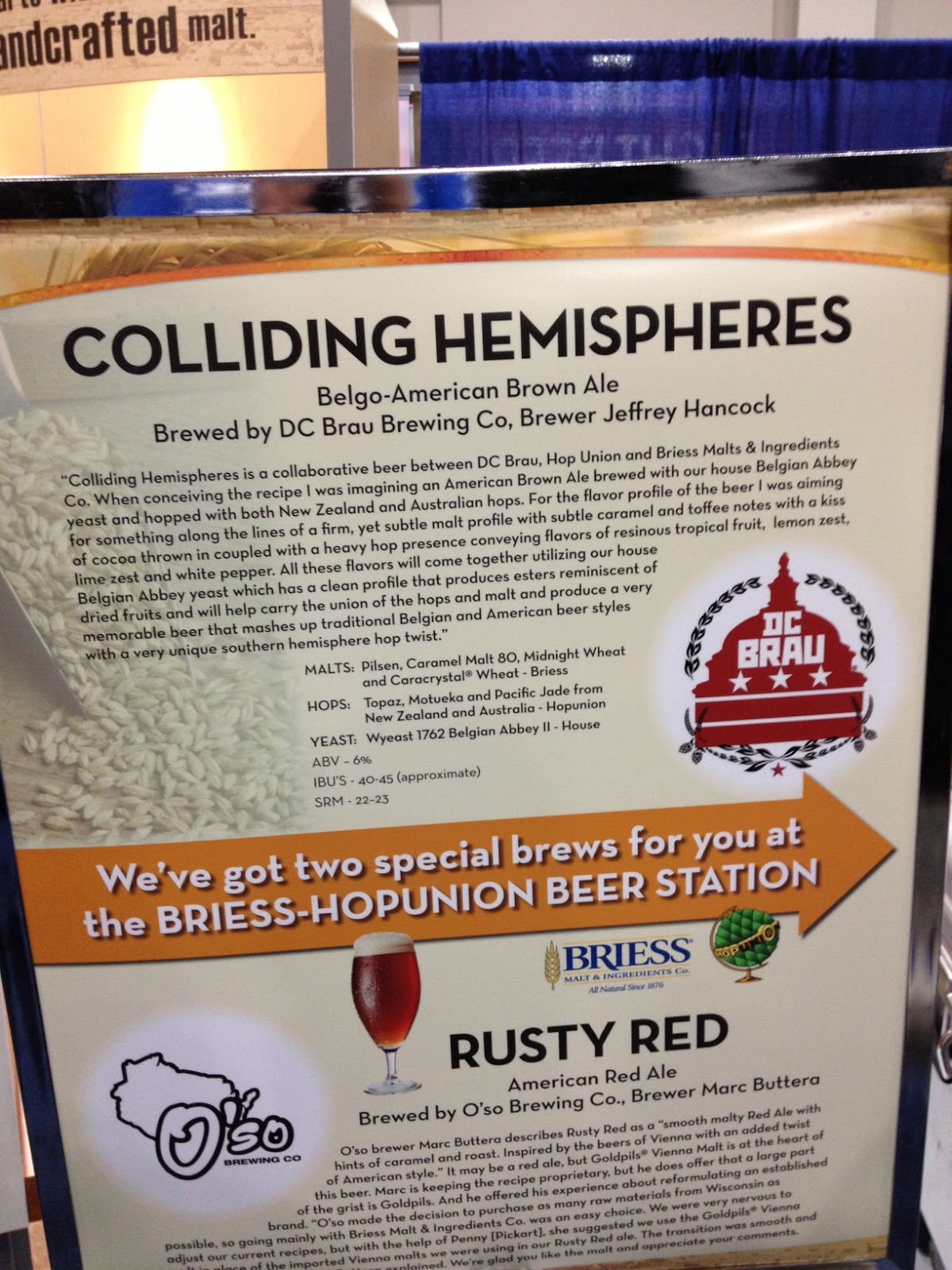
The 2013 Craft Brewers Conference Wrap-Up Post: Photojournalism!

From Monday, March 25th to Friday, March 29th, 2013, Washington, DC hosted the Craft Brewers Conference. Thanks to DCBeer.com, yours truly got to attend. This is what happened.

Tuesday afternoon I checked into the conference, as both Monday and Tuesday were pre-conference days and move in days for the exhibitors.

Every conference gives you a totebag, only this one
gives you beer. Pay attention, library conferences!
I opened this beer a few days later. There's a nice rye bite to this pilsner brewed specially for the Craft Brewers Conference by The Brewer's Art, DC Brau, and Devils Backbone.

On-site reception, courtesy of German hops growers.
The room smelled nice. 

Because, you know, science! 
I left the convention center and headed over to Churchkey, which put on an event featuring saisons, ales fermented with Belgian and Belgian-style yeasts originally made in farmhouses for workers in the fields. Beer geeks will be pleased to know that I sampled offerings from Hill Farmstead, Crooked Stave, Tired Hands, Jester King, and more.

From there the next stop was the Smithsonian National Air and Space Museum, for the conference welcome reception.

I'm in the National Air and Space Museum!
Drinking beer!

Towards the end of the event I found Heavy Seas, out of
Baltimore. They claim to produce more real ale than
anyone else in the United States, and brought a cask of
their Loose Cannon IPA with Cascade hops in the cask.
Yes, please. 

Beer and rockets. That's what it's all about, kids.
"I feel alive, so alive."  
I was happy to see DC Brau’s Brandon Skall, who’s been coming to this museum since he was a toddler, pouring beer there. If it was a cool feeling for me, imagine how he felt.

Selfie of the beer I brought into the Air and Space
Museum, just to prove that I brought beer into a
Smithsonian Institution. No ducky face. 
The conference began on Wednesday morning with a general session full of facts about the beer industry and a keynote from Kim Jordan of New Belgium. Said facts:

  • There are 2347 craft breweries in the United States, and they sold 13.2 million barrels of beer in 2012.
  • 1254 more breweries are in planning.
  • 409 breweries opened in 2012, though there were also 43 closings. 
  • The most popular style of craft beer is Indian Pale Ale. No surprise there. (The actual most popular "style" is "seasonal," but that encompasses at least 4 styles, one for each of the seasons.)
  • Amber lagers and wheat beers are on the decline.  

The conference schedule is posted here. At about 11:15am this session ended and the beer started flowing in the BrewExpo Exhibition area, which was overwhelmingly amazing. What better time for Deschutes Chainbreaker White IPA or a Sun King Cream Ale than 11am?

An Alsatian hop grower showcasing the finished product. Aramis, left, may
become a trendy hop. New Belgium is already using in in an India Pale Ale.    
Overall in terms of "it" hops, it looks like Mosiac will be the next big thing. Keep an eye out for it. It's already in use in a double IPA from Great Lakes and is the sole hop in a rye pale ale from Terrapin.

Local beer on tap in the Brew Expo.

A packaging company brought this. Sounds, delicious, no? 
I went to two sessions on the past, present, and future of malt and malting, and I feel like I took a 3-credit course on the subject. A wonderful experience. Here are my notes. Then it was back to BrewExpo.

As you can tell, they had a very good selection at this
station: Sweetwater, Dogfish, Left Hand, New Belgium...

Sly Fox Brewing's new can. Just peel back the lid.
The future!

Yeast man. There's no swag like mitosis swag.

On an eye-opening and perhaps disappointing note, I saw at least three vendors selling flavoring extracts, and one of these had a roster of craft brewers lined up for testimonials. So now I don’t know if there’s any actual chocolate in Rogue Chocolate Stout, one of the examples a vendor showed me, and I don’t know how I feel about that. Does it matter?

Over at DCBeer.com, there is some discussion about whether or not this conference was good for DC's beer scene and the local brewers, who may have been overshadowed by out-of-towners during that week. Praise for the week here, concern here. Cheers.

Thursday, April 18, 2013

Computers in Libraries Wrap-Up, Or, How to Attend a Conference

Last week I was fortunate to attend the 2013 Computers in Libraries conference. Unlike the American Library Association annual meeting, which I often find unwieldy, CIL is just about the right size in terms of attendees, panels, and vendor exhibits.

From looking at list the presentations and panels I attended, you'll notice a few patterns.
  • How information is displayed and presented on the library website, and how that information can be made more user-friendly. Often times this means thinking more like a school media specialist or school librarian than one who works at a university library, thus I attended a few presentations in that track. I find them a refreshing antedote to "big picture" presentations that we couldn't afford to do at my place of work. More on that in a minue. 
  • Managing electronic resources is challenging, especially for someone like me who's charged with these tasks, but has nothing in the way of formal learning, and very little in the way of informal learning. 
  • Demonstrating the value of said resources, and more, and then displaying and presenting that value in a way that is persuasive to stakeholders. 
  • I also want to be if not on the cutting edge, at least slightly behind it in terms of larger trends in larger libraries. Though my current place of work definitely does not fit that bill, I've worked at R1 institutions in the past. Much of what's presented at these panels doesn't apply and can't apply, to my current place of work, but it's nice to know what's out there and who's doing what.
Monday

D101 ● BYOD: Bring Your Own Device
10:00 a.m. – 10:45 a.m.
Jill Hurst-Wahl, Director, & Christopher Lawton, Program Assistant, Library & Information
Science Program, School of Information Studies, Syracuse University
Kateri Abeyta, IT Manager, Denver Public Library
Mobile devices are quickly becoming an essential element in both personal and workplace productivity. Library IT staff are faced with the challenge of maintaining network security with the flexibility of a mobile workforce. All types of libraries are being impacted by BYOD, whether they realize it or not. Do you have policies and guidelines in place regarding these devices? Our speakers share some insights, and then the audience shares their insights with their colleagues.

B102 ● Seven Deadly Sins of Websites
11:30 a.m. – 12:15 p.m.
Casey Schacher, Resource Discovery Librarian, &
Paige Mano, Web Communications & Social Media Coordinator, University of Wisconsin
Tony Aponte, Science & Engineering Librarian, UCLA
Is your library site all it could be? Far too often, library websites harbor major usability and design issues that prevent patrons from easily accessing the wealth of resources available to them. Speakers evaluate real-world library websites using authoritative guidelines and reveal the most common usability and accessibility sins being committed. Find out how your library website stacks up: Is it a sinner or a saint?

D103 ●
Innovative Library Tech: Practices & Services
1:30 p.m. – 2:30 p.m.
Carol Watson, Director; Maureen Cahill, Student Services Librarian; & Wendy Moore,
Acquisitions Librarian, University of Georgia Law Library
How is your library evolving? To meet changing demands at our institutions, many libraries have undertaken innovative technology initiatives over the past few years. Our libraries can develop best practices from sharing the results of our experiments with new services with each other. This is your chance to participate in an open forum. This session uses the “fishbowl” format to engage audience members in a discussion of creative library technologies. Speakers facilitate comments from audience participants in the fishbowl and encourage discussion from the audience as well on topics ranging from the latest whizbang gadgets to effective technology instruction tactics.

D104 ● Metrics, Value, & Funding
3:15 p.m. – 4:00 p.m.
Rebecca Jones, Managing Partner, Dysart & Jones Associates
Moe Hosseini-Ara, Director, Service Excellence, Markham Public Library
This interactive session starts with an overview of what metrics to look for and how to develop them from experienced librarians. It then proceeds with a whole-room discussion and brainstorming on how to get the right data to make an impact to funders and stakeholders

E105 ● Misinformation, Autopilot Thinking, and Credibility:
Teaching Information Evaluation
4:15 p.m. – 5:00 p.m.
Debbie Abilock, Co-founder, NoodleTools, Inc., Palo Alto, California
How does misinformation originate and spread? What cognitive factors come into play when students evaluate sources? And what can we do to teach them to de-bias their judgments? Ignite your teaching by learning to model quick-and-dirty “rules of thumb” that students can use or revise when they evaluate sources during short research tasks. And, conversely, learn when to add “points of friction” into your instructional design, so that your students will be willing to think deeply when their research project is “worth it.”

Tuesday

C201 ● Metrics That Work
10:00 a.m. – 10:45 a.m.
Karen Krugman, Chief, Research Library & Archives, Export-Import Bank of the United States
Kris Vajs,Chief Librarian, Research Library, Board of Governors of the Federal Reserve System
Karen White, Senior Librarian & Team Lead, USAID Knowledge Services Center
Are senior leaders getting the right message from your management reports? Are your reports a useful vehicle for your department or just part of the routine information you deliver to your manager? Do you want to learn how to communicate the importance of all of your library’s contributions to your organization but find that your metrics lack substance? Join our experienced leaders for this practical session to learn why management reporting is so critical for libraries, discover current management reporting trends, hear about management reporting at three federal libraries and see sample management reports, learn what statistics to track, how to turn them into real management information, and how to present your metrics effectively. Included are a list of metrics you can use in your own management reports.

B202 ● Creating a Culture of Usability
11:30 a.m. – 12:15 p.m.
Krista Godfrey, Web Services Librarian, Memorial University of Newfoundland
Paulette Hasier, Manager, Research Services, &
Jessica Sanders, Research Specialist, ARTI (DOD Contractor)
Library websites are slowly transforming into powerful, and more importantly, easy to use tools. In order to develop the latter, it is essential to perform constant and consistent usability testing. Hear how Memorial University of Newfoundland is trying to create a culture of thoughtfulness toward our users through the establishment of a web usability team. Learn why usability is important, how it implemented the new team and directions the schools are going in. Then hear how one library paid attention to the evolving needs of users, employed user-friendly open source tools to engage clients, created collaborative spaces, and improved the UX with new information delivery functionalities and mobile solutions.

A203 ● Negotiating Econtent & Tech Licenses
1:30 p.m. – 2:15 p.m.
Mike Gruenberg, Gruenberg Consulting, LLC, & Author, Buying & Selling Information: A
Guide for the Information Professional & Salesperson That Ensures Mutual Success
Richard Hulser, Chief Librarian, Natural History Museum Los Angeles County
By setting clear goals and expectations, information professionals can make the most of the meeting and develop a mutually beneficial relationship with the content sales people. Get tips from a long-time salesperson, supporter of libraries, and recent author and from a librarian who has been on both sides—sales and purchase!

A204 ● Institutional Repositories
2:30 p.m. – 3:15 p.m.
Julian Aiken, Access Services Librarian, Yale Law School
Hollie White, Digital Initiatives Librarian, Duke Law School
Duke and Yale Law schools have two of the most successful open access online institutional repositories in North America. Delivering more than 12,000 objects and 2-million-plus downloads to a global audience, the Yale Law School Legal Repository and the Duke Law Scholarship Repository are turning into indispensable resources for scholars and practitioners across the world. Join our speakers to hear how these two law schools are using their repositories to extend the global reach of their scholarship, and enhance their value within the academic community. Topics include platforms, permissions, staffing, workflows, outreach, and publicity.

E205 ● Open Educational Resources and the Open Web
4:15 p.m. – 5:00 p.m.
Heather Braum, Digital and Technical Services Librarian, Northeast Kansas Library System,
Lawrence, Kansas
Gary Price, INFODocket and FullTextReports, Washington, D.C.
Join two experts on the vital subject of finding free educational resources online. First, Heather Braum discusses open educational resources, a rising trend in classrooms, in libraries, and in DIY education circles. Learn how you can make the move from traditional textbooks and classroom resources and discover the what OER has to offer your library, school, and community. Then, hear veteran web resource locator Gary Price discuss discovery and finding tools, techniques, and even the necessary mindset you need to unearth the best digital content for education—so you can serve up just what’s needed for that social studies class, just when it’s needed.

Wednesday

B303 ● Evolving Tech Services to Manage & Discover E-Resources
1:30 p.m. – 2:15 p.m.
Li Fu, Digital Services Librarian, &
John Coogan, Systems Librarian, University of Maryland University College
Candice Kail, Web Services Librarian &
Colleen Major, Electronic Resources Librarian, Columbia University Libraries
Both of these libraries are transitioning their technical support functions to ensure access, discovery, assessment, sharing, and development of digital content and applications. Hear how these libraries are shifting their approaches to authentication, link resolvers, discovery tools, cataloging, usage statistics, web technology, the relationship between e-resources and virtual library environment, and the influence this is having on staff in systems and technical services.

A304 ● New Face of Reference
2:30 p.m. – 3:30 p.m.
David Stern, Associate Dean, Public Services, Illinois State University
Crystal Shiffert, Reference Librarian, Monroe County Library System
Shari Clayman, Internet Reference Librarian, &
Abbey Gerken, Assistant Library Network Coordinator, ASRC Primus, EPA
Krista Schmidt, Research & Instruction Librarian/Science Liaison, &
Joel Marchesoni, Technical Support Analyst, Western Carolina University
Stern talks about shared workspace collaboration tools and describes the use of a shared workspace for manipulating multiple media materials and the sharing of real-time workstation screens to understand and demonstrate more sophisticated search methods and to facilitate the mastery of more advanced tools and techniques. While increasing collaboration and interaction at a distance, remote control is also the next step in offering advanced instruction, assistance, and collaboration. The next two presentations include reference librarians who partnered with a library technical support analyst and a vendor to develop a tablet-based app and a mobile app to extend reference service. The last talk focuses on how an ask-a-librarian service leverages the time and expertise of EPA librarians across the country to present a unified service to all EPA staff. It shares lessons learned during the last 3 years and future plans.

C305 ● Data: Digging Deeper & Displaying
3:45 p.m. – 4:30 p.m.
Jeff Wisniewski, Web Services Librarian, University of Pittsburgh
Data you gather is just data until it is analyzed, interpreted, and conveyed in a meaningful way. With Google Analytics incorrect conclusions can be drawn without doing an in-depth analysis. Wisniewski provides a framework for accurately assessing the data to make informed design decisions in combination with other user tests, surveys and focus groups. See how Pittsburgh is mining data to learn about user behavior.

My notes on these sessions may or may not be useful to you. They're not as good as these notes. But here they are, all the same.


Here is a link, via Storify, to my tweets during the conference. I'm a big believer in using the back channel during conferences.

A full conference program, in pdf, is here.

Wednesday, April 3, 2013

It's baaaack! The BeerBrarian's Guide to Computers in Libraries 2013

Since I live in DC, I thought an insider's perspective might be useful for the upcoming Computers in Libraries 2013 conference, which meets at the Hilton just north of Dupont Circle.

A brief word about the guide:
With a few exceptions, anything posted below have been vetted by me. These are places I frequent, or at least have been in. Not mentioned is that west of the conference there are many embassies, which would be a nice walk during breaks, or after the sessions have ended for the day.

There are some dine arounds, but they're at very pedestrian restaurants. I understand the distinction between a good meal and good food, so if you're doing one of these, it's for networking and the company, and not what's on your plate.

The Washington Post has a guide to the area. It's a bit unwieldy, but comprehensive.

I write for DCBeer.com on the side. Here's their guide to beer in the area.

If you're familiar with Dupont Circle and think I missed anything, please let me know.


View Computers in Libraries in a larger map

Cherry blossom season in DC will hit its peak between April 3rd and 6th, right before Computers in Libraries. The Washington Post has put together a handy graphic on the Tidal Basin area.