Tuesday, February 26, 2013

January - February Beer Roundup

There's been much 'brarian-ing in this space, but not much beer-ing. In large part, this is because much of the latter is taking place over at DCBeer.com. Here's what I've been up to.

The most exciting news is that DC is getting yet another brewery. Hellbender Brewing Company has a location, and, like other DC breweries, they're taking advantage of DC's surfeit of industrial-zoned space on the east side of the city, not too far from where I live. In fact, this may be the closest brewery to my house, no small feat given the locations of the other three. You can read more about Hellbender here, and stay tuned for more updates on this brewery.


View Washington, DC Breweries in a larger map

The second bit of news is that we all got together to make a Kolsch-style ale. It's lagering as I type this.
Temperature control! Pic via DCBeer.
In addition, it's Girl Scout cookie season. They're delicious, beer is delicious, so why not pair them? Here's a sample:
Trefoils: Deus. Bubbles cut the buttery fat of the cookies basically treating this like sparkling wine and brie. Saisons tend to have higher carbonation than most kinds of beer, and would also work here Sierra Nevada's Ovilia saison and Ommegang Hennepin. Another option is to go with a more mild, flavor-wise, beer, like kolsch (Reissdorf, Gaffel, Schlafly or a pilsner on the lower end of the bitterness units scale for that style, like Eggenberg.
It's also hoppy beer season. Hopslam has come and gone, but the next round of Stone's "Enjoy By" IPA will hit shelves soon (April, 1st, 2013 edition) in Maryland, and Troeg's Nugget Nectar is plentiful. I wrote about these beers here.

Next month the Craft Brewers Conference comes to DC, which I'll be covering for DCBeer. Watch this space as well. Cheers.

Wednesday, February 20, 2013

Vine and Web-based Library Instruction

Imagine webpages that contain brief recursive videos, each one serving a different purpose for library instruction. Interested?

The versatility of Vines is perhaps its most important feature. Vines, by virtue of being six seconds long and looped, may be a middle ground between more effective image capture (Mestre, 2012) and more popular video-based instruction that too often taxes short-term memory (Oud, 2009). A series of Vines allows more advanced users to skip over the redundant, and enable non-linear instruction as each Vine can be a piece of a whole.

Quick, simple, elegant, Vine offers something more than a snapshot, but less than a three-minute tutorial in which one's eyes glaze over, or constantly pause and rewind to keep up. However, what Vine doesn't have is a a way to capture a website, instead relying on using a mobile device's camera pointed at a screen. Observe: http://vine.co/v/b6nzQxU1vjI.

Crude. Not entirely effective, but perhaps it shows promise, keeping in mind I held a smart phone in one hand with a laptop on my lap. Consider this a plea to Vine: please allow for six second, web-based screen captures. Please. Also, making Vines easier to embed would be nice, as the current way has you go through Twitter.
Over on Matt Anderson's blog there's a post about using Vine to promote library services and build a brand. Are you using Vine in your library, and if so, how? Let me know.

UPDATE, 2/25/13: Shelf Check also has a Vine post on tutorials.

Mestre, L. S. (2012). Student preference for tutorial design: A usability study. Reference Services Review, 40(2), 258-276. doi: http://dx.doi.org/10.1108/00907321211228318

Oud, J. (2009). Guidelines for effective online instruction using multimedia screencasts. Reference Services Review, 37(2), 164-177. doi: http://dx.doi.org/10.1108/00907320910957206

Wednesday, February 6, 2013

Copyright for Educators

Earlier this month a faculty member asked me to present to her class on technology for educators on copyright and fair use. Evidently, word got around campus that I was the person to see on such matters. It was a last minute request, but much of the time I spend in classrooms is teaching library instruction and information literacy "one shot" sessions, and this looked like a nice change of pace, beyond the importance of these issues.

I started with Kanye West's "Gold Digger," which I thought, correctly, would immediately command the students' attention. The song samples Ray Charles' "I Got a Woman," which, in turn, borrows heavily from spiritual songs called "I Got a Savior" and "Jesus Is All the World to Me." The purpose of this is to introduce complex issues of creation and ownership from the start. In light of all these samples, who owns "Gold Digger?" Who created it? I got the idea for this from chapter six of James Boyle's "The Public Domain: Enclosing the Commons of the Mind."


I then discuss the copyright clause of the Constitution of the United States of America, emphasizing the "limited Times" to be granted to copyright holders.
To promote the Progress of Science and useful Arts, by securing for limited Times to Authors and Inventors the exclusive Right to their respective Writings and Discoveries. 
- Article I, Section 8, Clause 8
The reason for the restrictions on copyrights are so that not only can authors, inventors, and other creators benefit from their work, but also society, writ large, after a given period of time. Others will have an opportunity to build off of the initial creations.

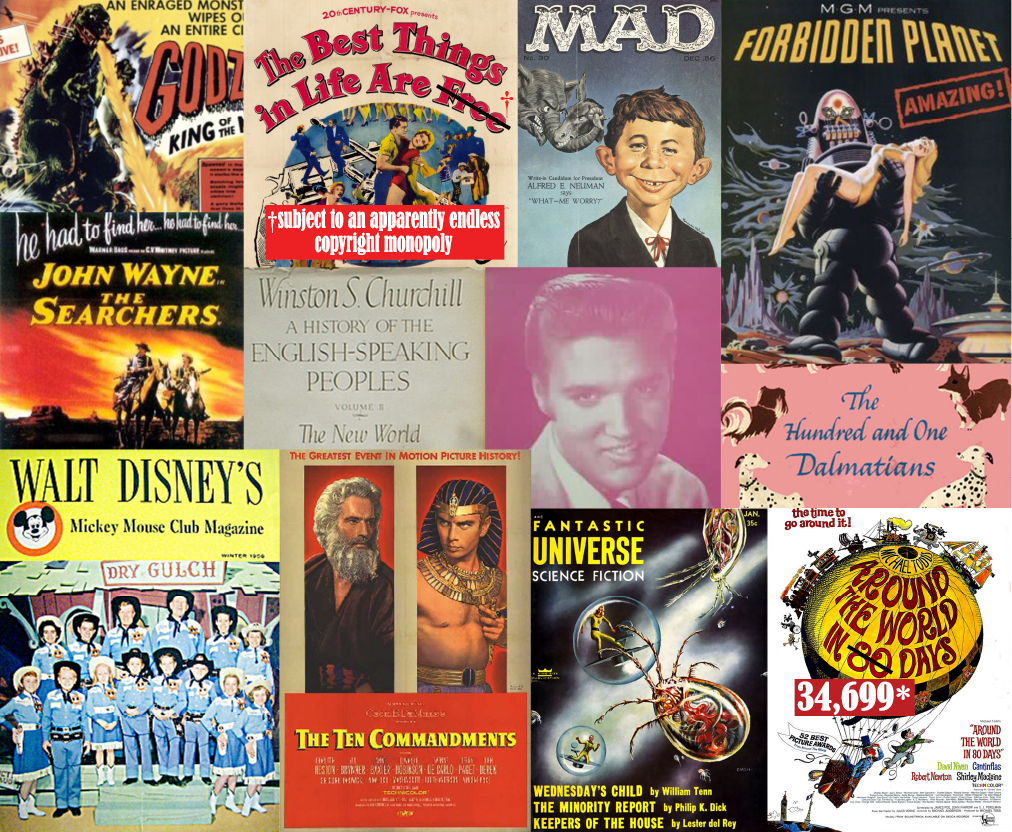
However, in practice, this limited amount of time is becoming less so, as copyrights are extended long beyond the historic norm. All of the following works would have entered the public domain, that is, the rights of ownership would have expired, on January 1st, 2013 under the pre-1976 copyright regime. However, now they will enter the public domain in 2052. One can only assume that in 2051, these rights will be further extended.
Source: http://web.law.duke.edu/cspd/publicdomainday/2013/pre-1976 
Educators can use copyrighted works, with some limitations, under the doctrine of fair use, enumerated by 17 USC § 107:
the fair use of a copyrighted work, including such use by reproduction in copies or phonorecords or by any other means specified by that section, for purposes such as criticism, comment, news reporting, teaching (including multiple copies for classroom use), scholarship, or research, is not an infringement of copyright. 
More here.
I expand on the classroom, being not just a physical space, but also a digital, virtual one. Course management software, like Moodle or Blackboard, are classrooms. Fair use is in effect there, too. Just ask Georgia State University and the University of California at Los Angeles. In sum, an intranet is a classroom.

To help determine what can be used fairly, I point students towards the excellent resources at the University of Minnesota. There, copyright librarian (!) Nancy Sims has created and curated an impressive selection of tools for librarians, educators, and copyright holders. Like Ms. Sims, I take a liberal view of what can be used for educational purposes, and emphasize this to students.

Both Creative Commons and the open access movement provide important counters to copyright regimes, in that copyright holders themselves can help liberate their works. I show students both the Directory of Open Access Journals and the Directory of Open Access Books, as well as discuss Creative Commons licensing.

I conclude with letting students, future teachers in particular, that they should not only know their rights, but flex them, which means distributing, time-shifting, and remixing in the classroom, be it a physical or virtual location. And as always, I end with a mic drop.

Source: http://awesomelyluvvie.com/wp-content/uploads/2013/01/KanyeDropsMic.gif

Copyright in Edu by

Friday, January 25, 2013

The Price of Scholarly Materials, Politics, and Access


Here is the full text of an email I just sent to a faculty member and cc'd to the Provost and Vice President for Academic Affairs. Let's watch what happens, shall we.
Dear [redacted],
Currently all books, save the [redacted] text, have been purchased and will be put on reserve if they have not already. We are considering purchasing the [redacted] text as well. However, under the current textbook paradigm there is a moral hazard, in which the library is supposed to make up the difference between the “perfect” text and a “good” one. This paradigm is unsustainable. If the price of a textbook is the primary factor in whether or not a student will add or drop a course, it is incumbent on faculty to take that into consideration when assigning materials.
Best,  
Jake

Wednesday, January 23, 2013

Outsourcing Technical Services: Some Thoughts on Columbia and Cornell


Last week, while libraryland discussed important issues, like the death of Aaron Swartz, and somewhat less important ones, like rockstars and egos and feelings, something very interesting happened that didn't get enough attention: Columbia and Cornell Universities are going to merge their Technical Services departments, expanding on a partnership, called 2CUL, formed in 2009.

The impetus from the initial collaboration was borne out of, in no small part, preexisting budget cuts. I worry, however, that in this latest move cause and effect have changed places. In 2009, Cornell University Librarian Anne Kenney said the partnership “will ameliorate the impact of  budget cuts while building our libraries' ability to innovate” (LJ, 2009). It was, and is, a clever solution to a series of problems concerning funding, non-English cataloging, data management, and digital preservation, among other topics, which has proved fruitful based on recent reports, quoted from a press release below, from 2CUL.
  • “Allowing Columbia and Cornell faculty, students and staff to borrow materials from either library on-site and expedite access through intercampus loan delivery; 
  • Building joint collections and sharing librarians and language expertise to expand access to more global resources in Asia, Latin America and Russia/Eastern Europe; 
  • Uncovering issues for long-term preservation and access to e-journal literature; and 
  • Creating programs to give tailored support for Ph.D. students in the humanities.” (Press Release)
Both Cornell and Columbia staff are taking great pains to note that this recent, upgraded relationship was not a merger, and a press release, again quoted below, favors the word "integration" instead, but make no mistake, this is going to cost some jobs and save some money. Job losses are, at the least, a positive externality for the two schools, in which Technical Services staff make up approximately twenty percent of library employees, if not part of the plan.
“This partnership goes far beyond avoiding costs. It extends to changing the way we think about staffing, task and expertise distribution and workflow design.” (Press Release)
It also begs the question that if two universities a four-hour drive away from each other can integrate some library departments, can it be done between schools, or libraries, that are a four-hour plane ride apart? What about a twelve-hour flight? Can Technical Services for Slavic-language materials be performed in a Slavic-speaking country? Might it be cheaper? Might some vendor capitalize on this idea and license it out to libraries? At what point does distance become a barrier?

For example, there are already digital preservation firms located in border states that take materials to Mexico where digital preservation and reproduction is significantly cheaper than it is in the United States. Is that the future of Technical Services as well?

Additionally, while partnerships, such as consortia, are formed by groups of libraries to benefit member institutions, there is a "feed the beast" mentality that often appears. 2CUL was formed to serve Columbia and Cornell, but it may not be long before Columbia and Cornell serve 2CUL in some way.

Regardless, kudos to Columbia and Cornell for truly thinking outside the box. If the merger costs jobs, as I suspect it will, I hope the losses are minimized to the extent possible. I also hope it doesn't give too many vendors too many ideas.

(Full disclosure: the author worked the circulation desk at Columbia University's Butler Library in 1999 and 2000.)
Image via http://www.future-shape-of-church.org/?e=71

Thursday, January 17, 2013

Makerspaces, 3D Printing, & Libraries

Thesis I: 3D printing is better-suited to public libraries, which already have a wealth of programming options, like butchery and homebrewing.
There, 3D printing takes place alongside other "community center" events, as opposed to "literary" events, though it's important to note that these two categories are not mutually exclusive. One can print a book, which is a three dimensional object, for example, and one can also read about homebrewing and then experience it at a library.
Thesis II: 3D printers make sense at large, R1 institutions, but they will probably end up in a lab, run by a department or departments, much in the same way that computing, science, and engineering equipment isn't often, or ever, found in a library.
That is, there are already communities of makers on many university campuses, whether they code or create objects in laboratory conditions. Those already-existing places make more sense than a library for a 3D printer. That being said, I am in favor of anything that gets people into the physical library space; if a 3D printer is one of those things on your campus, then by all means advocate for it. But please realize you may be lobbying against other departments and spaces on campus. 
Corollary: Beyond the "next big thing," which I think 3D printers will be, they seem to exist as a wish fulfillment fantasy for academic librarians because "making stuff" is a powerful alternative to the research paper. Every single research paper is 1) an invitation to plagiarize, and 2) a reminder to library staff that the way research is conducted is a miserable experience, fraught with friction.
1) Librarians and library staff are sick of research papers. The assignments are often poorly worded, full of grey areas that students interpret how they please, a danger zone in which plagiarism flourishes. Those that are not vague are overly-detailed to the point where the assignment may be longer than the paper. Students become so focused on following the rules of the assignment that they lose sight of what's important about research papers: finding stuff, interpreting it, and making credible and logical arguments. Panic may set in, which leads to plagiarism. 
2) In my heart of hearts I believe that the majority of students do not plagiarize. When students conduct research, they first use a search engine, almost always Google. They will be unable to distinguish between scholarly and/or authoritative resources and total crap. Savvier students will skip ahead to Google Scholar, where they'll be confronted with paying $42.99 for twenty-four hours of access to an article in pdf format. They will read abstracts and cite them as if they had read the full text of the article. Then, and only then, will they proceed to the library, either in person or via the library website, and that is where the friction happens. Search the catalog, then databases?, or use a "discovery" service that delivers everything at once, akin to drinking from a fire hose, wading through hundreds if, not thousands, of barely relevant results? That the research experience stinks is a painful reminder to librarians as to their, our, limitations, and failures in creating positive user experiences.
The research paper has a place, maybe even still a paramount place, in academia, but it should not be the only assignment given. Three dimensional printers are an expression of this discontent; "If only we academic librarians worked in a place where people actually 'made stuff.'"

In addition, 3D printers also capture the zeitgeist, tying into the rebirth of people who actually are making stuff. Leather workers cobbling shoes and wallets in Maine, and posting on Vimeo; the artisanal pickles at the farmers market; and yes, even craft beer; all these things are related. They do not take place in vacuums.

Discuss.


If you'd like to read more on the "3D printers at the library" debate, here are some good places to go:

http://hughrundle.net/2013/01/02/mission-creep-a-3d-printer-will-not-save-your-library/
http://quartz.syr.edu/blog/?p=2538
http://andromedayelton.com/blog/2013/01/04/3d-printing-library-missions-and-things-beside-the-point/

Friday, January 11, 2013

A Rant On Vendor-Librarian Relations

It's January 11th and we already have our first misguided, librarian-penned, article on libraries of 2013. In the spirit of the late, great Fire Joe Morgan, I'm going to break this one down. The article in question is "Six Mistakes the Library Staff Are Making," and you can read it here, though I'll heavily excerpt below.
What follows, then, is a combination of things boiled down into six points — the most commonly reported and (in my estimation) most important mistakes that library staff are making in their dealings with sales reps. 
1. Rudeness/unprofessionalism. Let’s begin with the most egregious and patently unacceptable of the mistakes listed here — rude and unprofessional behavior. Examples include: treating a sales rep or customer service staffer with discourtesy or derision; treating the rep like one’s personal therapist; unilaterally inviting a spouse or friend to a meal hosted by the rep; or failing to show up for appointments on time (or at all). 
Like the author, I will also plead guilty to the first instance of this category, though I suppose it's worth mentioning that as a conversation drags on, see item 2, below, the more frustrated I may become. I often, more than once a day, get cold calls from sales representatives who know nothing about this library, what library staff do, and the communities we serve. To the extent that one can do research ahead of time and recognize the milieu in which we find ourselves, which includes a consortium that may hamstring our ability to purchase materials, the more seriously a sales representative will be treated. Cold calling me to change our ILS is a nonstarter. Do your research.
2. Squandering one’s time with the rep. Wasting the rep’s time by forgetting a meeting or spending it on personal complaints falls under the category of rudeness and unprofessionalism, but squandering the time one has with the rep is a different matter. This is about failing to take into account the extremely limited opportunities that one has to work in-person with the sales rep, and consequently spending that time on activities that could and should have taken place before the meeting, or on conversations that could just as easily take place by email, or on issues that would be better addressed with a member of customer service staff.  
No. No no no no no no no. No. NO. I am not the one wasting time here. When I get cold called, my time is being wasted. There are two full-time staff here; I have better things to do than listen to a vendor try to sell me something. If I want something, I will initiate contact with a vendor. "But Jake, how do you know what's out there," you say. Well, dear vendor, that's what networking is for. That's what the internet is for. If I'm interested, I'll contact you. I'll come to your booth and take a pen and some candy (note: I will probably do this anyway). If I'm going to buy something from a vendor, there is no limit to the in-person opportunities. Seriously. We're working with a vendor right now on a Discovery platform. If I call this nameless vendor up right now, a representative will be in my office tomorrow. It's that easy. Vendors who don't provide this level of service are missing out. But I won't do that, because my time is precious, more precious than that of any vendor given our budget and level of staffing compared to theirs.

Similarly, after being given a five-minute version of an elevator speech, and on the phone it seems like an eternity, I don't really want to give a vendor feedback on their business model, as I'm often asked to do, or to recommend other libraries and/or library staff to be given the same sales pitch. If you'd like to hire me as a consultant, that's fine. I'll at least listen. But don't try to get that information for free.
3. Knee-jerk adversarialism and distrust. Many of my vendor-side informants bemoaned what they feel is a knee-jerk adversarialism on the part of many librarians and their staff. Now, some library-side readers will roll their eyes (“Of course our relationship is adversarial; you want our money, and we want what’s best for our patrons”), but the reps have a point. As rhetorically convenient as it might be to cast the library-vendor relationship as one of white hats vs. black hats, it should be obvious to any reflective person that the reality is far more complex than that. 
Based on what I've written above, I come across as adversarial. I understand that, and to the extent that I'm propagating that norm or stereotype, I'm sorry. But relations with vendors are often something like a power law. Ninety percent of my interactions with vendors are cold calls and solicitations. Yet those interactions do not take up anywhere near ninety percent of the time I spend with vendors. Rather, those ten percent of meetings, in person, on the phone, vie email, or otherwise, with sales representatives are fruitful, productive, and time-consuming. It is a disservice to many vendors to treat them with distrust, but there are also some who earn that, and they can earn it rather quickly if they don't do their research.
4. Failure to prepare for meetings. Before you meet with your sales rep, prepare an agenda. Send it to the rep ahead of time, and invite him or her to contribute to it. Know what will be discussed, prepare any documentation that will be needed in order for the meeting to be productive, and know what you hope to accomplish by the end of the meeting (as well as how you’ll know whether it was accomplished). If the rep provides spreadsheets, analyses, or specs ahead of time, you and your staff should read them beforehand so you’re not wasting time in the meeting trying to absorb the information they contain. 
Valid points, all. But I don't call meetings with vendors without doing this work, and I hope you, dear reader, don't either. It's sad that this needs to be said, and is even more sad that a librarian is the one saying it. As mentioned above, the majority of planning fails aren't on me, or library staff, they're on vendors who solicit having done no research on my library. It breeds distrust and adversity. 
5. Failure to prepare the ground for product consideration. One of the surest ways to waste both your time and that of your sales rep is to instigate trial access for a product that you know perfectly well you will never purchase, or for which it is not clear that there is real demand. Trials and pilot programs create work on both sides of the sales equation, and it’s important that the investment not be wasted. 
Confession, we have trialed products here knowing full well they would never be purchased or implemented. We've done it just to get vendors out of our hair, to show them that there's no demand. I'm not sure there's anything wrong with that. I dispute that there's anything wasted by it. At the least, I add a link to the "Trials" section of the library website and email interested parties in the community we serve. I doubt this process has ever taken longer than five minutes.
6. Putting political library concerns above patron needs. I’ve saved for last the “mistake” that I know is likely to be the most controversial, but I think it must be said. Because the issue is so complicated, this will be a topic for a full post at a later date, but for now I’ll just say that it has long seemed to me (and comments from my vendor-side informants seem to confirm it) that too often, we in libraries put politics ahead of mission and service. By “politics,” I mean our personal views about how the world ought to be, and more specifically our views about how the scholarly communication economy ought to be structured. 
Putting politics above mission and communities served is not so much a vendor issue as it is an "everything, everywhere in all workplaces" issue. In the context of library-vendor relations, I don't begrudge vendors profiting off the current state of scholarly communication, but there is a limit to those profits, as some vendors have realized. Even if all content were open access we would still need vendors to solve the coordination game of getting all this "stuff" in one, or a few places, making it as user-friendly as possible, for both patrons and library staff. There's plenty of value to be added by vendors even in the most utopian model.

Furthermore, politics is not just external, around the library, it's internal, within library departments, within a community. Vendors can and do benefit from the latter in the mad rush to allocate resources. The money I choose to spend on Discovery, for example, could go elsewhere. But it's going to a vendor. The allocation and distribution of scare resources, be they money, time, or staff, is politics. 

Keep in mind that this author is himself a library director, and has also written about what vendors and sales representatives should do before meeting with library staff, but does it look remotely equal to you? On which side of the equation does the money and staffing lie? Vendors can and should work harder, work more, and work better to serve libraries and library staff. I'm already on record as that library staff, especially fellow directors, should as well. Because we're the ones with two full-time employees. Not them. We all have responsibilities, but from where I sit, more of the onus is on them.