Thursday, June 13, 2013

SAVOR-Y, 2013 Edition


That song never gets old.

Thanks to the Craft Brewers Conference, SAVOR, an annual festival that pairs American-made craft beer with food, has moved to New York City, where it's having a bit of trouble selling out. So a colleague and I decided to have some fun over at DCBeer.com, letting New York know that the District appreciates good beer, and that we brew our own.
many breweries... claim to be in New York City, but brew elsewhere. Brooklyn Lager and other flagships? Utica, New York, home of the steamed ham. Sixpoint’s cans? Scranton, Pennsylvania (see below). Bronx Brewery’s many pale ales? Pawcatuk, Connecticut. The only major New York City brewery that doesn’t do some contracting is Kelso, which has enough capacity that it has contract brewed for Sixpoint. Take a bow.
Garrett Oliver, Brooklyn Brewery's brewmaster, even took time to comment on the post, and we had a good chat.

We also posted the DCBeer.com consensus top 25 beers of SAVOR. It's hard to pick just 25, but there was a fair amount of overlap between our choices. Here are my 25, in alphabetical order. Compare with DCBeer's.
Allagash FV13, American Wild Ale - Just an excellent sour beer.  
Avery Odio Equum, American Wild Ale - Just an excellent extremely sour beer.
Ballast Point Habanero Sculpin IPA  - The best IPA in America, spicier! 
Bayou Teche Cocodrie, IPA  - This brewery has done some interesting stuff, so it's telling that they waited this long before doing an IPA. Come see how they did. 
Bell's Black Note, Imperial Stout - This beer is highly-sought after, for good reason. You could drink a lot of this beer. You shouldn't, but you could. 
Bell's Raspberry Wild One, American wild ale - A little tart, a little funky.

Bull & Bush Brewery Tunip the Beets, Field Beer  - I might want 2 oz of this, which is what SAVOR is for. 
Boulevard Saison Brett - Perhaps the best example of this style.
Crooked Stave Surrette, Saison - Well, maybe this one. 
Yazoo Brett Saison - Or this one.
Choc Brewing Signature Gose - Choc is single-handedly responsible for resurrecting grazter, a smokey, hoppy, Prussian wheat beer. They found a recipe, found the yeast from a Polish homebrewer, the smoked malt from a German producer, and brought it back from extinction. Their gose will be similarly authentic.
Full Sail LTD Bohemian Pilsner
Firestone Walker Pivo Pilsner - Not one, but two breweries are bringing Czech-style pilsners. Fans of American IPAs may be pleased with the hop bite these two bring.
Hops & Grain Brewing Bourbon Barrel aged ALTeration - A barrel-aged alt? 'Murica!
Kane Bourbon Barrel Aged Solitude, Belgian-style dark ale - Kane is new to NJ and they're bringing out the big guns at SAVOR with this beer. 
Lost Abbey Deliverance, American strong ale - "A blend of bourbon barrel-aged Serpent’s Stout and brandy barrel-aged Angels Share." I think there's going to be a line at this table. 
Lost Abbey Saints Devotion, Belgian pale ale - The reason people geek out over this brewery is because of beers like this.
Schalfly Kolsch - I'll put this here every year. Also, it's now available for purchase in NY. 
Schalfly Single Malt Scottish Style Ale - Beer that tastes like scotch, and beer. It's so good I devoted an entire post to it. 
Shorts Goodnight Bodacious, Imperial American Black Ale - It's from Shorts, so you'll know you'll want 2 oz of it.
Spring House Brewing Co. Big Gruesome Chocolate Peanut Butter Stout - Dessert is served!
Starr Hill Monticello Reserve Ale, wheat beer - A little bit of history in a glass, brewed using Thomas Jefferson's "recipe." 
Three Floyds Zombie Dust, Pale Ale - It's in your head, it's in your heaaaad, citra, citra, citra-a-a-a!
Three Floyds Tiberian Inquisitor, Belgian-style pale ale - Aged in Chardonnay barrels, this one could be a keeper from a brewery that know what they're doing.
Yazoo Embrace the Funk Series “Wild Child,” Smoked Porter - This is a collaboration with a beer blogger, which is every beer blogger's dream.
In addition, SAVOR bills itself as "an American food and beer experience." We thought these pairings would hit the mark. Personally speaking, here's what I went with, in no particular order.
Founders Brewing Company Rubaeus  • Table Group 5
Paired with Shortbread Biscuit with Stilton and Pear  
Denver Beer Co. Rauchbier  • Table Group 8&
Paired with Eggplant Caponata on an Olive Oil Financier  
Terrapin Beer Company Side Project 19 Mosaic • Table Group 2
Paired with Bitter Chocolate Bon Bon with Passion Fruit and Mesquite Salt  
Santa Fe Brewing Company Freestyle Pilsner  • Table Group 3
Paired with Tomato Rasam (Southern Indian Stew) with Coriander and Cumin over Lentils  
Willoughby Brewing Company Peanut Butter Cup Coffee Porter  • Table Group 12
Paired with Black and Tan Brownie with Butterscotch and Pretzel Bite  
Captain Lawrence Brewing Company Smoked Porter  • Table Group 6
Paired with Pulled Chicken Taco with Black Mole

The Bruery Sans Pagaie  • Table Group 1
Paired with Tart Apple and Brie in Puff Pastry  
Brooklyn Brewery Black Ops  • Supporter Circle
Paired with Chicken Liver and Chocolate  
Cigar City Brewing Jose Marti  • Table Group 12
Paired with Glazed Short Rib of Beef with Soft Polenta and Crispy Leeks  
Burnside Brewing Company Sweet Heat  • Table Group 11
Paired with Jumbo Lump Crab Cake with Corn, Sweet Pepper and Citrus  
Bonus pairing! 
Upland Brewing Company Dantalion Dark Wild Ale  • Table Group 10
Paired with Demisphere of Grape Wrapped in Goat Cheese and Pistachio
A full list of beers and beer pairings is here. Check back next week to see how we did.

Cheers.

In older SAVOR news:
http://beerbrarian.blogspot.com/2012/06/savor-2012-wrap-up.html
http://beerbrarian.blogspot.com/2012/04/savor-y.html
http://beerbrarian.blogspot.com/2011/06/savor-wrap-up.html

Monday, June 10, 2013

Exit, Voice, and Loyalty in the Academic Library

Fully 91% of Americans ages 16 and older say public libraries are important to their communities; and 76% say libraries are important to them and their families. And libraries are touchpoints in their communities for the vast majority of Americans: 84% of Americans ages 16 and older have been to a library or bookmobile at some point in their lives and 77% say they remember someone else in their family using public libraries as they were growing up. 
Still, just 22% say that they know all or most of the services their libraries offer now. Another 46% say they know some of what their libraries offer and 31% said they know not much or nothing at all of what their libraries offer. (Library Services in the Digital Age, Pew Research Center)
Ahh, libraries. Never more important, and never more irrelevant. One could be forgiven for thinking that along with declining budgets, libraries themselves, as a concept, are in decline. When faced with this perception, or perhaps the reality, librarians have three options: exit, voice, and loyalty.

Exit means leaving the profession, as at least one librarian has done rather vocally in the last week. Others are thinking about it. The specific reasons for exiting are varied, but stem from dissatisfaction. Exit need not be physical; plenty of people mentally exit their jobs.

Voice means the airing of grievances, and I suspect the majority of librarians fall into this ideal type; seeking to improve libraries and working conditions by speaking up in a variety of media.


Loyalty is the action and behavior of those relatively satisfied with their organizations. We rarely hear from them, and as a result tend to discount their numbers.

Voice takes many forms, but a recent meme is to decry the death and decline of libraries at some future date thanks to current events. Enter the "academic library at risk."

Armed with horrific data about what faculty think of us, never mind that 76% of faculty are adjuncts whose own livelihood is far more tenuous than any academic library's, the "academic library at risk" trope is for the most part unhelpful because it offers alarmist rhetoric without any solutions. To wit:
We will not survive by focusing on what we think our patrons need and ought to want, in contradiction to what our patrons say and believe they need and want. We will not survive by trying to convince them to want what we provide, but only by changing and coming up with new provisions that excite and delight them.
And
We need to change. We need to provide new and different services. We need to preserve some services, but significantly change the manner in which they are delivered.
And
And yes, that means we need to reduce and eliminate other services too. Change is hard. Yes, there are still some staff and patrons who are used to and rely on the services we’ve got now exactly how we deliver them now, and are going to be disrupted and upset by change.
Okay, so I'm cheating, because all those three quotes are from the same article. And to be fair, alarmist rhetoric is not without value. And unlike many other articles I will not link to, these are worth reading. But at what point is an academic institution going to forgo a library? When will it happen, and will it happen because the library becomes nothing more than a website with databases and a discovery service? Who among institutions of higher education is "disruptive" enough to do something truly daring and close a library?

How important are libraries? So important that as soon as opposition occupies physical space, it attempts to build one, as evidenced by recent actions in Turkey as well as the Occupy Wall Street movement. So important that 91% (!) of Americans ages 16 and older say public libraries are important to their communities. And yet, at the same time, not important enough to fully fund. Not important enough to keep people from exiting for monetary reasons.

Focusing on a decreasing percentage of tenure-track and/or full-time faculty to show an academic library's worth and to obtain funding is a fool’s errand. Budget cuts are coming regardless, and have been for some time; appealing to this shrinking group won’t be a bulwark against cuts.

Rather, these cuts originate in state and local governments, and the rise of a bloated administrative class of higher education professionals whose populations sometimes exceed the number of full-time/tenure-track professors, as is the case in the University of California system. It is telling that even climate change denier George Will recognizes this latter point. There are three ways to get tenure: teach, research, and administrate. We can infer from the rise of Massive Open Online Courses, MOOCs, who is in charge and what they think of teaching.

Many academic libraries are playing a game that’s rigged. We may as well focus on what we do best, and that includes student services, whether they are appreciated or not. As a librarian and an administrator, if my library is going down regardless, it’s going to do so on my terms. The primary focus of this library, and, I suspect, most academic libraries, isn't faculty, or administrators. It's students. So I'm concerned that 18% of faculty agree with the statement "Because scholarly material is available electronically, colleges and universities should redirect the money spent on library buildings and staff to other needs," up from 8% in 2006 (Source is figure 44 below), but I'd be a lot more concerned if they came from the people who use our library the most, students.

Download Report

What else do we do best? We have values. We don't give your data away, we don't violate your privacy, and most of us will politely chuckle when you make a Dewey Decimal System joke. We are a "third place," and that includes a place for faculty. And yes, we're more than "just books."

I won’t give up on outreach to administration or faculty; I will continue to use the language of institutional mission statements and strategic planning and to collect and present data that shows what we do and how we add value, and values, but how we go about earning that data is going to be on our terms, not theirs.

Tuesday, May 28, 2013

Choose wisely


"...his contempt for his own university faculty is astonishing; when he was asked about the quality of SJSU’s [San Jose State University] online courses, for example, he just quipped that 'It could not be worse than what we do face to face.'" (Source)

That is a quote from the person in charge of the university that produces more Masters of Library and Information Science than any other program in the country.
That is a social coupon site offering a deal (‽) on a Masters degree. I strongly urge readers to look at the fine print of this relationship between Udacity and The Georgia Institute of Technology, which includes specifics on how many "face hours" course "assistants" must provide students, among other details. To their credit, the Georgia Tech faculty are suspicious of this arrangement.

http://www.skipprichard.com/

That is the personal website of the person who is in charge of the organization that is in charge of libraries cataloging, and other, metadata. Platitudes exist in the disconnect between thought and action. Without the latter, these koans are the web-based equivalent of a page-a-day calendar of inspirational quotes.

"OCLC's position in the profession has been greatly compromised in effectiveness by its continual blurring of the line between being a for-profit vendor and being a non-profit library cooperative." (Source) Many librarians, myself included, are curious to see how Mr. Prichard balances these interests. His website does not offer many clues.

Choose wisely.

*To be fair, Mr. Prichard travels with Old Bay, which is awesome. There may be hope for us yet.

Tuesday, May 7, 2013

The Things They Carried: Preserving User-Generated Data in Learning Management Systems.


Like many librarians, I am the product of a distance-learning Masters of Library and Information Science program, which means that I am familiar with using learning management systems (LMS) like Blackboard and Moodle as media for delivering courses. Even in brick-and-mortar, face-to-face education, LMS are popular for a variety of reasons. They enable faculty to "flip" classrooms by posting lectures and notes online, serve as a forum for discussions and chats outside of scheduled class time, and are a platform to deliver quizzes and assignments, among other roles.

LMS generate a tremendous amount of data, the far majority of which does not get used again and is lost to history. While faculty can and do copy and export the skeletal structure of courses from semester to semester, the meat of what takes place in an LMS is often thrown away once a class ends. I'd like to change this.

Much of my work in a MLIS program is saved to Google Drive and/or a local hard-drive. But not all of it. I wish I had access to what I had written in discussion forums. And maybe you do, too. Even if you don't in practice, in the abstract it makes sense. Users created that data. Let them have it beyond that semester. It may come in handy later on. Or it may sit in a box like my college notes, but let the users decide. It's their information. They made it.

Though I am often a critic of MLIS programs, the discussion boards of our LMS were useful. They're gone now, which is a shame. It doesn't have to be that way. Moodle, a popular open-source LMS allows for the creation of "portfolios" for users. The sum total of a user's Moodle activity can be downloaded or exported. Here's how. Note that "Portfolios are disabled by default" in this LMS.

I do not know if this option exists in Blackboard, but entire discussion boards can be exported and saved to .zip files. Here's how.

Why MLIS programs? Because librarians, and by extension library science programs, are natural partners for this endeavor. We care about data, about information. We preserve it and make it accessible every day. Except here.

This isn't just talk. I'm working with our Director of Educational Technology to create user portfolios within Moodle that can be downloaded and exported upon graduation or transfer (or drop-out, but let's not talk about that. Yet.). I urge you to do the same. Thank you.

Thursday, May 2, 2013

Property and Ownership: The Discourse of Craft Brewing

"'Property,' Welsh muttered to himself too softly for anyone else to hear. 'All for property.'"
- First Sergeant Edward Welsh, in James Jones's The Thin Red Line

"But to me, you’re not legit until you’ve got skin in the game, which means capital at risk."
- Hugh Sisson, founder and Chief Executive Officer, Heavy Seas Brewing Company

"If you don't like what's being said, change the conversation."
- Don Draper, Season 3, Episode 2, "Love Among the Ruins," Mad Men

In an increasingly crowded craft beer marketplace (2,347 breweries, 1,254 in planning, 409 opened in 2012), competition increases as well. Everything in craft beer becomes elastic: brewing equipment and space, hop contracts, and shelf space, among other goods and services. Enterprising brewers and companies have found two market inefficiencies in this environment. The first is termed, somewhat pejoratively, "gypsy brewing." The second is a marketing tactic called "craft versus crafty."

Gypsy brewers do not own brewing facilities. Instead they find breweries with excess capacity and travel, sometimes between continents, to these places to make beer. Though some of these itinerant, wandering brewers have taken out second mortgages, maxed out credit cards, and gone into debt to pursue careers in brewing, they are deemed as being lesser by some, like Sisson above, because they do not own property. For a vocal, but probably minority, group of brewers, craft beer is "all for property."

When Sisson voiced his opinion in Beer Advocate Magazine, there was a minor uproar (please do read the comments on the article), and Sisson quickly backtracked (again, please read the comments), but by then the discursive damage was done, and it is clear that some elements of craft beer do not understand the increasingly "postmodern, transnational craft beer scene." Will Myers, head brewer of Cambridge Brewing Company, reignited this discussion earlier this month, writing that
By making Craft Beer welcoming to all by design, we’ve made it a desirable industry in which people want to play a part. This includes the inevitable number of beer marketing companies, aka contract brewers [definition: a brewery that writes recipes for beers that are then produced by other people at a facility not owned by that brewery] (a few of whom call themselves “gypsy brewers”), who either feel that there’s money to be made in this fad or who genuinely love craft beer but don’t want to invest the capital in their own brick and mortar breweries. This lack of skin in the game shows me that they value short term gains over long term personal investment and hard work. (Source)
Note the similar discursive formations of these critiques of gypsy brewing. It has become a meme in the original sense of that word that craft beer, in addition to having high quality ingredients and independence from multinational corporations, must also be associated with a place.

The “property” line of attack on gypsy brewing is telling because it hits these brewers with something they do not have by definition, though ownership of a facility does not necessarily enhance the quality of the beer. The language about property from critics is the velvet glove surrounding the iron fist that is these critics’ annoyance that gypsy brewers are running successful operations and brands without capital, or at least sufficient capital, and without facilities that one can walk in or around or sell or mortgage. The argument about property being a requisite to brewing resonates with both the norms and American dream of business ownership and the image of small businesses as job creators (searching that phrase results in 22.4 million Google hits), and as the lifeblood of the economy (2.7 million hits). These gypsy brewers, according to Myers, are tied to a piece of paper, a contract, not to land, not to a facility, not to property. They have no roots. They are hardly brewers. They are marketing companies. They don't make anything, whereas true craft brewers do. This argument places gypsy brewers outside of an industry. They are instead part of the nebulous service sector.

Perhaps the most eloquent defense of renting, of not owning, functions as a defense of both gypsy brewing and contract brewing, comes from Jeff Leiter of Somerville Brewing Company, also known as Slumbrew. Leiter points out that a great many more "traditional" craft brewers, including Brooklyn Brewery and Sam Adams, began as contract brewers and that he aspires to own and operate a brewing facility. Property? More skin than he already has in the game? Leiter wants that. He wants to become "more craft," in the traditional, normative sense of the term as formulated by Sisson. "With this endeavor, we will surely sign more promissory notes and personal guarantees that are so highly acclaimed as a badge of honor to some brewers," writes Leiter, who goes on to describe in great detail the kind of skin he has in this game, which proves Sisson's point, by following the discursive norms mentioned above, that this is the battlefield on which the argument will be fought.
Holy shit a gypsy brewer actually working... #noskinbutalittlesweatinthegame twitter.com/EvilTwinBrewin…— Evil Twin Brewing (@EvilTwinBrewing) April 21, 2013
However, Leiter also, perhaps inadvertently, perhaps intentionally, undermines the Brewers Association's attempt to differentiate craft beer, a definition from a trade association, and "crafty" beer, the second market inefficiency, which is the attempt to obscure the macro origins of beers like Blue Moon (owned by SABMiller) and Shock Top (owned by InBev), among others.
In the end, do the actual people that like our beer and buy our bottles or draught make their decision to support us by whether I checked the gravity on the 2nd day of fermentation at 10:30am? If I am personally not present to transfer our Flagraiser IPA from primary fermentation to a brite tank, will it taste less genuine?
A craft brewery, according to the Brewers Association is
  • Small : at or under 6 million barrels produced per year, (a number that has been raised twice for Sam Adams), 
  • Independent: a brewery must have no more than 25 percent ownership by a non-craft brewer, and 
  • Traditional: in that the flagship beer is a product of malted barley, and not other adjuncts like corn and rice, though those can be used to enhance as opposed to lighten the flavor of less than half the beers brewed (never mind that corn is a tradition brewing grain in the United States; just ask Dick Yuenling or August Schell).
To the Brewers Association, crafty beer hides its ownership, uses the capital of said hidden ownership, and may brew with adjuncts.

In Leiter's offset quote above the battle is not between ownership versus contracting or craft versus crafty, both of which share a discursive formation focused on ownership and property, be it physical or intellectual, but between beer that tastes good and beer that does not. It is an argument that ignores process, that negates it. Ownership does not matter.

Publicly held (Sam Adams and AB-InBev), privately held (Sierra Nevada), or employee-owned (New Belgium and Full Sail)? It does not matter. A scrappy small business (how every craft brewery views its operation) or a multinational corporation (Bud, Miller, Coors)? It does not matter. Who brewed the beer, and who developed the recipe? Are they the same people? That does not matter. What about output and volume and scope and scale? In five months in 2012, Budweiser sold one million barrels of Platinum (thanks, Pitbull!), more than the yearly output of every craft brewery except for Sam Adams and Sierra Nevada. These elements also do not matter here.

For this reason, the idea that taste trumps all may be too simplistic. Purchasing patterns and consumer behavior tell us this isn’t true. Questions like who and where and how and why beer is brewed are as important to many beer drinkers as how the beer tastes. There is a role for process, but what? Were flavoring extracts uses as opposed to original source ingredients? Does it matter that supporting a local brewery keeps money local? That doing so supports neighbors and communities? That the beer will be fresher? That is where this much more nuanced debate will take place once craft brewers stop fighting multiple fronts against crafty, contract, and gypsy brewers.

So let's change the conversation by having a dialogue about these issues rather than counterproductive and distracting arguments over what it means to be a brewer, over what it is to make beer, over a definition of craft beer coined by a craft beer trade association. Gypsy brewers make good beers. Breweries with properties make good beer. Crafty breweries make good beer (and if you’ve had something from Goose Island recently, you’d be hard pressed to deny it.)

Enter Brian Strumke, a gypsy brewer last seen in this space in 2012, claiming that one of his beers, Stillwater Premium, was a "reconstruction" of macro American adjunct lagers, like Budweiser, Miller High Life, and Pabst Blue Ribbon. Strumke takes the ingredients of these beers, deconstructs them, and turns them into craft beer, a "postmodern joke" that is deadly serious, uniting the end result of taste with a focus on the process, even if he is not present to oversee all aspects of brewing. Over at DCBeer.com he graciously agreed to answer some questions, and to announce that a new "deconstructed" beer, Classique, is coming to cans. Here is an excerpt.
DCBeer: Premium was phrased as a "reconstruction." Are these beers, Premium and Classique, yin and yang? Or, to use more postmodern terminology, are they mutually constitutive, in that one cannot exist independent of the other? I don't mean that physically, but these beers strike me as two sides of the same coin.
Stillwater: I would say they are kind of mutually constitutive... perhaps Classique should have came first, but I suppose it was created out of necessity... so I would have to say that Classique would not exist without Premium.
DCBeer: Another heady question: I wonder if you're familiar with the term "simulacrum," which I'm using to tie the macro lager question and answer to the postmodern one. Gilles Deleuze, a French philosopher, uses simulacrum to describe an alternate presentation or representation that can challenge the current, hegemonic, dominant order, which in this case would be macro lager, while Classique is the upstart. Is that a fair analysis?
Stillwater: Sure, although I was thinking more on the lines of Jacques Derrida's approach to Deconstruction, that is associated “with the attempt to expose and undermine the oppositions, hierarchies, and paradoxes on which particular texts, philosophical and otherwise, are founded.”
DCBeer: Of course neither Classique nor Premium would exist without American-style adjunct lagers. It’s an interesting relationship. Your thoughts on why Bud/Miller/Coors can't also "fix" this process?
Stillwater: Macro lagers are now a style, and one that appeals and is targeted to a mass market. They were created to emulate pilsners and have now grown to be the American standard for “beer.” While I cheekily joke about “fixing” the process, I am actually just taking a different approach and using the building blocks within that style to make something new, but with a familiar foundation, hence the “deconstruction” aspect of the project.
The key here is that beer must move beyond the broad strokes. If you’ve had something from Stillwater, you know that not having a location all his own isn’t hamstringing the beer. You’ve no doubt had beer that’s disappointing from a brewery with a lease on a property. The nuances are what’s key here. The discourse is valuable but we must be critical of it for the overall product’s sake, and isn’t that what we’re all here for, to advance beer as a product? We hope you’ll talk about these issues below. How much does the process matter to you? Taste uber alles? How important is locality and freshness to you? Cheers.

* The author is indebted to Bill DeBaun for his help with this article. A version of this post appears on DCBeer.com.

Monday, April 29, 2013

The Adjunctification of Academic Librarianship


Much ink has been spilled talking about the future of libraries, but comparatively little attention has been paid to the future of staffing libraries, outside of Jeff Trzeciak's infamous recommendation to hire PhDs as opposed to librarians credentialed with Masters of Library and Information Science degrees. What is happening at my place of work suggests that perhaps we should be paying more attention to this aspect of potential library futures.
As director of the library, I'm culpable in this exercise. Trzeciak proposed to take advantage of a market efficiency, an excess supply of labor on the PhD market, and I am doing the same for MLIS holders. I have advocated for more full-time staff, paraprofessional and credentialed librarians, but due to an operating budget of $35 million (that's for the university, total, per year), my inability to successfully lobby the administration (though I'm unclear if I could successfully do so), and the political economy of permanent crisis in higher education, I find myself here, propagating a system I hate. There are two full-time staff and six part-time staff, two of which are in MLIS programs. Four are part-time librarians. They are, in short, adjunct librarians. This future of academic libraries may be coming to a university or college near you.

Why call these part-time staff adjunct librarians? Because when the only tool administration has is a hammer, everything looks like a nail. Adjuncts are a solution to a problem in academic departments. They are now a solution in the library. And to paraphrase Tarak Barkawi, I am in part to blame for administering and legitimating this "Thatcherite budget-cutting exercise."

The only way, it seems, I can staff a library, is to exploit the surplus labor on MLIS job market. That is frustrating. That is sad. That is depressing. And I don't know what to do about it. I would love to make the part-time staff full-time, but clearly that is not going to happen any time soon here. In the meantime, part-time staff get a paycheck, but no benefits, and some experience. We get labor. But that labor is tenuous. Last week two of these staff members gave their notice. One librarian has moved on to a full-time job, six months after receiving a Masters degree. Another is leaving to focus on the final semester of an MLIS program, and the frantic job hunt that goes with it. And for us, the cycle begins anew. I wish I knew how to stop it.


Tuesday, April 23, 2013

The 2013 Craft Brewers Conference Wrap-Up Post: Photojournalism!

From Monday, March 25th to Friday, March 29th, 2013, Washington, DC hosted the Craft Brewers Conference. Thanks to DCBeer.com, yours truly got to attend. This is what happened.

Tuesday afternoon I checked into the conference, as both Monday and Tuesday were pre-conference days and move in days for the exhibitors.

Every conference gives you a totebag, only this one
gives you beer. Pay attention, library conferences!
I opened this beer a few days later. There's a nice rye bite to this pilsner brewed specially for the Craft Brewers Conference by The Brewer's Art, DC Brau, and Devils Backbone.

On-site reception, courtesy of German hops growers.
The room smelled nice. 

Because, you know, science! 
I left the convention center and headed over to Churchkey, which put on an event featuring saisons, ales fermented with Belgian and Belgian-style yeasts originally made in farmhouses for workers in the fields. Beer geeks will be pleased to know that I sampled offerings from Hill Farmstead, Crooked Stave, Tired Hands, Jester King, and more.

From there the next stop was the Smithsonian National Air and Space Museum, for the conference welcome reception.

I'm in the National Air and Space Museum!
Drinking beer!

Towards the end of the event I found Heavy Seas, out of
Baltimore. They claim to produce more real ale than
anyone else in the United States, and brought a cask of
their Loose Cannon IPA with Cascade hops in the cask.
Yes, please. 

Beer and rockets. That's what it's all about, kids.
"I feel alive, so alive."  
I was happy to see DC Brau’s Brandon Skall, who’s been coming to this museum since he was a toddler, pouring beer there. If it was a cool feeling for me, imagine how he felt.

Selfie of the beer I brought into the Air and Space
Museum, just to prove that I brought beer into a
Smithsonian Institution. No ducky face. 
The conference began on Wednesday morning with a general session full of facts about the beer industry and a keynote from Kim Jordan of New Belgium. Said facts:

  • There are 2347 craft breweries in the United States, and they sold 13.2 million barrels of beer in 2012.
  • 1254 more breweries are in planning.
  • 409 breweries opened in 2012, though there were also 43 closings. 
  • The most popular style of craft beer is Indian Pale Ale. No surprise there. (The actual most popular "style" is "seasonal," but that encompasses at least 4 styles, one for each of the seasons.)
  • Amber lagers and wheat beers are on the decline.  

The conference schedule is posted here. At about 11:15am this session ended and the beer started flowing in the BrewExpo Exhibition area, which was overwhelmingly amazing. What better time for Deschutes Chainbreaker White IPA or a Sun King Cream Ale than 11am?

An Alsatian hop grower showcasing the finished product. Aramis, left, may
become a trendy hop. New Belgium is already using in in an India Pale Ale.    
Overall in terms of "it" hops, it looks like Mosiac will be the next big thing. Keep an eye out for it. It's already in use in a double IPA from Great Lakes and is the sole hop in a rye pale ale from Terrapin.

Local beer on tap in the Brew Expo.

A packaging company brought this. Sounds, delicious, no? 
I went to two sessions on the past, present, and future of malt and malting, and I feel like I took a 3-credit course on the subject. A wonderful experience. Here are my notes. Then it was back to BrewExpo.

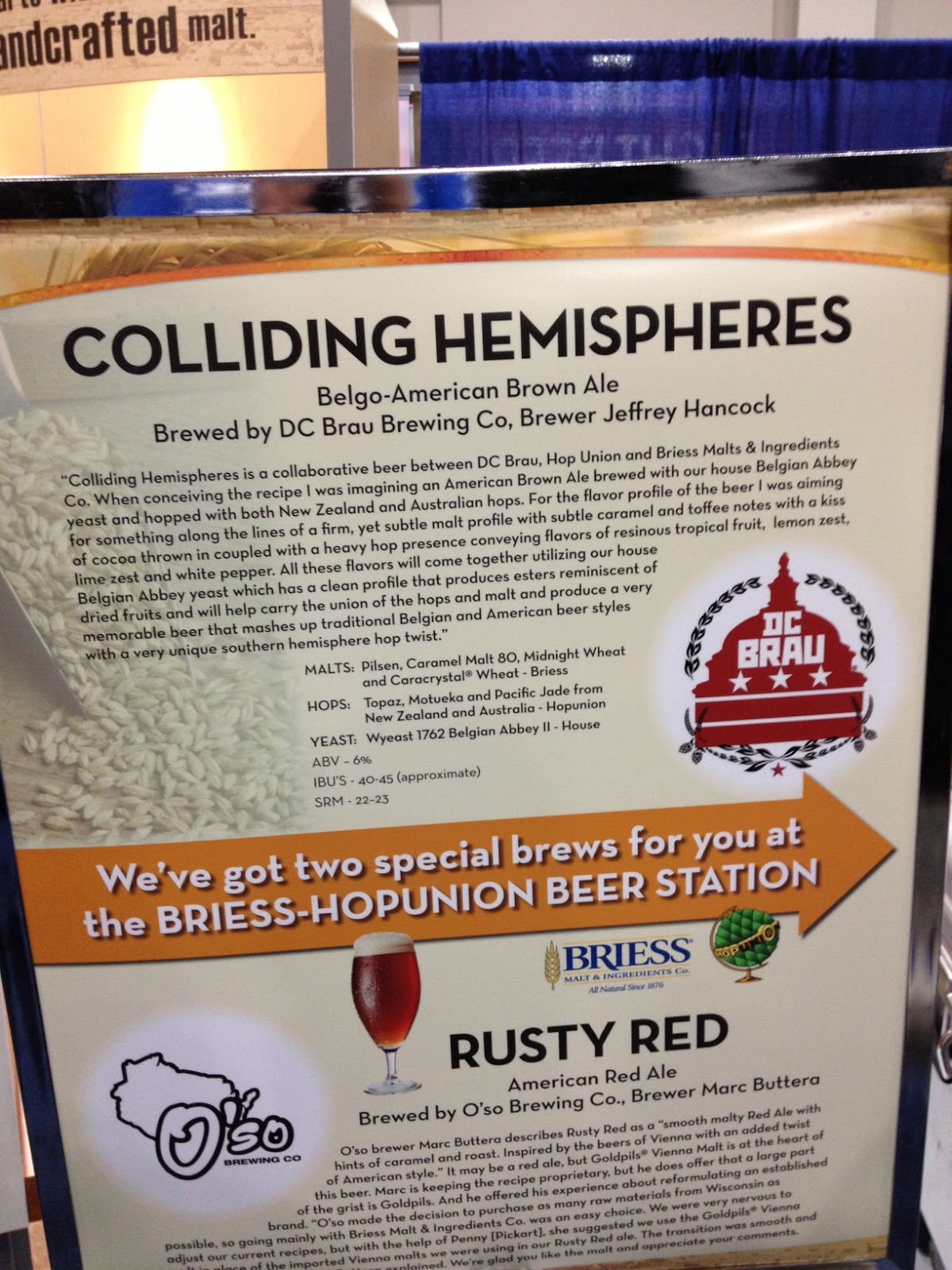
As you can tell, they had a very good selection at this
station: Sweetwater, Dogfish, Left Hand, New Belgium...

Sly Fox Brewing's new can. Just peel back the lid.
The future!

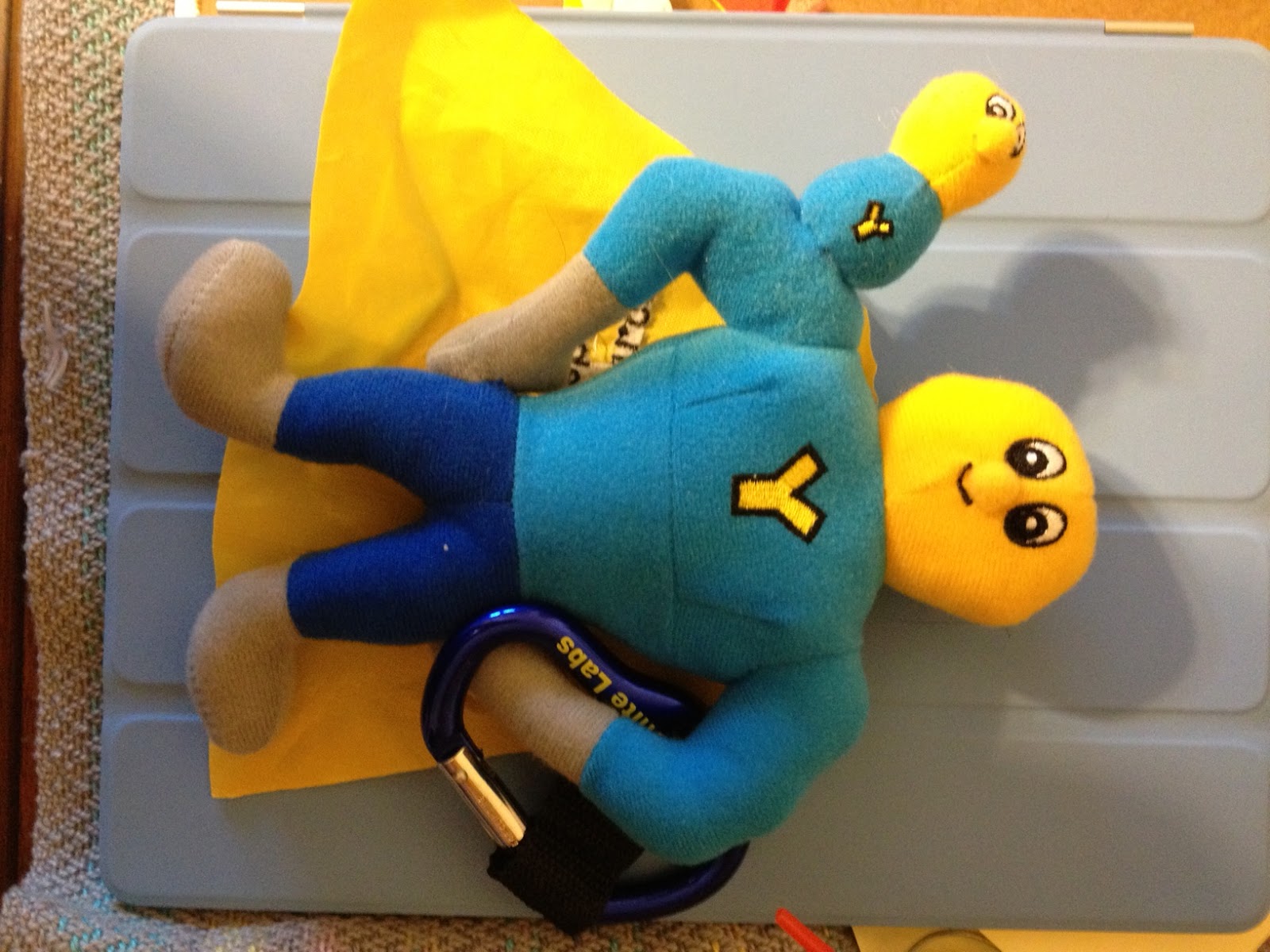
Yeast man. There's no swag like mitosis swag.

On an eye-opening and perhaps disappointing note, I saw at least three vendors selling flavoring extracts, and one of these had a roster of craft brewers lined up for testimonials. So now I don’t know if there’s any actual chocolate in Rogue Chocolate Stout, one of the examples a vendor showed me, and I don’t know how I feel about that. Does it matter?

Over at DCBeer.com, there is some discussion about whether or not this conference was good for DC's beer scene and the local brewers, who may have been overshadowed by out-of-towners during that week. Praise for the week here, concern here. Cheers.