Showing posts with label serials. Show all posts

Thursday, November 5, 2015

Parsing Elsevier: Lingua and Open Access

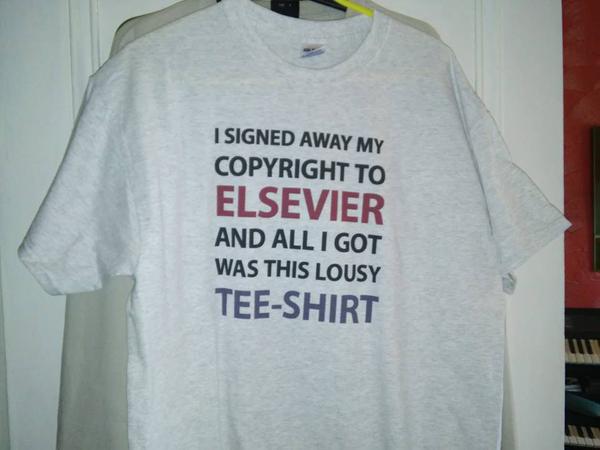
Yet again, http://www.cafepress.com/fakeelsevier 
In late October, the editors and editorial board, six and thirty-one people, respectively, of the linguistics journal Lingua resigned. They did so to protest the publisher's, Elsevier, policies and pricing, having unsuccessfully asked the company to convert the journal to open access and hearing from libraries that one of linguistics premier journals was becoming too expensive. Per Inside Higher Ed:
Johan Rooryck, executive editor of the journal until his resignation takes effect at the end of the year, said in an interview that when he started his editorship in 1998, "I could have told you to the cent what the journal cost," and that it was much more affordable. Now, he said, single subscriptions are so expensive that it is "unsustainable" for many libraries to subscribe. Rooryck is professor of French linguistics at Leiden University, in the Netherlands, where academic and government leaders have been sharply critical of journal prices.
This was not the first instance of a journal editorial board quitting over Elsevier, as The Economist noted in 2012:
In 2006, for example, the entire editorial board of Topology, a mathematics journal published by Elsevier, resigned, citing similar worries about high prices choking off access. And the board of K-theory, a maths journal owned by Springer, a German publishing firm, quit in 2007.
Simmons hosts a comprehensive list of journals that have declared independence.

Tom Reller, Vice President and Head of Global Corporate Relations at Elsevier, addressed this most recent resignation in a blog post. In it, Reller makes a number of claims that should go fact-checked. I do so below.

I am not the first person to parse Elsevier's statement. Martin Eve, Senior Lecturer in Literature, Technology and Publishing at the University of London and head of the Open Library of Humanities, which will play host to the new journal to be run by the previous editors of Lingua, Glossa, does an excellent job clarifying some of what Reller wrote. Eve notes that it was not Rooryck, solo, who wanted to take ownership of the journal, as Reller asserts, but rather the editors, writ large, and counters Reller's claim that Elsevier founded the journal. More importantly, Eve takes issue with Reller's definition of "sustainable," given that Elsevier reported a 37% operating profit in 2014.

These are the 2012 numbers. Chart via Alex Holcombe at the above link.
Reller argues that lowering the article publishing charge (AAPC), a fee that authors and/or institutions pay Elsevier for publication, for Lingua from $1800 to $440 is unsustainable, yet given the publishers' profit margins this seems unlikely. Indeed, Elsevier does publish other journals with lower APCs, more in line with what Rooryck, other editors, and the board asked for. At issue here is a definition of sustainability that takes Elsevier's profits into account, but not the balance sheets of academic libraries.

To Eve, let me add:
  • In Reller's response, he notes that Elsevier is "the world’s third largest open access publisher," but this, too is misleading. His company is the largest publisher of scholarly journals, but of the 2,500 journals they publish, only 300 are fully open access. Another 1,600, including Lingua, have some hybrid form of open access. Elsevier's claim comes from its size, a function of how many journals it publishes. Elsevier is not a member of the Open Access Scholarly Publishers Association, as some of its competitors are, including Springer, Wiley, Taylor and Francis, SAGE Publications, and Oxford and Cambridge University Presses, among others, which signals a lack of commitment to Open Access Gold, immediate free and open dissemination. Indeed, if one were to point to the largest strictly open access publishers, it would include the Public Library of Science and BioMed Central Ltd., owned by Springer, among others. Not Elsevier. 
  • Reller claims that "Elsevier will receive 1.2 million article submissions this year, publish 400,000 of them into a database of 12 million articles," for an acceptance rate of 33%, higher than that of the American Psychological Association, and many other publishers.* One effect of "the big deal" for libraries includes charging for lesser journals that don't get much use, similar to paying for cable television for just a few of the hundreds of available channels. 
    • To wit, the Massachusetts Institute for Technology notes that "UC economist Ted Bergstrom concludes through his calculations (including price per citation) that 59% of Elsevier titles are considered a “bad value.” In comparison, The American Physical Society has 0 titles that are “bad value” based on the same calculations." 
  • Elsevier is more than entitled to make a profit, which includes happy and productive employees that can exercise on the job, but sustainability is a two-way street. There are ways to make money in strictly open access environments that academic librarians should invite them to explore, such as "generating better metadata for... open access items; designing stronger, more relevant search functionalities; and creating attractive and user-friendly platforms." (Source) 
  • Per usual, when discussing issues of open access, faculty are barely present. So long as faculty cannot or do not or refuse to recognize the political economy of scholarly communication, the longer it will remain a moral hazard in which they are immune to its costs. If it is professionally and personally possible, academic librarians should initiate these conversations with faculty and academic administration. That means you, tenured librarians. To colleges and universities that employ scholarly communications librarians and help them succeed: thank you. 

Elsewhere on this site, explore the open access tag.
A Chronicle of Higher Education article on Lingua.

* Yes, I know that this is a problematic argument for a variety of reasons and I lack access to Cabell's Directory of Publishing Opportunities at the moment, but bear with me.

Tuesday, September 8, 2015

On Institutional Repository Success: Discovery, Search, Metadata

Over the summer I was asked to talk about institutional repositories and how to define what makes them successful as part of a job interview in an academic library. The text of what I said, along with some of the accompanying images, is below.


DIGITAL REPOSITORY SUCCESS

I've been asked to present my thoughts on what it means for a digital repository, an institutional repository, to be successful, and how to measure that success.

Very few people I know go into an institutional repository (IR) to look for something. It's not the way that search and discovery work. What I propose we do is to link the IR to our current search and discovery workflows, that is, link the IR to things that people already use.

It's not about making the repository more visible, it's about making the stuff in the repository more visible.

The IR is nothing without the things inside it; we need to have things that people want, and people need to know that they want those things, those items. Those items need to be where people can find them.

Don't have an IR just for the sake of having one. I turn here to one of my favorite library and information science theorists, Frank Zappa.

Thanks, Zappa estate.
Zappa once said that if a country wanted to be taken seriously, it needed two things: a beer and an airline. For Zappa, these are symbols of modernity. I want to make sure that an institutional repository isn't just a symbol of modernity, that we don't have one just because everyone else does, or because it's what academic libraries "should" have, but because it will be used. And for sure, having one is nice. On its own, an IR sends a positive signal concerning open access initiatives to faculty, to an academic community, and that's good, but it shouldn't be the main reason for having one.

Furthermore, we shouldn't have an IR because it's seen as a solution to non-existent or undefined problems. In organization theory, this is known as the "garbage can model" of decision making.

Not sure why PBS hosts this smushed image.
If we're going to have an IR, it should solve existing problems. It should help, not hinder, and it shouldn't exist for its own sake.

So with that in mind, we have an IR here, and an open access initiative and policy. We can improve the IR, and more importantly the stuff in it, in two ways, discovery and search.

For discovery, there are a few options. At my former place of work, we used widgets as well as a tab in our discovery search box.


Note the widgets, circled. (And yes, this is called burying the lede.) 
If possible, add a facet in the discovery layer search results. We already teach the use of these facets, may as well make the IR, and thus the stuff inside, more visible.

Note: no IR facet here. 
Results can also be expressed such that the IR is more visible. In "bento box" results, there could be an IR section of results, for example.

And of course if we don't have strong metadata for items in an IR, this won't matter. Application Platform Interfaces (APIs), Omeka has one, for example, are a good way to bring robust metadata into discovery. Digital Commons uses Open Authentication Interface, which is also workable. There's certainly room for collaboration with vendors here.

Metadata is also important in searching outside the library. Plenty of us, and faculty, use Google Scholar. With a link resolver we can bring faculty back to the library site, to the IR.

What success can look like. 
The library isn't a gateway, isn't always a starting point, so we need to bring what we have to where our users are. The library may not function as publisher, but it can certainly act as distributor.

Why is metadata so important here? Because Google Scholar works better with some schemas, some formats, than others. It doesn't play nicely with Dublin Core, for example. Without that robust metadata, we might come across our friend the paywall.

We've all seen one of these before, right? 
Ahhhh, the paywall, simultaneously too expensive, "you want how much for that paper?," and insultingly inexpensive given all that work that goes into research and publishing. Poor metadata will send people to a paywall instead of an IR for the same paper.

So discovery and search are two ways to build on IRs, to expand their capabilities. But if these methods work, how will we know? How can we track the output and measure the impact of an IR?

Traditionally, we use bibliometrics: citation tracking, pageviews, downloads, and the like. Our good friend COUNTER fits the bill. As the number of digital-only items grows, altmetrics become more important. Are articles being shared on LinkedIn or twitter? I know that one organization has tried to measure the effects of "#icanhazpdf," article sharing on social media, with mixed results. And increasingly, the line between biblio- and altmetrics are blurring.

Return on investment is also an opportunity to measure IR success, albeit crudely. Back to that paywalled article; we know that Elsevier thinks it's worth $36. Could we then write, in an annual report, that we added x-number of articles to our IR in 2015, or a fair market value of x times whatever the median article value is? That might be effective in terms of telling a story to academic administration.

Qualitative methods could also prove useful. Interview faculty, either individually or in focus groups, ask how IRs work, or don't, for them.

Speaking of faculty, this doesn't work without buy-in from them. It's why open access policies and initiatives are so important. Open access papers tend to get cited, get read, and get used more than those that are paywalled. Academic publishing looks like a moral hazard at times; faculty publish stuff and then we in the library have to buy it back from publishers.

Want one? Buy one!
We're asking a lot from faculty here, with the open access policy and the repository. We're asking them to trust us with their research, their work, and we librarians need to continually earn that trust. And that trust is part of success.

So to recap, institutional repository success is, to me, when you find the stuff, whether you notice the repository or not. When the repository is
  • Easy to use. 
  • Useful.
  • Interoperable, in that it works with what we have in terms of discovery platforms and search.  
  • Smooth and seamless, reducing friction so we don’t have to search in multiple places. That is, the IR can be unseen and still work! 
  • Branding/marketing can be useful: be consistent.
Thank you very much for the opportunity to present, and I look forward to your questions and comments. 


Take this with a grain of salt because I did not get the job.

Tuesday, June 7, 2011

QR Codes: Quick, Easy, Cheap

A quick and easy use for QR codes at the library: take your online serials to the print serials. Here’s how.

1. You’ve got a master list of all print serials you subscribe to, right? If not, make one.
2. For each print serial, use your link resolver (my place of work doesn’t have one of these, which is a problem. I’m working on it) and/or database and/or OPAC (yeah, I just used that term, I'm old) that holds the online version, and get a stable URL for each title.
3. Use these URLs to create QR codes, for free, at QRStuff.com. Feel free to pretty them up.
4. Get yourself a smartphone, even if you’re borrowing one from another staff member. Install the free app ATT Scanner on an iPhone, or the QR Droid app, also free, on an Android phone.
5. Quality control: make sure even first generation smartphones, like my 3G iPhone, for example, can read the QR codes. Expand or contract the size of the codes as needed.
6. Print out the QR codes, and make sure to protect the paper, which might include laminating (expensive) or well-deployed packing tape (cheaper). Perform more quality control.
7. Place the corresponding QR code next to where each print serial is shelved. Post instructions in clearly visible locations. Don’t forget the details; at some libraries patrons may have to join a wireless network to access online serials.
8. Shamelessly promote it. Library blog posts, table toppers, posters... you get the idea.

Why do this?

1. Having the ability to search past issues of a title next to the more current paper issues can help patrons conduct research.
2. QR codes are hip, modern, and interactive. Making your library a hipper, more modern, more interactive place to be will pay off for you.
3. Many of the patrons at MPOW (my place of work) don’t have internet access at home, except for smartphones. It’s a tool that they’re comfortable with. We as librarians should be comfortable with it as well, and as we see smartphone use on the rise, I hope that vendors begin to design easy to use mobile sites alongside more traditional interfaces. In the meantime, let's bring the library to our patrons, via QR codes and mobile computing.