Tuesday, December 15, 2015

Why Critical Librarianship? Or, the #whyicritlib Post

Many moons ago, when I was pursuing a PhD in political science, a professor I looked up to told me something that's stuck with me. Marxists, he said, don't often have the right answers, but they ask the right questions.

Gif via ina.fr and gifwave.com
So why am I a critical librarian?
  • Because it's important to ask "who benefits?" and I wish more of us in the library and information sciences would follow in the footsteps of Sanford BermanE.J. JoseyHope Olson, Rory Litwin, and others in asking these kinds of questions.
  • Because critical librarianship is, in large part, what you make it. It's one of the few places where I feel like I have a significant degree of agency in librarianship. I hear the critiques of the #critlib chats being an echo chamber, and while on some level I think that opinion is a valid one (this blog post might be evidence of that), if someone wants to propose a chat on a topic they think is under- or unexplored, they can and should do so. Last June I moderated a chat, attempting to critique whatever critlib is (movement, mindset, group, place,...) from the inside, and I suspect that with his questions above, this critique is something that Kevin would like to explore as well.
  • Because I'm not neutral, and neither are libraries. There are intended and unintended policies and consequences that do real harm that I think we can mitigate. But only if we ask "who benefits, how, and why?"
  • Because one of the highlights of my year, or any year, really, was being in a room with Jessica Critten, Donna Witek, Kevin Seeber, and Kenny Garcia, listening, talking, and learning. I've found fellow "critlibbers" to be friendly, kind, patient, smart, and caring, among other positive traits.
  • Because as a community, critical librarianship keeps me accountable to myself, my ideals, and challenges me to continue to listen and learn and refine, among other things. 
  • Because before I lurked in critlib chats, I was a critical political science student. A professor introduced me to the work of Michel Foucault, and that was as close to an "a ha!" moment as I'll have (I maybe even crossed a threshold, if you will). I got to spend a day with James Scott, one of my professional heroes. And then I got to apply critical theories from the social sciences and humanities to libraries, in theory, and in practice, thanks to people like Maria Accardi
  • Because this is my life homey you decide yours.


Why do I identify with these ideas?
  • Because I've never not been critical. I grew up in New York City in the 1980s. My parents told me not to walk on Amsterdam Avenue (also called Murderdam or Cracksterdam), to take Broadway instead, and I began to ask questions. I saw how people who weren't white were treated. By police, by teachers, by peers, by the law. That was the start. It took me a while to find the theoretical frameworks to help me process what I saw, but I'm glad I did. 
Why do I participate in these chats?
  • It's more often the case that I lurk, listening, liking tweets, saving things for later. I feel like I have a voice, however limited, in this profession, and I want to hear what others have to say. The last thing librarianship needs is another cis het white dude taking up space. That being said, thanks for reading, and thanks to Kevin for asking. 

Monday, December 7, 2015

The Academic Library Job Market is Broken

Here are some blind items from my interactions with academic libraries over the past few months. They don't paint a pretty picture of the hiring processes therein.
  • The university that schedules a phone interview, then, out of the blue, a second phone interview three weeks later with an entirely different search committee and no explanation.
    • That same university, when asked during the second phone interview, has no timeline to bring anyone in for an on-campus interview, a clear sign that they have no idea who or what they're looking for in the position.
  • The multiple instances in which the person you report to isn't part of the search committee.
  • On-campus interviews where the people you'd manage aren't part of the hiring process.
  • Places where you're told "the position is what you make it" even though there's a long, almost unicorn-like job description and a title that strongly suggests which area of academic librarianship the position falls into. Again, a clear sign that they have no idea what they're looking for in the position.
  • Places where more than a third of the students are non-white, but all the librarians are Nice White Ladies. 
  • Place that check your references and then ghost. 0_o 
  • Places that ask for a salary range and when supplied with one, with tons of wiggle room, might I add, feel the need to note that they're a non-profit. Passive aggressive much? 
  • Places that have lost a significant percentage of their staff, but those that remain are clinging to their silos rather than trying to reorganize, reward versatility, and become more agile and open. 
    • The counter: Places that awkwardly combine two or more positions into one to compensate for budget cuts. See that unicorn-like job description, above. 
  • Places where it's clear you'll be punished for wanting to publish, to share knowledge, whether that's peer reviewed, presented, or blogged.
    • "So, I see you publish," I was told, with a tone and body language that made it clear I shouldn't aspire to such things. 
    • "I've read your blog and twitter," remarked one hiring official, who did not and would not expand on that when I asked them what they thought of my online presence. 
    • "Why can't you stick to beer?" is something that I was told by someone in human resources at one institution. If I weren't a cis het white male, I'd send that into the LIS Microaggressions zine. 
Errata:
All directors, with no exceptions, think that if I, as an ex-director, interview for a librarian position, then I'm out to steal their job. Meanwhile, other library staff at these organizations can't fathom why I'd give up a directorship, not understanding how fraught middle management in academic libraries can be, often feeling trapped between library staff and academic administration, which can sometimes be at cross-purposes. Why is it not okay to be a librarian, a part of a team? We don't all have to aspire to management, even those of us in management. 
A sign you're in a good place: when someone eats a fruit cup with both breakfast and lunch and not once touches the honeydew. Honeydew is a garbage melon.  
The performance of whiteness is an important barrier to diversity in library and information science. I was aware of this before job hunting, but nowhere is this more true than when you're on the market. "Small talk" is crucial to determining whether or not one "fits" in an organization. I mentioned farmers markets, Cub Scouts, homebrewing, and many other topics, some consciously, some not, to show employers that I'm "like" them. No doubt it helps that I look like them, too. If you're looking for a job in libraries, I encourage you to read Angela Galvan's "Soliciting Performance, Hiding Bias: Whiteness and Librarianship," and April Hathcock's "White Librarianship in Blackface: Diversity Initiatives in LIS," both published in In the Library With the Lead Pipe
Do you have horror stories you'd like to share? If you're able to, I'm here for that.

Tuesday, December 1, 2015

The Beerbrarian Moves On

Over the course of eight years, I held three positions at my former place of work (MFPOW). For more than half that time, I served as Director of Library Services. I started as a paraprofessional, with "Specialist" in the title, got an MLIS on the job, and worked my way up. I'm grateful to them for the opportunities and growth, and I hope they're as proud of what we were able to accomplish as I am. No doubt they took a risk in making me a director. Working with other library and university staff, faculty, and academic administration, we were able to
  • modernize the library, including adding discovery services and a link resolver.
  • promote the use of open educational resources (OERs) to the point where every introductory science course uses them, saving our students a lot of money.
  • hire, train, promote, and maintain a diverse library staff 
  • break down silos by cross-training all library staff on both public and technical services, with robust documentation.
  • create a culture of experimentation, where staff aren't afraid to fail and learn from it.
But all those things cost a lot. They cost political capital. They cost emotional labor. And after those eight years, I got the sense that there wasn't much more I could do except maintain. I got the sense I wasn't wanted anymore, but I tried to stick it out. I was lonely as a middle manager, operating between university administration and library staff, and balancing those two often-competing roles was tough. I wasn't happy. I let it get to me. To their credit, the powers that be realized this. The timing wasn't perfect, but hey, it rarely is. I should have started my job hunt earlier, and I shouldn't have taken MFPOW for granted-- if you're thinking about going on the job market in "six months," start now! Though we occasionally disagreed on strategy and tactics, the mission of my former place of work remains a worthy one, and I wish them the best of luck. It's telling that the staff who remain, including the current university librarian, are people I hired and trained. It's a nice legacy to have. Onward. 

I came to librarianship as a failed academic, having dropped out of a political science PhD program. This new job gives me a chance to put that other Masters to good use (I applied for pretty much every Political Science Librarian position on the east coast, but never got past phone or Skype interviews--more on this later), and is right in my wheelhouse in terms of what my dissertation was to be: an examination of the role, or lack thereof, the globalization of the English language plays in state language policies, if you're wondering. I'll also get to work with area studies materials and other resources from my poli sci days.

In addition, I hope to bolster my skill-set. Some front-end web development, often involving integrated library systems (ILS) and learning/content management systems (the LMS is the scene of one of my better failure stories); more project management; more committee work; and maybe more instructional design. Also, a chance to turn a weakness, marketing and outreach, into a strength; and an opportunity to explore what critical librarianship looks like in a special library, as this position is in the academic wing of a federal library.

That being said, it's not an academic library, at least not in the traditional sense. I want to find out what I like more: librarianship or higher education. I want to make sure I'm not in the former as a way to stick around the latter.

I wasn't the job I left. I am not the job I just accepted. We are not our jobs. Not the ones we left. Not the ones we want to take. You are not your job.

Let's see where the day takes us.

Thursday, November 5, 2015

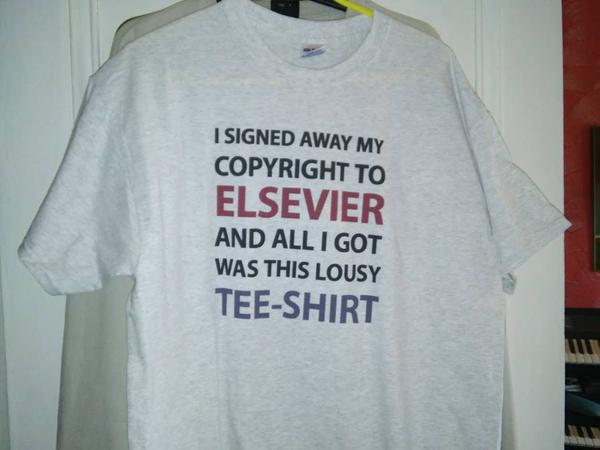
Parsing Elsevier: Lingua and Open Access

Yet again, http://www.cafepress.com/fakeelsevier 
In late October, the editors and editorial board, six and thirty-one people, respectively, of the linguistics journal Lingua resigned. They did so to protest the publisher's, Elsevier, policies and pricing, having unsuccessfully asked the company to convert the journal to open access and hearing from libraries that one of linguistics premier journals was becoming too expensive. Per Inside Higher Ed:
Johan Rooryck, executive editor of the journal until his resignation takes effect at the end of the year, said in an interview that when he started his editorship in 1998, "I could have told you to the cent what the journal cost," and that it was much more affordable. Now, he said, single subscriptions are so expensive that it is "unsustainable" for many libraries to subscribe. Rooryck is professor of French linguistics at Leiden University, in the Netherlands, where academic and government leaders have been sharply critical of journal prices.
This was not the first instance of a journal editorial board quitting over Elsevier, as The Economist noted in 2012:
In 2006, for example, the entire editorial board of Topology, a mathematics journal published by Elsevier, resigned, citing similar worries about high prices choking off access. And the board of K-theory, a maths journal owned by Springer, a German publishing firm, quit in 2007.
Simmons hosts a comprehensive list of journals that have declared independence.

Tom Reller, Vice President and Head of Global Corporate Relations at Elsevier, addressed this most recent resignation in a blog post. In it, Reller makes a number of claims that should go fact-checked. I do so below.

I am not the first person to parse Elsevier's statement. Martin Eve, Senior Lecturer in Literature, Technology and Publishing at the University of London and head of the Open Library of Humanities, which will play host to the new journal to be run by the previous editors of Lingua, Glossa, does an excellent job clarifying some of what Reller wrote. Eve notes that it was not Rooryck, solo, who wanted to take ownership of the journal, as Reller asserts, but rather the editors, writ large, and counters Reller's claim that Elsevier founded the journal. More importantly, Eve takes issue with Reller's definition of "sustainable," given that Elsevier reported a 37% operating profit in 2014.

These are the 2012 numbers. Chart via Alex Holcombe at the above link.
Reller argues that lowering the article publishing charge (AAPC), a fee that authors and/or institutions pay Elsevier for publication, for Lingua from $1800 to $440 is unsustainable, yet given the publishers' profit margins this seems unlikely. Indeed, Elsevier does publish other journals with lower APCs, more in line with what Rooryck, other editors, and the board asked for. At issue here is a definition of sustainability that takes Elsevier's profits into account, but not the balance sheets of academic libraries.

To Eve, let me add:
  • In Reller's response, he notes that Elsevier is "the world’s third largest open access publisher," but this, too is misleading. His company is the largest publisher of scholarly journals, but of the 2,500 journals they publish, only 300 are fully open access. Another 1,600, including Lingua, have some hybrid form of open access. Elsevier's claim comes from its size, a function of how many journals it publishes. Elsevier is not a member of the Open Access Scholarly Publishers Association, as some of its competitors are, including Springer, Wiley, Taylor and Francis, SAGE Publications, and Oxford and Cambridge University Presses, among others, which signals a lack of commitment to Open Access Gold, immediate free and open dissemination. Indeed, if one were to point to the largest strictly open access publishers, it would include the Public Library of Science and BioMed Central Ltd., owned by Springer, among others. Not Elsevier. 
  • Reller claims that "Elsevier will receive 1.2 million article submissions this year, publish 400,000 of them into a database of 12 million articles," for an acceptance rate of 33%, higher than that of the American Psychological Association, and many other publishers.* One effect of "the big deal" for libraries includes charging for lesser journals that don't get much use, similar to paying for cable television for just a few of the hundreds of available channels. 
    • To wit, the Massachusetts Institute for Technology notes that "UC economist Ted Bergstrom concludes through his calculations (including price per citation) that 59% of Elsevier titles are considered a “bad value.” In comparison, The American Physical Society has 0 titles that are “bad value” based on the same calculations." 
  • Elsevier is more than entitled to make a profit, which includes happy and productive employees that can exercise on the job, but sustainability is a two-way street. There are ways to make money in strictly open access environments that academic librarians should invite them to explore, such as "generating better metadata for... open access items; designing stronger, more relevant search functionalities; and creating attractive and user-friendly platforms." (Source
  • Per usual, when discussing issues of open access, faculty are barely present. So long as faculty cannot or do not or refuse to recognize the political economy of scholarly communication, the longer it will remain a moral hazard in which they are immune to its costs. If it is professionally and personally possible, academic librarians should initiate these conversations with faculty and academic administration. That means you, tenured librarians. To colleges and universities that employ scholarly communications librarians and help them succeed: thank you. 

Elsewhere on this site, explore the open access tag.
A Chronicle of Higher Education article on Lingua.

* Yes, I know that this is a problematic argument for a variety of reasons and I lack access to Cabell's Directory of Publishing Opportunities at the moment, but bear with me.

Monday, September 28, 2015

Ride, Live at the 930 Club, September 17th, 2015


In 2013, My Bloody Valentine reformed, recorded a new album, and went on tour. In 2014, Slowdive did the first and third of these, prompting me to joke that in 2015 it was Ride’s turn. And here we are.
Of these three shoegaze groups, Ride were the rock traditionalists; MBV and Slowdive were forerunners of post-rock, using guitars and pedals to make sounds free of form, at times experimental, ambient, and discordant. Ride, on the other hand, rejected the shoegazer moniker, were more likely to listen to the Nuggets box set–they’ve covered The Creation’s “How Does It Feel to Feel?”–and it’s no accident that after they broke up guitarist, vocalist, and songwriter Andy Bell joined Oasis, albeit as a bassist.

And so on Thursday, September 17th, a rock show broke out at Washington, DC’s 930 Club. Ride opened with “Leave Them All Behind,” as close to a defining statement as they have. The band clearly wasn’t content to “play the hits,” as they were, busting out “Birdman,” live for the first time since 1995, as well as “Decay” and “Seagull,” both for the first time since 1991. “Twisterella” followed the first of these rarities, with Bell, doing his best guitar god impression and inexplicably clad in a Neu! trucker hat, turning the song into a southern boogie workout via his clean, single-note picking. “Black Nite Crash” and “Time of Her Time” similarly rocked, with the middle-aged crowd pogoing and bopping along. Mark Gardener, Ride’s other guitarist, vocalist, and songwriter, broke up the group when Bell brought these songs to the studio, but he was all smiles this evening, harmonizing with his co-vocalist in the style of The Byrds. Meanwhile, Laurence Colbert dished out plenty of hi-hats and cymbal crashes and bassist Steve Queralt held down the low end.

Ride may still reject the shoegaze label, but delay, reverb, and other effects pedals were employed on many songs, including an extended freakout in the middle of “Taste,” while the vocals from Gardener and Bell were appropriately buried in the mix throughout. When Bell asked the crowd if this was their, our, first Ride show, many hands stayed down, and there was plenty of singing along during the concert. “Vapor Trail” was dedicated to us first-timers, Bell’s guitar and pedals mimicking the famous cello solo. The band closed with “Seagull,” sending the audience out into the night ears ringing, and thus ends the holy trinity of shoegaze reunions.

Ride Setlist 9:30 Club, Washington, DC, USA 2015, Reunion Tour

Elsewhere on this site and beyond: 
My review of Slowdive 
My review of My Bloody Valentine
This review was originally posted at Midnight to Six

Tuesday, September 8, 2015

On Institutional Repository Success: Discovery, Search, Metadata

Over the summer I was asked to talk about institutional repositories and how to define what makes them successful as part of a job interview in an academic library. The text of what I said, along with some of the accompanying images, is below.


DIGITAL REPOSITORY SUCCESS

I've been asked to present my thoughts on what it means for a digital repository, an institutional repository, to be successful, and how to measure that success.

Very few people I know go into an institutional repository (IR) to look for something. It's not the way that search and discovery work. What I propose we do is to link the IR to our current search and discovery workflows, that is, link the IR to things that people already use.

It's not about making the repository more visible, it's about making the stuff in the repository more visible.

The IR is nothing without the things inside it; we need to have things that people want, and people need to know that they want those things, those items. Those items need to be where people can find them.

Don't have an IR just for the sake of having one. I turn here to one of my favorite library and information science theorists, Frank Zappa.

Thanks, Zappa estate.
Zappa once said that if a country wanted to be taken seriously, it needed two things: a beer and an airline. For Zappa, these are symbols of modernity. I want to make sure that an institutional repository isn't just a symbol of modernity, that we don't have one just because everyone else does, or because it's what academic libraries "should" have, but because it will be used. And for sure, having one is nice. On its own, an IR sends a positive signal concerning open access initiatives to faculty, to an academic community, and that's good, but it shouldn't be the main reason for having one.

Furthermore, we shouldn't have an IR because it's seen as a solution to non-existent or undefined problems. In organization theory, this is known as the "garbage can model" of decision making.

Not sure why PBS hosts this smushed image.
If we're going to have an IR, it should solve existing problems. It should help, not hinder, and it shouldn't exist for its own sake.

So with that in mind, we have an IR here, and an open access initiative and policy. We can improve the IR, and more importantly the stuff in it, in two ways, discovery and search.

For discovery, there are a few options. At my former place of work, we used widgets as well as a tab in our discovery search box.


Note the widgets, circled. (And yes, this is called burying the lede.) 
If possible, add a facet in the discovery layer search results. We already teach the use of these facets, may as well make the IR, and thus the stuff inside, more visible.

Note: no IR facet here. 
Results can also be expressed such that the IR is more visible. In "bento box" results, there could be an IR section of results, for example.

And of course if we don't have strong metadata for items in an IR, this won't matter. Application Platform Interfaces (APIs), Omeka has one, for example, are a good way to bring robust metadata into discovery. Digital Commons uses Open Authentication Interface, which is also workable. There's certainly room for collaboration with vendors here.

Metadata is also important in searching outside the library. Plenty of us, and faculty, use Google Scholar. With a link resolver we can bring faculty back to the library site, to the IR.

What success can look like. 
The library isn't a gateway, isn't always a starting point, so we need to bring what we have to where our users are. The library may not function as publisher, but it can certainly act as distributor.

Why is metadata so important here? Because Google Scholar works better with some schemas, some formats, than others. It doesn't play nicely with Dublin Core, for example. Without that robust metadata, we might come across our friend the paywall.

We've all seen one of these before, right? 
Ahhhh, the paywall, simultaneously too expensive, "you want how much for that paper?," and insultingly inexpensive given all that work that goes into research and publishing. Poor metadata will send people to a paywall instead of an IR for the same paper.

So discovery and search are two ways to build on IRs, to expand their capabilities. But if these methods work, how will we know? How can we track the output and measure the impact of an IR?

Traditionally, we use bibliometrics: citation tracking, pageviews, downloads, and the like. Our good friend COUNTER fits the bill. As the number of digital-only items grows, altmetrics become more important. Are articles being shared on LinkedIn or twitter? I know that one organization has tried to measure the effects of "#icanhazpdf," article sharing on social media, with mixed results. And increasingly, the line between biblio- and altmetrics are blurring.

Return on investment is also an opportunity to measure IR success, albeit crudely. Back to that paywalled article; we know that Elsevier thinks it's worth $36. Could we then write, in an annual report, that we added x-number of articles to our IR in 2015, or a fair market value of x times whatever the median article value is? That might be effective in terms of telling a story to academic administration.

Qualitative methods could also prove useful. Interview faculty, either individually or in focus groups, ask how IRs work, or don't, for them.

Speaking of faculty, this doesn't work without buy-in from them. It's why open access policies and initiatives are so important. Open access papers tend to get cited, get read, and get used more than those that are paywalled. Academic publishing looks like a moral hazard at times; faculty publish stuff and then we in the library have to buy it back from publishers.

Want one? Buy one!
We're asking a lot from faculty here, with the open access policy and the repository. We're asking them to trust us with their research, their work, and we librarians need to continually earn that trust. And that trust is part of success.

So to recap, institutional repository success is, to me, when you find the stuff, whether you notice the repository or not. When the repository is
  • Easy to use. 
  • Useful.
  • Interoperable, in that it works with what we have in terms of discovery platforms and search.  
  • Smooth and seamless, reducing friction so we don’t have to search in multiple places. That is, the IR can be unseen and still work! 
  • Branding/marketing can be useful: be consistent.
Thank you very much for the opportunity to present, and I look forward to your questions and comments. 


Take this with a grain of salt because I did not get the job.

Thursday, July 9, 2015

I Got Soul, But I'm Not a Soldier: On "a quiet culture war in libraries"

University of Utah Associate Dean for Scholarly Resources and Collections Rick Anderson has published an opinion piece in Insights, titled "A quiet culture war in research libraries – and what it means for librarians, researchers and publishers." This article is illuminating and instructive, but not, I suspect, for the reasons Anderson intended. Rather than revealing or elucidating a problem – the author offers no evidence beyond his opinions as the first comment on the article points out and cites only himself – it is a useful look into the mindset of a dean, one that I suspect is shared by others, as well as university and associate university librarians throughout North America. The article can also be read as an apologia for the current state of scholarly communication and library and information science (LIS) practitioners' roles in that.

I.

Anderson posits a spectrum from soldier to revolutionary with regards to how academic librarians and library staff approach their jobs, and that the tension between these mindsets drive much of the labor in academic libraries. To wit:
The soldier can be thought of as generally operating under ‘marching orders’, which he takes from his institution’s mission and strategic goals, and tends to focus mainly on local needs, the impact of library services on current patrons, and the library’s alignment with its institutional mission. Those with a predominantly soldier mindset will tend to think of the library primarily as a service and support program for its host institution.
And
The revolutionary mindset thinks less in terms of marching orders than in terms of global vision. A librarian with a predominantly revolutionary mindset will tend to think more about the library’s effect on the global scholarly community, its potential role in solving global and systemic problems, and the long-term impact of its collections and services in that context. The revolutionary will tend to think of the library less as a service than as a leader and educator on campus.
Anderson is rightfully careful to note that soldiers and revolutionaries operate on a spectrum, but by focusing on the extremes, "two different orientations," he writes, or at least the Weberian ideal types, the article gives the appearance of binary thinking and false dichotomies. His use of "spectrum" and "continuum" as cover are not unlike a lawyer who introduces something for the jury to hear, knowing it will be stricken and thus resonate.

The multiple uses of "war" are worth examining. Soldiers protect and defend, while revolutionaries take, using tactics that are sometimes outside the norm ("Man the barricades!"). Soldiers, viewed here, are drones, executing a mission, a mischaracterization of what actual soldiers do, and the discretion they exercise. The title of the article, however, postulates a different kind of war, one that will be familiar to students of United States' politics and history, a culture war. This phrase has a particular meaning, left-right/liberal-conservative.

This is a profoundly unserious analogy and metaphor, as the culture war in the United States had, and has, very real victims: poor people, single parents, the LGBT community, women seeking abortions, and people of color who used drugs, among others. However, it is because of these victims, and the co-option of militaristic language by the right in the United States that we must take it somewhat seriously. After all, if Anderson wanted to he could have used the principal-agent problem from organization theory to make the same, still unserious, point. That he chose to use the language he did is telling.

Soldiers defend the status quo (right/conservative), while revolutionaries seek to overturn it (left/liberal). As it pertains to scholarly communication, here is what soldiers are defending:
A professor publishes something, using the labor (librarians) and capital (materials purchased and leased) of the institution. The library, as an arm of the institution, then must pay for that article (again!), often as part of a "big deal" package of databases. 
It's a heck of a system to defend, and a great many people in higher education and publishing would not agree that the current political economy of scholarly communication is worth defending. Yet Anderson seems to treat the status quo as the correct, proper, and neutral system; a defense from someone who knows firsthand how tenuous the political position of academic libraries can be on a campus. Running an academic library is a fascinating middle-management experience; perhaps many library and university administrators expect soldiers while fearing or silencing revolutionaries. Yet when administration and the library align, which can be often, it's a beautiful thing. At one former place of work, I presented to faculty on open access and open educational resources (OERs), then worked with faculty and administration on assigning OERs instead of textbooks, and helped bring about a policy change in the university regarding required texts. Soldiers and revolutionaries look less like a spectrum and more like a Venn diagram than Anderson acknowledges, though there is some overlap on one of his matrices.

If there is any value in rescuing Anderson's soldier-revolutionary continuum, it is that they are not mindsets, but rather a series of practices that are contingent on a host of factors, both local and global, that would be difficult to pseudo-scientifically chart, plot, or graph. Library and university administrators can foster such practices or suppress them; some tech companies tout an 80/20 or 90/10 work schedule that gives room for practices Anderson deems revolutionary.

Stuck between university administration and the revolutionaries he sees online, Anderson may have internalized the mindset of the former. This is the writing of a person who views himself as under attack, both professionally and personally, in libraries, politics, and society. To the extent that others in positions of power in libraries share this mindset, this evidence-free article made it through the peer review process, after all, it is worth exploring.

II.

Anderson's scholarship is a self-referential meta-communication, more #critlib than #critlib. Time and time again Anderson has attempted to police the bounds of discourse he deems acceptable in the LIS community, particularly as it pertains to open access and scholarly communication. For someone who seems closed to the works of Michel Foucault, it is an interesting turn. Anderson continually attempts to create "truth," what is or should be accepted as reality, in his writings on Scholarly Kitchen, and this article can be read as an extension of that.

No doubt Anderson has observed the revolutionary mindset on twitter, and I suspect he has built this mindset inductively from his time on that site, a Burkean watching the new media revolution. Yet Anderson does not like to interact on twitter, finding the 140 character restriction to be limiting, lending itself to attacks rather than debate, which gives no credit to interactions like #libchat, #snaprt, and #critlib. He is happy to mine twitter for content, and to stereotype, but not to participate in community-building and learning networks.

Anderson positions himself as someone with answers, someone who sees the big picture and lays it out, never mind that the current model is increasingly unsustainable, which people realize, which is why we are seeing more big deal cancellations and open access mandates. Helpfully, however, Anderson has published this opinion in a web-based, open access journal, itself a revolutionary practice that is becoming more normal. This, too, is telling. After all, if scholars want to reach the most people, open access publications are the best scholarly medium for doing so.

III.

Anderson writes, "We are now working in an information environment that makes it possible for each library to exert a global influence in unprecedented ways. The desire to do so is both praiseworthy and solidly in keeping with many of what most of us would consider core values of librarianship." And yet so much of this article is not about those values, but how those values pertain to monetary value. Return on investment, time is money,... the monetization of all aspects of librarianship, the tension between these mindsets, is what this article is about, not our values. Anderson asks that we consider the trade-offs, the consequences, of his mindsets, but it certainly seems like economic scare tactics to this reader: that one should be more a soldier than a revolutionary.

In the end, it is not the soldier and revolutionary mindsets, nor the spectrum of the two, that matter here, but Anderson's. To the extent that other library and university administrators share his, this article is a valuable look inside, behind the curtain. It is worth reading to understand certain strains of thought in higher education and academic libraries, not for the arguments or opinions themselves. Anderson sees himself, his position in libraries and society, and those like him, as under attack. The same is true for the political economy of scholarly communication. He simultaneously shortchanges and overstates the power of LIS professionals (we cannot cajole or coerce faculty into OA mandates without their buy-in, for example), on social media and in their workplaces. There is danger therein, as is often the case with those who feel threatened. This application of organic statism to academic libraries concerns me, and I wonder what kind of candidates the University of Utah will get for open positions if Anderson's opinion is widely read. Be that as it may, I commend Anderson for showing us his thought processes in an easily accessible journal, and I wish other deans, university librarians, and administrators would do the same.


Elsewhere on this site concerning this author:
A Rant on Vendor-Librarian Relations
Your Special Collections Won't Save You